
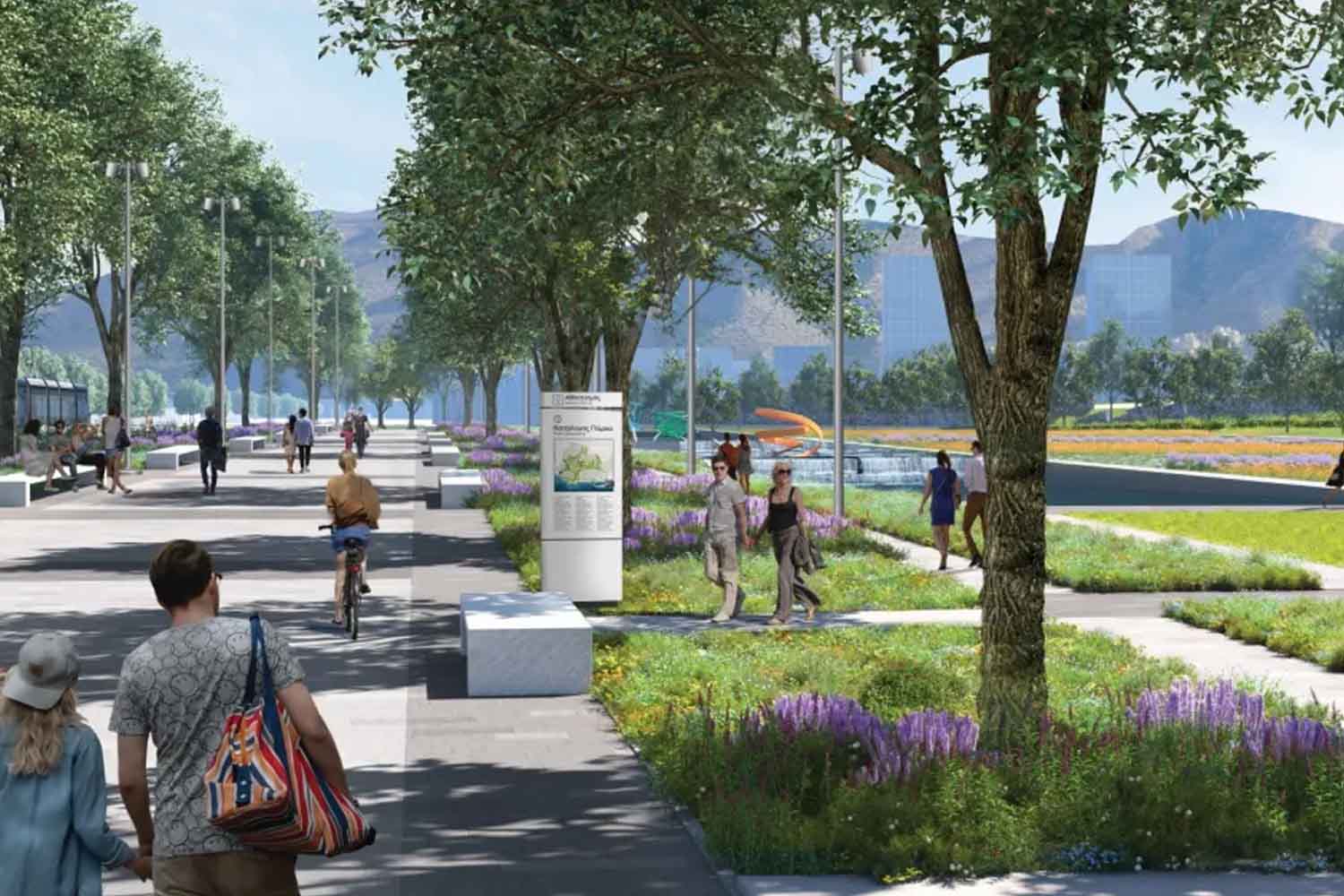
On the old runways of Ellinikon airport, south of Athens, concrete is changing jobs. A part will be recovered to build seats, walls and other elements of the new park; around, the project includes more than 3 million plants, including around 30 thousand trees. Where asphalt and engines accumulated for decades, an enormous green area overlooking the sea is being prepared. And with a fairly demanding request: being able to remain livable during extreme heat. In fact, LAMDA Labs indicates a green coverage of over 70% and a network of paths designed, through thermal simulations, to be up to 4°C cooler than the surrounding areas.
It is called Ellinikon Park and it is the green heart of the gigantic redevelopment of the former Athenian international airport, decommissioned in 2001. The official website speaks of approximately 2 million square meters of greenery, connected by tens of kilometers of pedestrian and cycle paths. Athens, moreover, is not planning all this for landscape sake: the Municipality warns that very hot days and heat waves are increasing in intensity, frequency and duration. Here the shade begins to have a much less ornamental value.
Those 4°C come from the simulations, not yet from the thermometers
The detail that immediately catches the eye is that of the 4°C less. The project used thermal mapping and Computational Fluid Dynamics, i.e. simulations that allow us to study how heat, shadow and air movement will change in different points of the park. From here the network of so-called “cool routes” was born, the cool streets designed to take advantage of trees, ventilation and layout of spaces. The documentation published by LAMDA Labs speaks of temperatures up to 4°C lower than nearby areas.
Here, however, the thermometer must also be placed on the promise. This is a result of the design simulations, not a difference already measured for years within a mature park. Scientific research, however, gives a rather solid basis to the idea: a systematic review published in 2025, built on 84 studies, found temperature reductions of approximately between 1 and 7°C in urban green spaces, with enormous differences related to climate, tree density, layout of greenery and the method used to measure cooling. Four degrees, in short, are possible. If there are really four in Ellinikon, the park will have to decide once it grows.
Part of the strategy involves vegetation. More than 70% of the planned species will be native or adapted to local conditions, while the declared objective is to create habitats capable of hosting over 520 species of flora and fauna. The Sasaki design studio, which leads the landscape project together with Doxiadis+, describes a system built by choosing plants also for their ability to resist the soil and climate of Attica, as well as to offer food and shelter to the fauna.
Three million plants also need to drink
Planting 30,000 trees in an increasingly hotter Mediterranean city comes with one small inconvenience: water. A park like this cannot afford to be green only in the renderings.
For this reason the project envisages that the recovered water covers irrigation needs. A treatment plant will have to produce up to 7 thousand cubic meters per day of non-potable water to also be used for greenery maintenance; this is accompanied by a 10 thousand cubic meter tank already built. Sensors in the ground and meteorological data will then regulate irrigation, with savings indicated by the project of up to 90% compared to conventional systems.
Even rain is treated as something to be held back instead of quickly sent down the sewer. The system includes rain gardens, drainage areas, small vegetated channels and the recovery of the Trachones stream. The old Olympic pool used in 2004 for canoes and kayaks will also become a lake of approximately 1.5 hectares capable of accumulating rainwater in the wet season and also functioning as a reserve during droughts and fires. A water infrastructure disguised very well as a walk in the park.
The old tracks also remain, just in different pieces
Not everything about the airport will disappear underground. Sasaki estimates that approximately 28,700 square meters of concrete from runways and aprons will be reclaimed and incorporated into the landscape. Some historic structures will be preserved, including the terminal designed by Finnish-American architect Eero Saarinen. The idea is to reuse what already exists instead of demolishing, taking away and buying new material a few kilometers further on. Which seems almost revolutionary, until you remember that it is simply an economy of materials.
Another thing should also be clarified. The entire old airport is not becoming a park. Ellinikon Park is the large green nucleus of a much larger urban transformation, which includes housing, commercial facilities, sports facilities and other buildings. The master plan covers a total of approximately 6.2 million square metres. Telling the story as “an airport transformed entirely into forest” would be decidedly more romantic, except that several buildings would be missing.
And not even all the green already exists. A first portion, the Experience Park, has been open since 2021 and today hosts around 900 trees and 80 thousand plants on 75 thousand square meters. The complete metropolitan park is still under construction; according to the official timing of the project, most of the interventions of the first phase should take shape between 2027 and 2028.
For now, there remain bulldozers, young trees, simulations and an airport that is slowly losing its shape. If the project works as planned, in a few years one of the hardest surfaces on the Athenian coast could become exactly what is missing during a July afternoon: a place with shade, water and a few degrees less. The planes, at least there, have already stopped warming the runway.
