
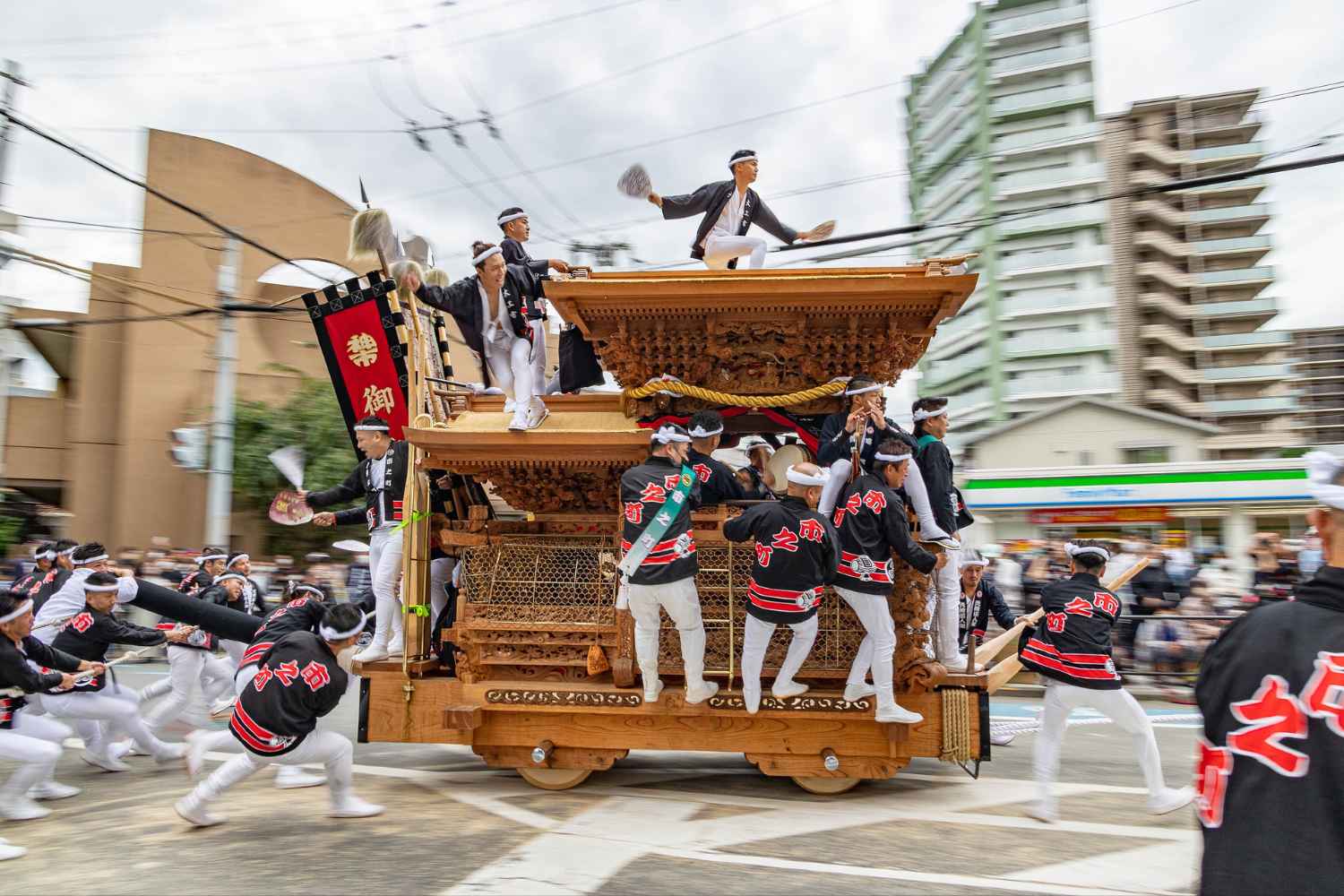
The Kishiwada Danjiri Matsuri is a festival celebrated in Kishiwada, in the Ōsaka prefecture of Japan, in the month of September, which features more than thirty wonderful wooden floats called danjiri, made by expert local carpenters.
Kounosu via Wikimedia Commons
The floats, meticulously decorated with scenes depicting memorable battles and war stories, can weigh up to four tons, represent the districts of the city of Kishiwada and are pulled by long ropes by different teams, who compete to achieve victory. Each team is made up of numerous participants, each of whom is entrusted with a specific role.
View this post on Instagram
It is not easy to drag the carts through the narrow city streets, especially when you have to change direction, considering that they travel at high speed and transport several people, including the daikugata, a carpenter who has the honor of positioning himself on the roof.
In this privileged, but also dangerous, position, the daikugata performs a spectacular dance and jumps from side to side to shift the weight of the chariot and facilitate it as it crosses the narrowest curves.
View this post on Instagram
The Kishiwada Danjiri Matsuri was born as a harvest festival in 1703 when the daimyo, or feudal lord of Kishiwada Castle, prayed to the Shinto gods to ensure an abundant harvest.
View this post on Instagram
In Kishiwada there is also a museum dedicated to the history of the festival, the Danjiri Museum, in whose exhibition hall you can admire the oldest float in the city.
View this post on Instagram
In recent years, the Kishiwada Danjiri Matsuri has continued to attract thousands of visitors from Japan and abroad, becoming one of the best-known traditional events in Ōsaka Prefecture. The event generally takes place in two distinct moments: the main festival in September, dedicated to the neighborhoods of the old city, and a second celebration in October involving other areas of Kishiwada. Both occasions retain the same spirit of community participation, with residents of all ages engaged in the preparation of the floats and ritual activities.
Yariwashi: the most difficult maneuver
One of the most spectacular elements of the festival is the yarimawashi, the famous maneuver with which the danjiri negotiate curves without stopping. During this test of skill and coordination, teams must use strength, timing and perfect communication to rotate the heavy wooden carts at great speed. The moment is accompanied by the sound of taiko drums and the shouts of the participants, creating an intense atmosphere that represents the very heart of the event.
The construction and maintenance of danjiri are considered true arts passed down from generation to generation. Each wagon is a masterpiece of traditional carpentry, decorated with elaborate wooden sculptures made using local artisan techniques. The carved images often tell episodes of Japanese history, military legends and heroic figures, transforming each danjiri into a sort of moving artistic tale.
The festival not only represents a competition between neighborhoods, but also an important moment of collective identity for the Kishiwada community. The preparation begins many months before the event and involves numerous inhabitants, from the young people who participate in pulling the carts to the elderly who preserve knowledge and traditions linked to the construction and management of the danjiri. Through this collaboration, the festival keeps alive the link between generations and local cultural heritage.
In 2016 the Kishiwada Danjiri Matsuri was included among the Japan Heritage, a recognition given by the Japanese Cultural Affairs Agency to places and traditions that tell the story and identity of the country. The festival is considered a significant example of how a religious and agricultural celebration can transform, over the centuries, into an event capable of uniting art, craftsmanship and popular participation.
Because it is considered the most dangerous festival in Japan
Its reputation as a particularly dangerous festival derives above all from the spectacular maneuver of the yarimawashi, during which the danjiri, which can weigh several tons, are dragged at great speed and rotated sharply in the narrow streets of the city without the use of modern brakes. The greatest risk occurs precisely during curves: the wagon can lose stability, oscillate or require a sudden effort from the teams to be brought back in the correct direction.
What makes the scene even more impressive is the presence of the daikugata, the carpenter who positions himself on the roof of the wagon while it is moving. From that elevated position he performs acrobatics and ritual movements to coordinate the team and accompany the maneuvers, exposing himself to considerable risk in the event of a loss of balance.
When does it take place?
Even today, the Kishiwada Danjiri Matsuri continues to take place every year in September, keeping alive a tradition that began over three centuries ago. The 2026 edition was held on 19 and 20 September 2026.
In addition to the famous festival in September, Kishiwada also hosts a second celebration in October, dedicated to the neighborhoods of the city’s hilly area. Although less known to foreign visitors, this version of the Danjiri Matsuri retains the same spirit of devotion, competition and community participation, with numerous wooden floats dragged through the streets by local residents.
SOURCES: OsakaInfo/Japan Cheapo
