
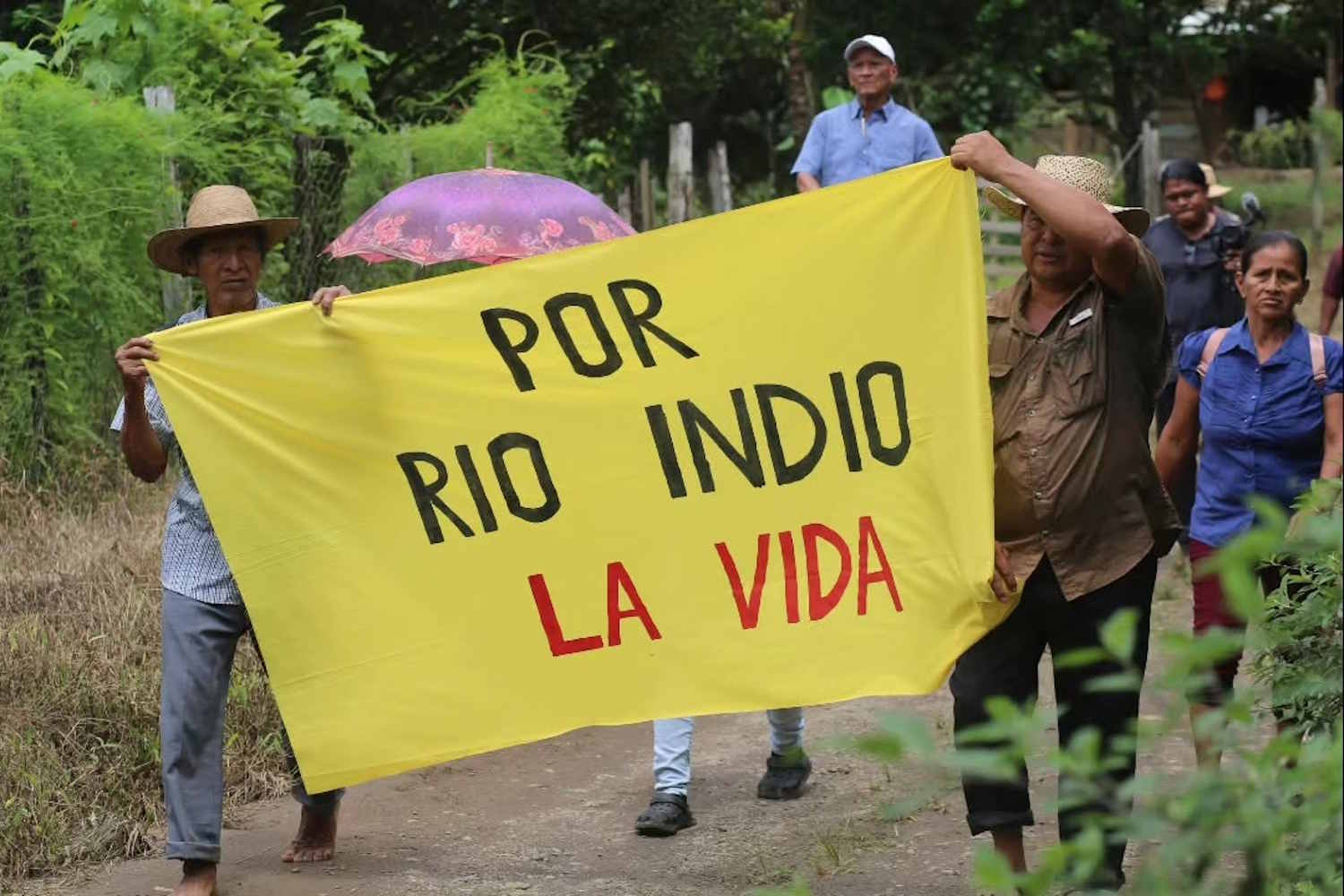
Thousands of inhabitants will be uprooted from their ancestral lands, amid general indifference. It happens in the small village of Limón de Chagres, in the heart of the Panamanian forest and east of Panama, where the isolated peasant communities at the mouth of the famous Canal live from the cultivation of beans, corn and the sale of some cow’s dairy products.
“Self-sufficiency, away from the noise, with our traditions”, says Maricel Sanchez, spokesperson for the Rio Indio peasant assembly who is part of the Coordinadora Campesina por la Vida (Peasant Coordinator for Life), a grassroots social and community organization made up of farmers, indigenous communities and civic groups in Panama, and a mother of two little girls. However, this quiet life on the banks of the Río River Indio “will soon disappear, swallowed up by the waters of a basin project.”
That’s right: Limón de Chagres, with its 62 wooden houses, a small colonial church, a cemetery, a health center and a school, will be one of the first settlements submerged by the construction of the new Río India reservoir by 2028. In total, it will submerge 4,600 hectares of land and 38 villages.
Why all this? Because it is necessary to guarantee water to the Panama Canal in an era marked by increasingly frequent droughts.
View this post on Instagram
The water crisis
The Panama Canal is one of the most important maritime infrastructures on the planet: it connects the Atlantic and Pacific Oceans and allows the passage of approximately 5% of the world’s goods. Its functioning, however, depends on fresh water. The locks are fed by artificial lakes Gatun And Alhajuelabut in recent years decreasing rainfall has put pressure on the system.
In 2016, 2019 and 2023, water shortages forced authorities to reduce the number of ship transits and limit their cargo. Climate change is making these situations more and more frequent: in 2026, the return of the El Niño climate phenomenon also contributed to changing the rainfall regime, pushing the authorities to temporarily reduce the number of ships crossing the canal.
The new Río Indio basin should therefore become a strategy to ensure the future of the trade route.
View this post on Instagram
Thousands of people risk losing their homes
The cost of the project is estimated at approximately 1.3 billion euros. According to the Panama Canal Authority (ACP), there will be around 2,500 people to be transferred (but local communities dispute this figure and claim that the inhabitants involved could be at least 13,500). An urgent problem, therefore, for housing, but also and above all the relationship with the territory. Here, many families live from agriculture, fishing and small livestock farming. Losing land near the river means losing a source of livelihood built over generations.
When will we leave? Where will we go? Who will build our new homes? And what will we live on once we lose our lands?, are some of the questions raised by the inhabitants of the communities involved.
The Canal Authority instead ensures that the families will receive equivalent land or economic compensation and that approximately 350 million euros will be allocated to support the transferred families.
The alarm of environmentalists
In addition to the social impact, the project raises environmental concerns. The Río Indio basin is in fact located in an area connected to the Mesoamerican biological corridora vast network of forests that crosses Central America and is home to numerous animal species. According to environmentalists, the new lake could endanger more than 237 species of birds, 35 reptiles and 49 mammals, including pumas, jaguars, ocelots and the Baird’s tapir, the largest land mammal in Central America.
The Canal Authority claims that environmental compensation measures will be adopted, including the reforestation of an area double the size of the submerged one and interventions to maintain animal passage corridors. The final environmental impact study is scheduled for December 2026.
For over a year and a half, the inhabitants of the areas involved have been protesting against the mega project, supported, needless to say, by the local authorities according to which it would be necessary to protect a fundamental infrastructure for the national and international economy.
The construction of the new Río Indio lake thus presents Panama with one of the most complex challenges of the climate crisis era: how to adapt large infrastructures to environmental changes without leaving behind the communities living in the territories involved?
