
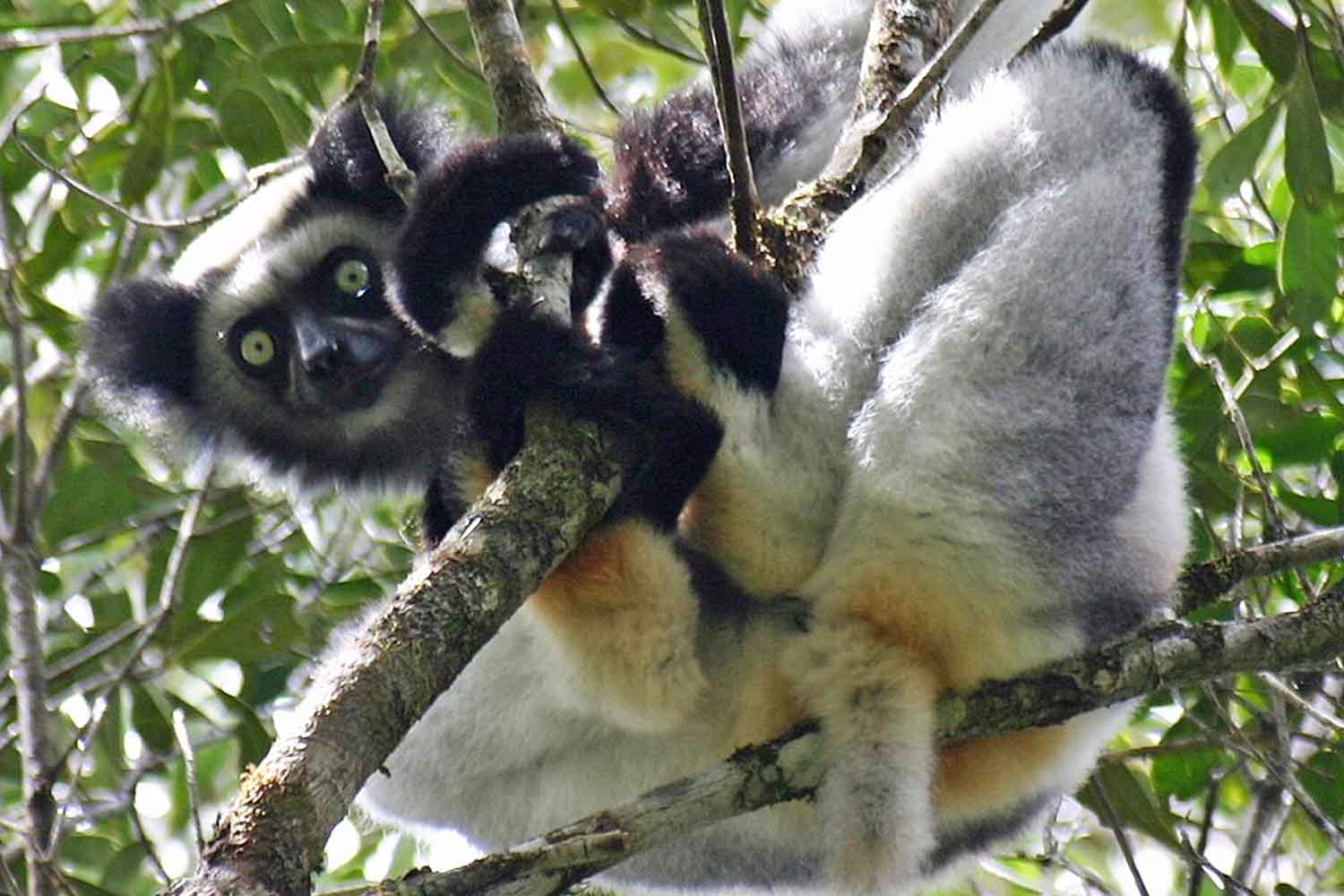
The indri sings hanging from the trees of the forests of Madagascar and, when he needs to get louder, he does something very precise: he opens his mouth wider. Frame after frame, the researchers saw the frequency of the sound and the distance between the lips increase together. It is the same acoustic principle used by opera singers to give more strength to high notes. With one fairly obvious difference: Indri did not attend the conservatory.
This is measured by a study published in PLOS Computational Biology by an international group led by researchers from the University of Turin and the University of Warwick. THE’Indri indri it is the only known lemur capable of producing real songs, vocal sequences also used to communicate with its group and be heard by neighbors through a forest where trees, leaves and distance do a fair job of disturbance.
The higher the note, the more the mouth opens
The researchers started from 83 video recordings of 19 wild Indians, collected in Madagascar. Software followed 13 reference points on the animals’ faces, including the center of the upper and lower lips, allowing the mouth opening to be measured while the audio simultaneously recorded the frequency of the singing.
Leaves in front of the muzzle, poorly shot animals and inevitably complicated shots significantly reduced the usable material. After the checks, 3,598 frames remained from 23 videos of 12 indri. Enough, however, to see a very clear relationship: in the vocalizations analyzed, between 573 and 1,238 hertz, the higher notes coincided with larger mouth openings. The difference between males and females, in this case, was not significant.
It’s interesting because something similar happens in human singers. Opening your mouth more changes the shape of the vocal tract and therefore its resonances, the so-called formants. When one of these resonances approaches the frequency produced by the voice or its harmonics, the sound can gain intensity. It’s the formant tuninga technique well known in classical singing.
The indri appears to have the same physical solution available. For an animal that has to send its voice through dozens of meters of dense vegetation, making the sound come out better can be much more useful than a nice high note of applause.
A resin skull to follow the sound
The mouth movement alone still left one question: Does that opening really change the resonances of the indri’s voice?
Directly studying the vocal tract of these animals is complicated. Indri live only in some forests of Madagascar and do not survive in captivity, so the researchers worked with two resin replica skulls. They moved the jaw by simulating openings of 0.2 to 5 centimeters and reconstructed the internal shape of the cavities to obtain an acoustic model of the vocal tract.
When the jaw was opened, the simulated resonance frequencies also changed. Some followed precisely the trend of frequencies observed in animal songs. The result therefore supports the hypothesis that the indri can modify the configuration of the vocal tract while singing, increasing the intensity and propagation capacity of certain notes.
The soprano lemur should be taken with caution
The similarity with human singers concerns the acoustic mechanism. The study cannot determine whether the indri voluntarily opens his mouth to amplify his voice or whether that movement simply accompanies the production of higher notes.
Even the jaw tells only part of what happens during singing. Lips, tongue and pharynx contribute to modifying the vocal tract and no one can directly observe all this inside the throat of an indri while it sings several meters high in a tree. Furthermore, the researchers obtained three-dimensional measurements from normal video footage: if the animal turns its head, the geometry changes and the data becomes less reliable. These are limitations that the authors themselves describe in the study.
However, there remains the first direct quantitative evidence of a very refined coordination between mouth movement and song frequency in this primate. And above all, another example of very different animals that, faced with the same physical problem – send a voice far enough – end up finding surprisingly similar solutions.
The indri, meanwhile, will continue to do what it did long before anyone invented the conservatory: open its mouth, rise in note and send its song beyond the trees.
