
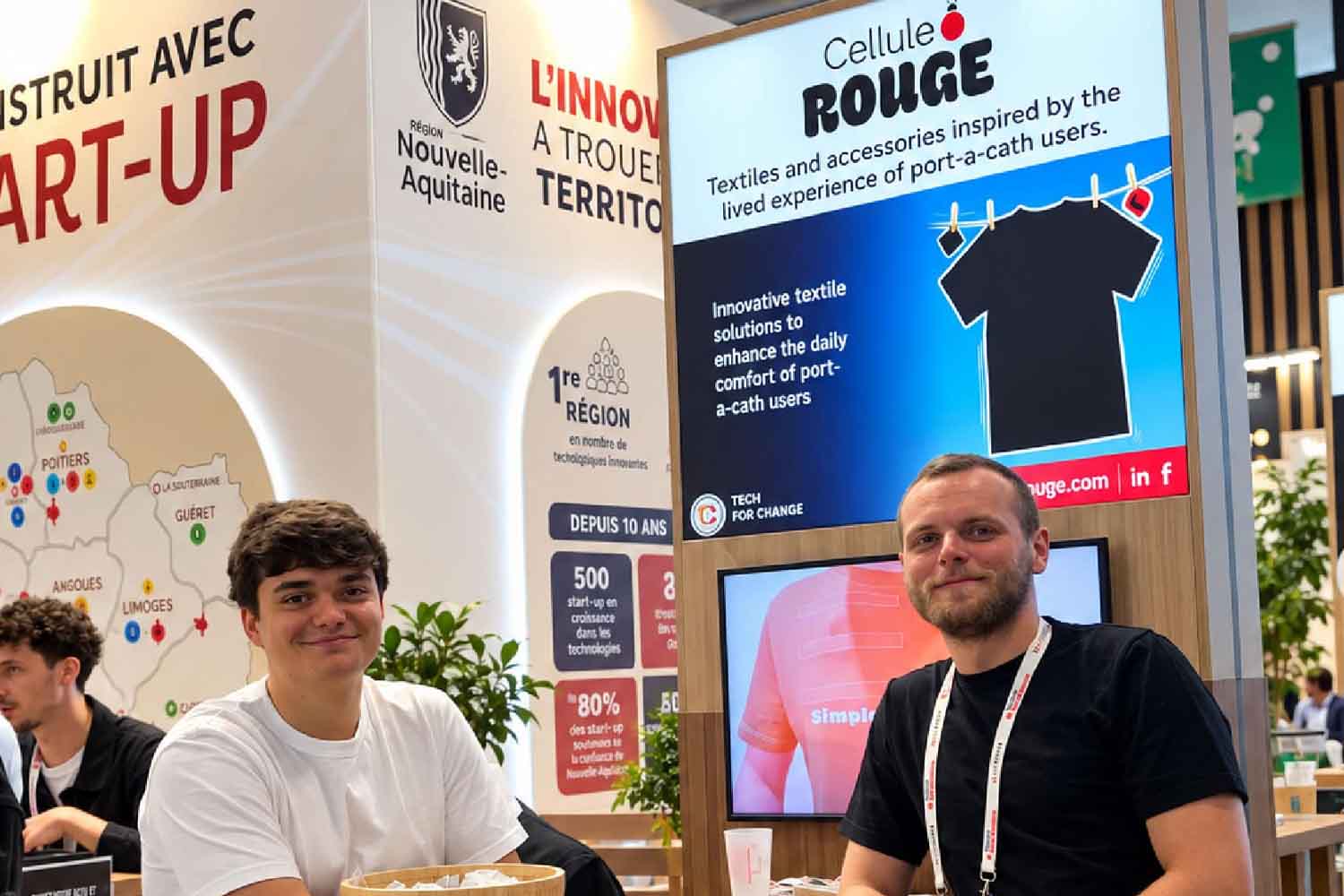
Fasten your seat belt, put on a backpack, sleep on your side. Rather banal gestures until there is one under the skin of the chest implantable chamber. Ange-Solal Llantia discovered it during her treatment for a blood cancer and, together with Benjamin Leroy, transformed that annoyance into a decidedly un-science fiction object: a t-shirt, a pocket and a small rigid protector. He was born like this Cinellethe first project of the French startup Cellule Rouge.
The objective is very concrete: to create a barrier between the area where the implantable chamber is located and everything that, during the day, can press on it or rub it. No robots, sensors or artificial intelligence. This time the innovation starts from a car belt that is annoying.
When even a belt can become a problem
The implantable chamber, also called port-a-cath or PAC, is a small device placed under the skin and connected through a catheter to a central vein. It is used in patients who must receive repeated intravenous therapies for long periods, including some chemotherapies, avoiding having to find a peripheral vein each time.
The device can remain in place for months and therefore accompany the patient far beyond the hospital door. And that’s where decidedly less talked about problems begin: a belt that passes right over the implant point, a shoulder strap, a backpack, repeated rubbing during movement.
Llantia knew the problem firsthand. In 2021, after being diagnosed with blood cancer, he was fitted with an implantable chamber. From that experience, together with my friend and former classmate Benjamin Leroy, the idea of Cellule Rouge was born: to develop protection that would allow you to continue moving, reducing pressure and friction on the area.
A mobile pocket and a small coque around the device
Cinelle is made up of three elements: a technical t-shirt, an adjustable pocket and a protective cover. According to the description published by Cellule Rouge, the Velcro system allows you to move the protection both in height and laterally, adapting it to the position of the chamber on the chest.
The coque has a rectangular shape with rounded edges and above all a central circular opening: the protective material therefore remains around the implantable chamber instead of crushing it directly. Inside there is a foam designed to absorb small shocks, while a soft layer between fabric and skin serves to limit chafing, including that near scars.
It’s a less trivial detail than it seems. The implantable chambers are not positioned with identical precision on all patients: a fixed protection would risk working very well on a mannequin and decidedly less so on a real person.
Cellule Rouge explains that it developed the project by gathering patients’ needs and continues to use their feedback to decide which accessories to create next. The proposals on the site include specific protection for the belt and shoulder strap, a reinforced shell for sporting activity and protection designed for sleep.
The problem also affects thousands of Italian patients
The story originates in France, but the device that Cinelle tries to make more bearable is also part of Italian oncology everyday life.
According to the report The numbers of cancer in Italy 2025, created by AIOM together with AIRTUM, AIOM Foundation, National Screening Observatory and other scientific bodies, in our country in 2025 approximately 390 thousand new cancer diagnosessubstantially stable compared to the previous year.
Naturally, this number does not coincide with that of people who use an implantable chamber: not all cancer patients need it and the device is also used in different contexts. However, it serves to measure the size of a care system in which more and more people live for months or years with therapies, checks and medical devices.
And this is precisely where a seemingly tiny problem stops being so. Central venous access facilitates repeated treatments; then the patient goes home and has to drive, get dressed, carry a bag, sleep and move around with that device still under the skin. Medicine does the big work. Daily life, as often happens, remains full of details.
Cinelle doesn’t cure anything, but tries to make the treatment less uncomfortable
Here you need to keep your feet on the ground. Cinelle is not a therapy and does not replace the implantable chamber. The founders present it as a textile solution for daily comfort and, among the available materials, there are no published clinical studies demonstrating its effectiveness.
Some data collected directly by Cellule Rouge also appears on the company website: 68% of the people interviewed reported discomfort related to the room in the first months and 48% again after at least six months from the end of the treatments. I am results of an internal company surveytherefore they cannot be extended to the general population.
Furthermore, the project is still in the launch phase. Cellule Rouge is preparing a crowdfunding campaign on Ulule to finance the first production of the kits and pre-registrations are open on the site. It’s a small innovation by definition, but sometimes you just need to start right there: with a belt that keeps going through exactly the wrong place.
