
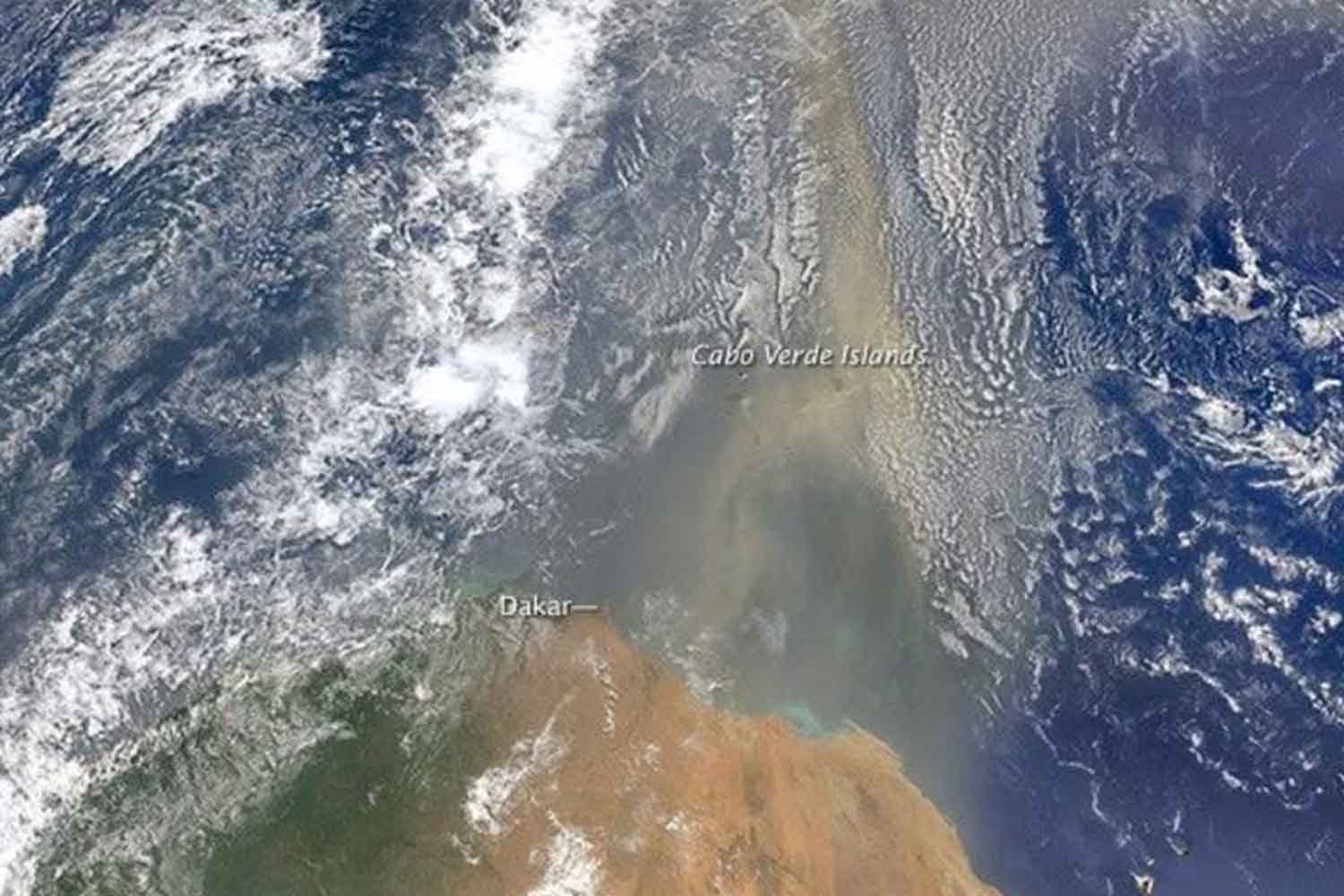
There is less dust above our heads than twenty years ago. Between 2003 and 2023, the amount of global atmospheric dust fell by about 10%, according to a new study published in Science Advances. And the consequence is less intuitive than it seems: those tiny particles raised especially by large deserts also help to cool the planet slightly. If they decrease, a small part of this effect disappears.
The researchers reconstructed the dust pattern by combining satellite observations, ground measurements and atmospheric models. Different sources which, this time, tell the same story: in the first two decades of the 21st century the Earth’s atmosphere became less dusty.
“This is the strongest evidence yet that Earth’s atmosphere has become less dusty in the early 21st century,” said study lead author Ashok Gupta, who conducted the work at UCLA and now works at Vanderbilt University.
From the Sahara to the Gobi, less dust reaches the sky
A huge part of the dust circulating around the planet originates from the Northern Hemisphere. The Sahara, in particular, can send mineral particles across the Atlantic for thousands of kilometers; on the other side of the Asian continent the Gobi desert does something similar. They are masses of material large enough to enter into the workings of the global climate, oceans and even glaciers. Yet, in the period analyzed, their overall presence in the atmosphere has decreased.
Scientists are still trying to understand what caused this decrease. Among the factors under examination are changes in surface winds and other environmental transformations capable of modifying how much material is lifted from the ground and transported into the atmosphere. The direction, however, appears clear. After increasing for much of the twentieth century and reaching a maximum around the 1980s, in recent decades the dust has begun to move in the opposite direction.
Because less dust can mean a little warmer
Seen from below, the dust above all seems like something to breathe as little as possible. Seen from space it also becomes a sort of very thin screen. The mineral particles suspended in the atmosphere reflect a part of the solar radiation towards space, contributing overall to a small cooling effect. Jasper Kok, study co-author and UCLA researcher, said:
The decrease observed over the last twenty years has probably contributed modestly to the warming produced by anthropogenic climate change.
Dust loss does not take the place of greenhouse gases or suddenly become the driver of global warming. However, it adds another piece to a climate system in which even relatively small variations can shift the Earth’s energy balance. That is, as human activities continue to push temperatures higher through greenhouse gas emissions, one of the small natural mechanisms that tended to offset some of that heat may have weakened slightly.
That dust travels much farther than it seems
His work, moreover, does not end with the temperature. When carried by winds, dust brings with it minerals and nutrients that can settle in seas and on land. Material from deserts crosses entire oceans and thus also participates in the functioning of ecosystems far away from the place where it was raised.
However, when it settles on snow and ice it produces the opposite effect to what it has while floating in the air: it darkens the surface, reduces its ability to reflect light and can promote greater absorption of heat.
Then there is the air quality. Dust storms can increase concentrations of respirable particulate matter and carry material enormous distances. In short, simply hoping for “more dust” to cool the planet would be a fairly questionable climate plan.
Dried up lakes and human activities also end up in the atmosphere
Not all contemporary dust comes from great deserts. Among the springs there are also dried up or heavily reduced lake basins, where the remaining uncovered land can be easily lifted by the wind. It happened, on an enormous scale, in the Aral Sea; similar dynamics affect the Great Salt Lake in Utah, the Salton Sea and the Owens Valley in California.
Water management can therefore leave a signature much further from the shore: you remove the water, you expose the sediment, the wind comes and some of that soil goes directly into the atmosphere.
Despite the decline recorded since 2003, current levels of dust still remain higher than those before industrialization. The next step will be to understand how much of the observed decrease depends on the winds, how much on soil humidity and how much on other transformations of the territory.
For now, one fairly clear fact remains: in twenty years the Earth’s atmosphere has lost about a tenth of its dust. A very small thing to see with the naked eye, large enough to leave a trace even in the climate.
