
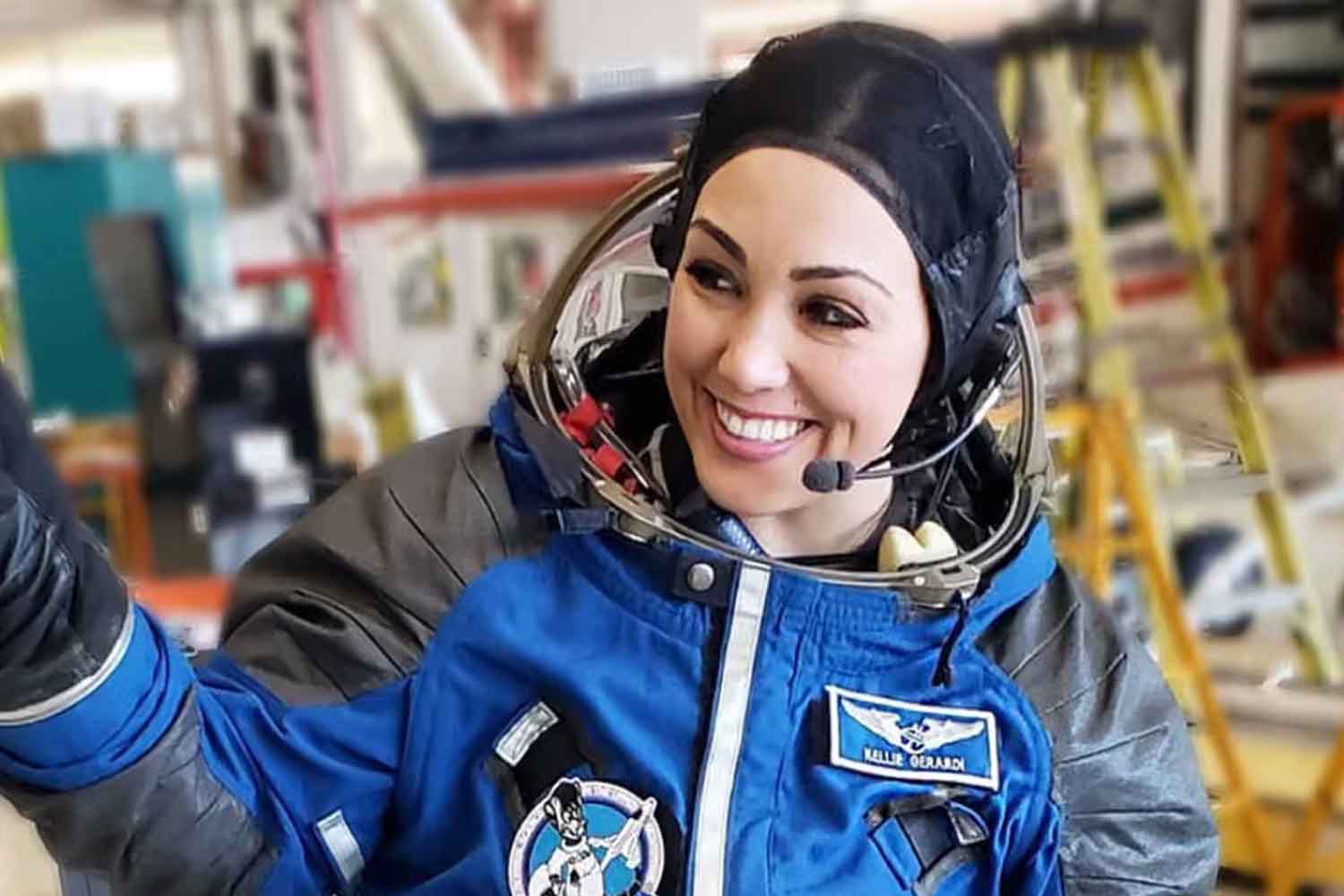
Kellie Gerardi takes her blue flight jacket, peels off the patches one by one, and puts them back on a pink jacket. The request comes from her daughter Delta, six years old: why can’t her astronaut mother’s be pink? Can. And, for the more apprehensive, physics continues to work.
The scene appears in one of the 194 Instagram posts analyzed by Karen Shalev, Shannon Pappas and Jocelyn Steinke of the University of Connecticut in a study published in Journal of Science Communication. The researchers sifted through the posts published between June and November 2024 by three women involved in space research: the American Kellie Gerardi, the Canadian Shawna Pandya and the Irish Norah Patten.
View this post on Instagram
Inside they found microgravity, space medicine and training. But also Barbie, maternity, clothes, Taylor Swift, David Bowie and a decent assortment of glitter. A sample rather distant from the old photograph of the serious scientist, possibly a man, possibly wearing something white. A photograph that many of us (including myself, I admit) carried with us without realizing it.
View this post on Instagram
A Barbie can stand next to a science experiment
Gerardi is the one who mixes the two worlds the most. He publishes content on microgravity research and then shows up at New York Fashion Week with his daughter. It talks about the loss of a pregnancy and the in vitro fertilization process. She even displays her collection of Barbies in different careers, linking each to a milestone in her life.
In another video she wears a dress sewn by a little girl who, for a school project called “Miss Solar System”, had created miniature dresses for a series of Barbies inspired by the planets. Gerardi tells her that she is good at many things and that he hopes she knows that she doesn’t have to choose just one. A phrase that, my dears, would be worth hanging in the kitchen. Because evidently you can study space and sew a dress. You can be an astronaut and love a Barbie. Even in the same afternoon.
Pandya most often brings space medicine, parabolic flights and research into his posts. In some of the content analyzed, she and Patten perform tests of insertion and removal of an intrauterine device on a uterus model in microgravity. An experiment related to women’s health that would hardly need glitter to be interesting, but Instagram allows a certain freedom of decor.
View this post on Instagram
Patten often returns to the little girl who wanted to go to space long before she knew how to get there. It shows collages and artwork from when she was little, photographs from visits to the Kennedy Space Center, and works from a time when that career existed mostly in her head. In short, inside a flight suit there continues to be a person. With a mother, a daughter, a pet, a favorite song and, in some cases, several Barbies.
Charli XCX, Bowie and Taylor Swift: physics still holds up
Then there’s Instagram, which remains Instagram even when it comes to bioastronautics. Gerardi defined herself as a “bratstronaut,” borrowing the aesthetic of Brat by Charli XCX. Patten joked about Taylor Swift’s arrival in Ireland, writing that she could now step aside because Norah was back in town (I want that as an epigraph). Pandya edited images of the crew during a microgravity flight to the tune of Space Oddity by David Bowie.
View this post on Instagram
The authors read these references as part of the strategies with which the three women adapt scientific communication to the language of the platform. Music, trending audio, and pop culture can bring content in front of people who weren’t looking for “biomedical research in microgravity” when they opened Instagram. Understandable: I don’t usually look for it before breakfast either.
In another post Gerardi asks his daughter what will happen to a small stuffed octopus during the flight. Delta imagines that the tentacles will float up and down. In the next movie the puppet actually floats. Hypothesis, experiment, observation: scientific method, with less bureaucracy.
View this post on Instagram
Astronauts, mothers, daughters. Even all together
Among the themes identified in the study is “I am a woman in STEMM”. STEM is the English acronym for Science, Technology, Engineering and Mathematicsthat is, science, technology, engineering and mathematics. In this case a second M appears because the researchers also include medicine: hence STEMM.
The three protagonists work in sectors still strongly associated with men and on social media they do not eliminate anything that might seem too feminine to be scientific. Gerardi talks about his daughter and the family moments lost due to work. Pandya shows research, education and professional life. Patten recounts his journey towards space also starting from photographs from when he was a teenager.
And then there are pink, purple, friendship bracelets, clothes with stars and planets. Gerardi’s pink jacket tells exactly this. It takes one of the most recognizable objects in astronautics and simply changes color. It doesn’t lose parts, it doesn’t stop being professional and, at least from the study, there are no propulsion failures.
Five months of Instagram, 194 posts and three different ways of being in science
The researchers analyzed 194 posts published between June 24 and November 24, 2024, looking at videos and photographs, reading captions, hashtags and emojis and listening to audio and songs. The result was six major themes, seven recurring ways of constructing the message and five communication tactics. It describes how they communicate, it doesn’t measure how well it works.
Because in those 194 posts there are together a model of a uterus in microgravity, David Bowie, an astronaut Barbie, a little girl watching her mother on television and a flight jacket that has become pink because, simply, it could be. It took us longer to get over it than it took her to change the patches.
