
©BLS
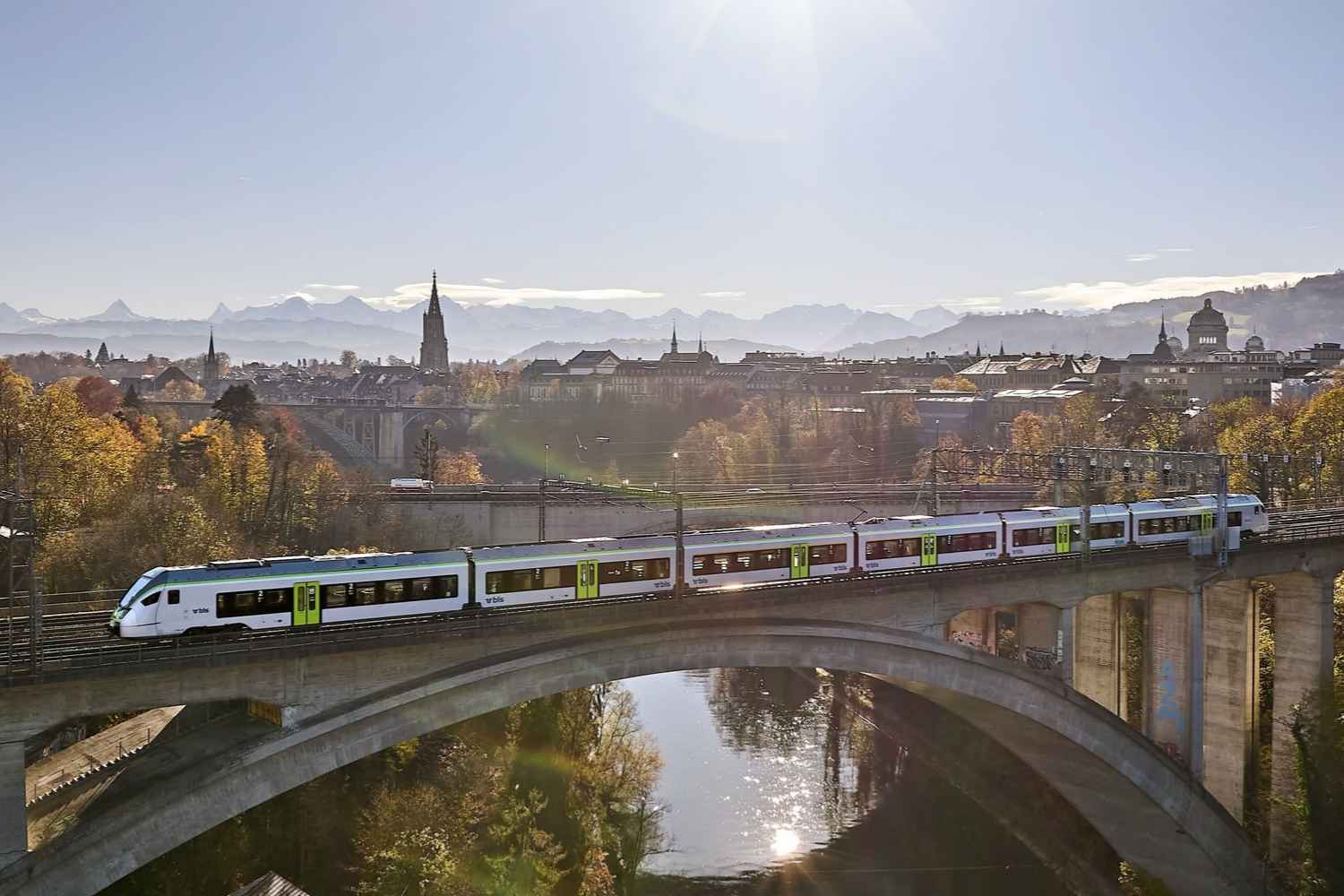
There are trains that only serve to get there, and then there are trains where the journey becomes part of the experience. The Trenino Verde delle Alpi belongs to the second category: here the destination counts, but it is the route that tells the story of the territory.
From Domodossola to Bern it takes just under two and a half hours to travel about 150 kilometres, but the sensation is that of crossing different worlds. After Brig the convoy begins to climb the mountainside, the valleys open up outside the window and what seemed like a simple train journey slowly transforms into an experience worth living.
And this is precisely the philosophy of the Trenino Verde delle Alpi: with the Trenino Verde BLS daily card, also available for two days, you can get on and off along the route as many times as you want, choosing your own stops and building a personal itinerary between villages, lakes and mountains. The train thus becomes the underlying theme of an unhurried journey, where each stop can become a new discovery.
From Domodossola the journey begins from the window
The first stretch resembles that of many commuter journeys: the crowded Milan station in the early morning, the regional one towards Ossola, the stops passing one after the other. Then you arrive in Domodossola and something changes. Here begins the journey on the Trenino Verde delle Alpi, the convoy that follows the historic lines of the Simplon and the Lötschberg, connecting the Ossola Valley to the valleys of the Bernese Oberland.
On one side the Italian mountains, on the other the Swiss ones: in between there are over a hundred years of tunnels, viaducts and railway engineering that have made it possible to cross the Alps.
The windows are large, the train goes up the side of the Rhone valley while the sunny terraces of the Valais open up beneath the tracks, with the villages leaning on the slopes as if someone had placed them there with care. Then comes the Lötschberg tunnel: a few minutes of darkness and, at the exit, Kandersteg appears, with meadows, rock walls and the first peaks of the Bernese Oberland.
Inhabited valleys, alpine cheeses and lake wine
From the window, Switzerland does not look like a perfect postcard, but a lived-in territory. The valleys are inhabited and worked, the barns coexist with production activities, the pastures almost reach the tracks: a landscape where nature and work have met for centuries.
And where there are mountain pastures, there is also a dairy tradition that is still very much alive. Berner Alpkäse AOP is born in the Bernese Oberland, produced in summer with the milk of cows that climb to high altitude pastures. After a longer maturation it becomes Hobelkäse, the cheese to be cut into very thin sheets.
Further down, towards the lake, the landscape changes again. In Spiez, between mountains and water, there are also vineyards, cultivated for centuries and still part of the identity of the territory today. A lake wine, grown in the shadow of the Alps.
Second stop: Spiez, where it is better not to have plans
©Interlaken Tourism
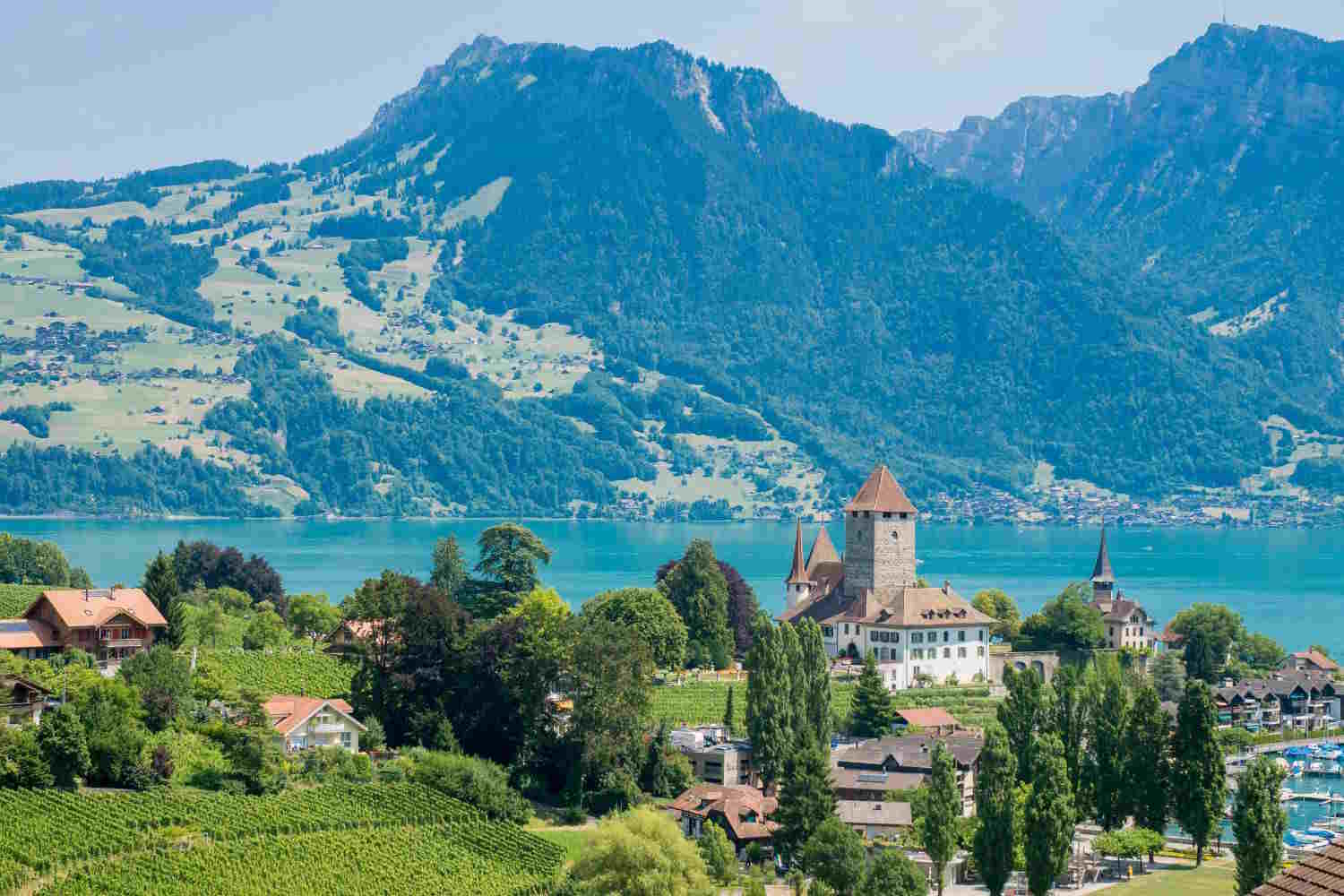
Just outside the station, the bay, the marina, the waters of Lake Thun and the mountains in the background appear all together, in a single glance. The village of Spiez develops between the lake, the vineyards and the castle, which from its tower has dominated the landscape for hundreds of years.
A little further south stands Niesen, the mountain that the Swiss call their pyramid and at the foot of which Spiez almost seems to rest.
There is only one piece of advice here: don’t rush. A walk along the lakeside, a climb between the rows, a stop on a bench without looking at the clock. In Switzerland, where keeping time accurate is almost a national tradition, allowing yourself to slow down almost feels like a small transgression.
Spiez is also a natural gateway to the Bernese Oberland: from here the journey can continue towards the lake, the side valleys and the mountains.
Third stop: Lake Thun, from train to boat
©BLS
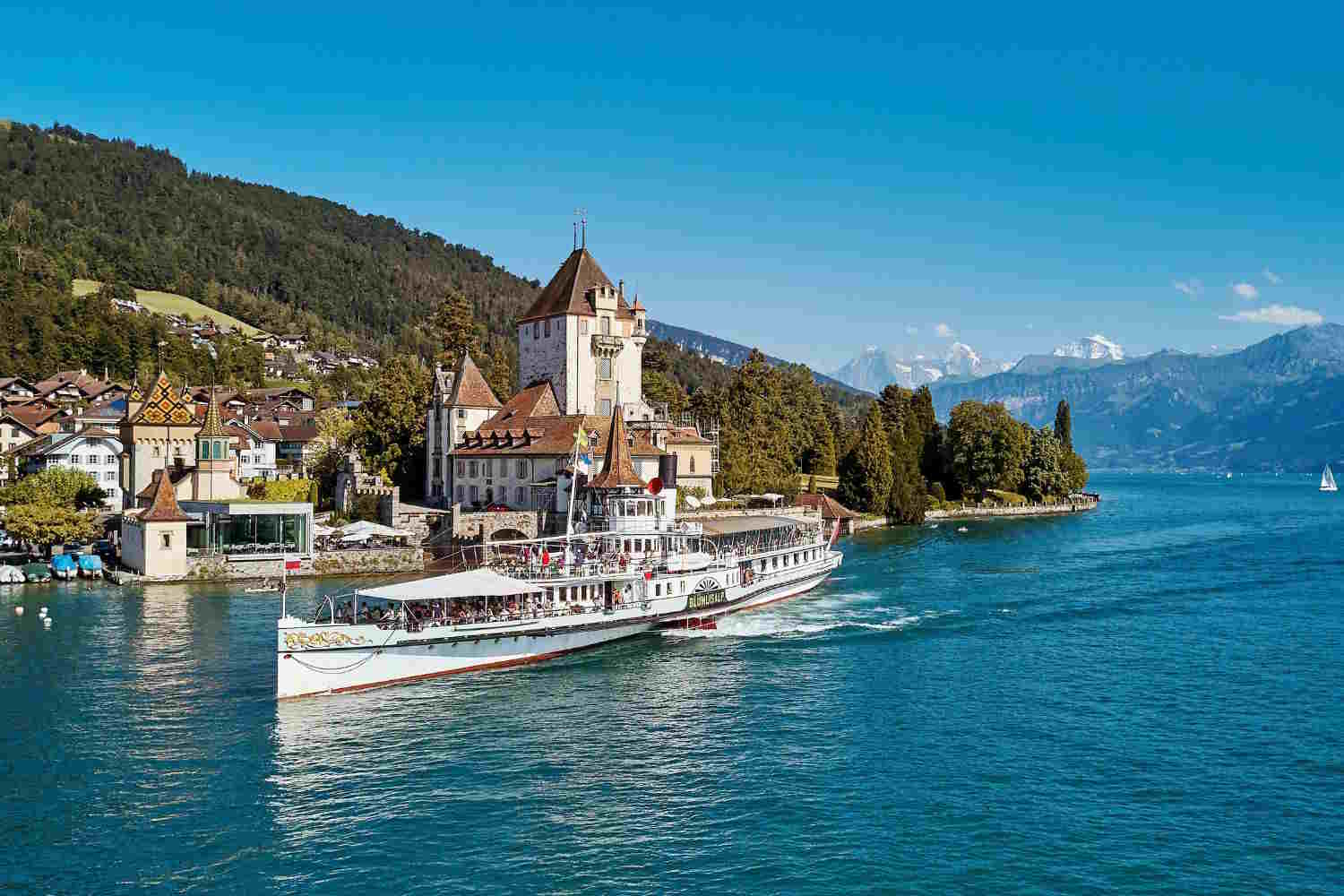
The Trenino Verde day pass doesn’t stop at the tracks. It includes the scheduled boats on Lake Thun, between Thun, Spiez and Interlaken West, and the postbus that goes from Spiez station to the landing stage. A practical detail that completely changes the way you live your day: the train becomes one of the means of transport, not the only one.
From the bridge the perspective is reversed again and the mountains no longer flow to the side, they are in front and are reflected in the water when the lake is calm; the villages on the shore, seen from here, seem smaller and closer together. The pace is decided by the boat’s engine, and for once no one is in a hurry to arrive.
Fourth stage: the Stockhorn, from the valley to the summit without a car
©Interlaken Tourism
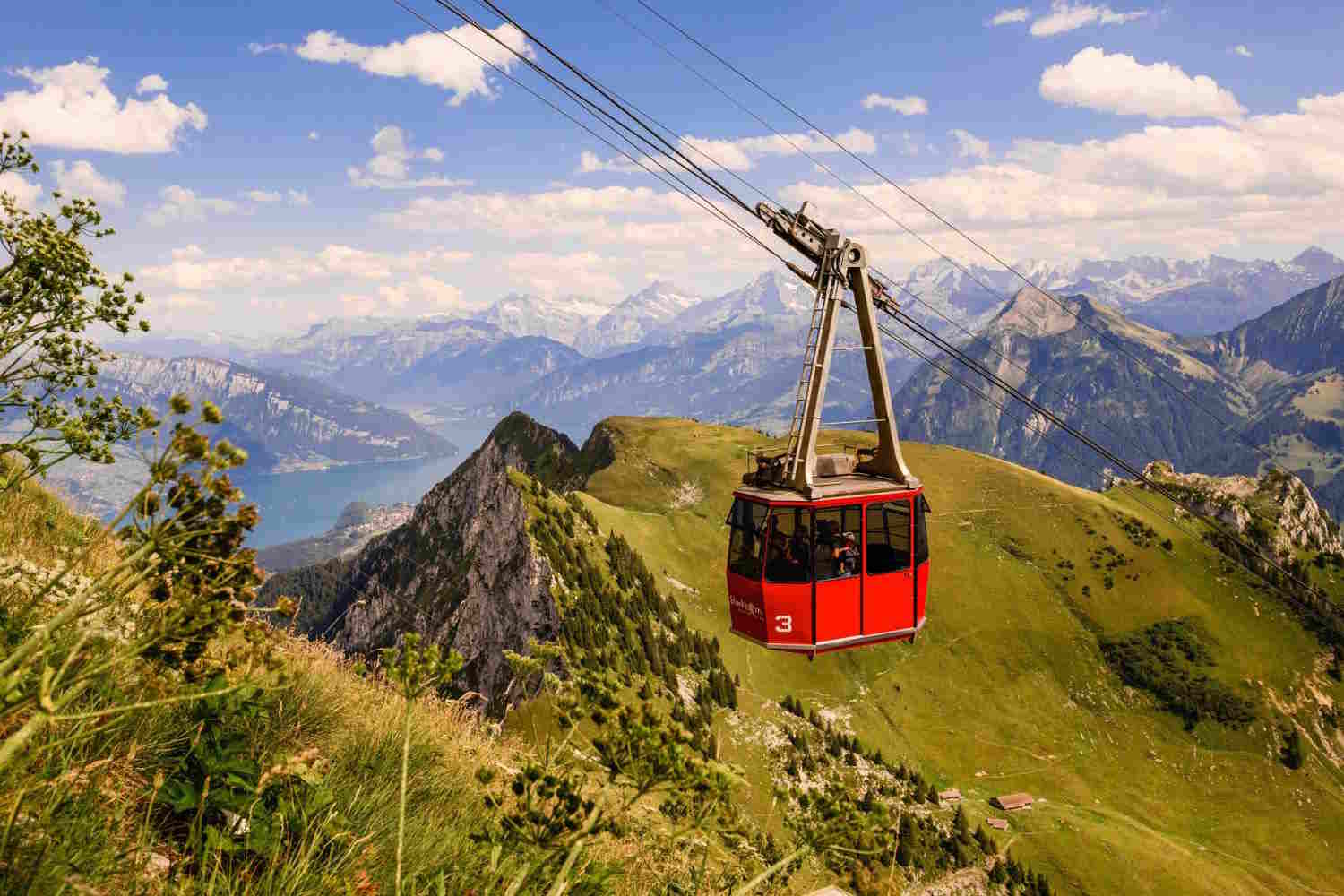
The novelty of the season is called Stockhorn: the new experience of the Little Green Train of the Alps, which takes you up to almost 2,200 meters above sea level, where the view of the Bernese Alps truly leaves you speechless.
Reaching the summit is very simple: you get off the Green Train of the Alps in Spiez and then take a regional train headed to Erlenbach im Simmental. From there, after a walk through the town, just take the cable car to get to the top.
The cable car ascent is divided into two sections: spacious cabins take you to the intermediate station of Chrindi, then smaller cabins go over the Hinterstocken lake and head straight to the summit.
At the top, at 2,190 metres, you find yourself on the highest point of the Stockhorn chain, a rock tower that dominates Thun and which is easily recognizable from great distances from the plain. On the clearest days the view runs over the city, Lake Thun and the Swiss Mittelland up to the Jura; from the platform on the north face, with the particularly clear sky, you can glimpse the Black Forest.
Up there there are paths for every level, and the facility is also accessible to people with reduced mobility, a detail that is not to be taken for granted at high altitude.
Fifth stop: Bern, the city where time has a mechanism
©Bern Welcome
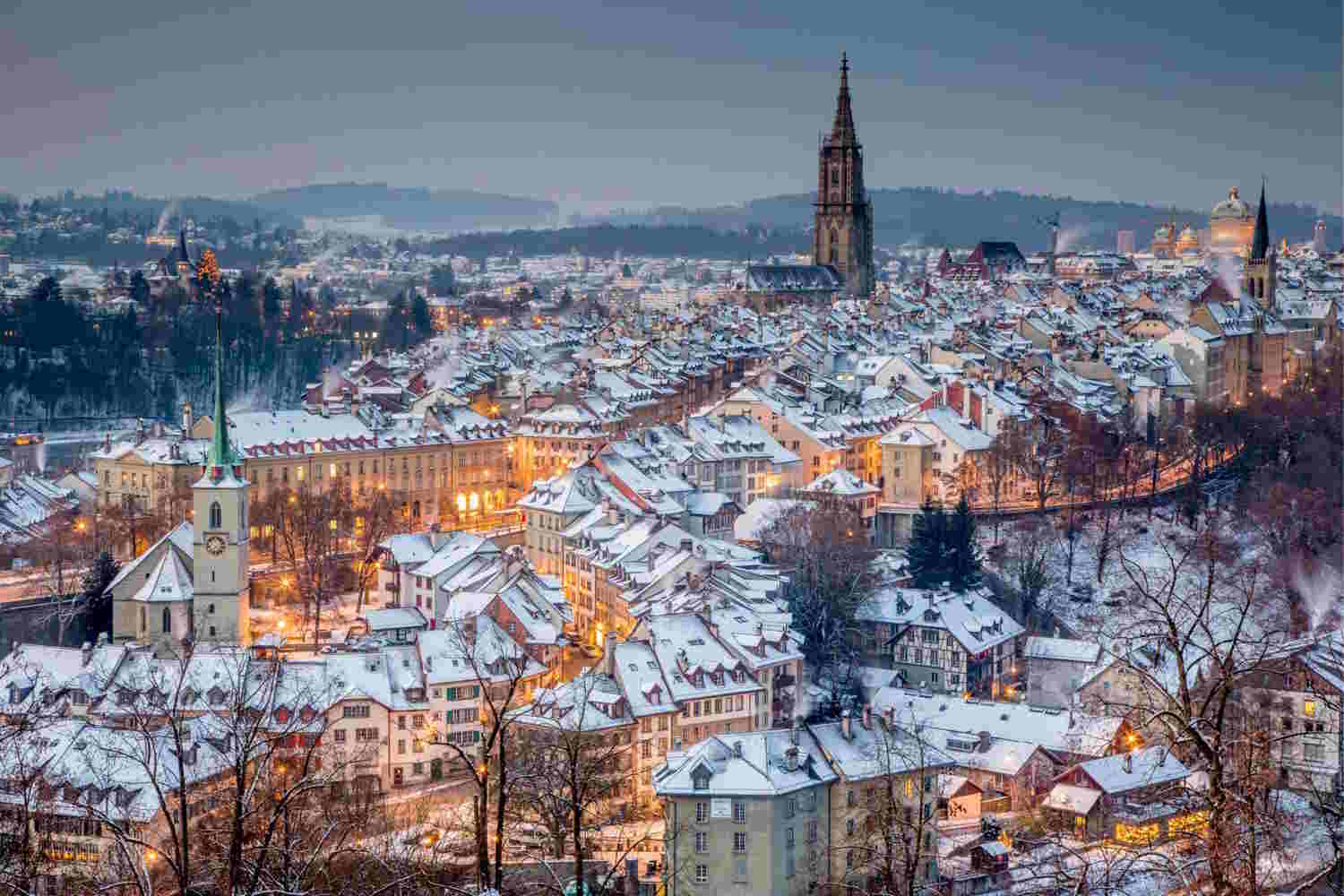
The last stop of our journey is the capital. The historic center of Bern, founded in the 12th century on a hill enclosed in a bend of the Aare, has been a UNESCO World Heritage Site since 1983. UNESCO highlights its fifteenth-century porticoes and sixteenth-century fountains, within an urban layout that has remained consistent for centuries. The arcades, the Lauben, run for about six kilometers and form one of the longest covered promenades in Europe. When it rains, you immediately understand what they are for.
At the center of it all is the Zytglogge, the Clock Tower. It has existed since the 13th century, it became a clock tower after the fire of 1405 and houses a mechanism from 1530, the work of Kaspar Brunner, a watchmaker who arrived from Nuremberg. The same mechanical heart moves the hands and the astrolabe, which marks the months, moon phases, zodiac signs, sunrise and sunset. And above all it moves the carousel of figures: a few minutes before the hour the golden rooster crows, the jester rings his bells, the bears spin in circles, Cronus overturns the hourglass and at the top of the tower a little golden man strikes the bell. With a guided tour, upon reservation and in small groups, you can climb the 130 steps up to the gears.
Travel on tiptoe, but on the tracks
Train, bus, boat and cable car. At the end of the day the car is never needed, and this is perhaps the most practical point of the Green Train of the Alps, more than any slogan on sustainability: it is possible to reach the mountain thanks to public transport.
The rest is told by the way in which the Swiss manage their territory, without too many proclamations. The cantons delimit quiet areas for wildlife, marked on the ground, and the Federal Office for the Environment supports the “Respektiere deine Grenzen” campaign, aimed at winter sports enthusiasts. The rules, four in total, ask you to respect protected areas and stay on the marked paths in the woods, to stay away from woodland edges and patches without snow, and to keep your dog on a leash. Common sense rules put in writing.
Practical information for organizing your trip
The complete route goes from Domodossola to Bern, passing through Brig, Kandersteg, Spiez and Thun. It takes approximately 2 hours and 20 minutes, with connections available every two hours every day.
The Trenino Verde BLS day pass is the most convenient solution if you want to explore the route calmly: it allows you to get on and off the train freely during the day and also includes scheduled boats on Lake Thun and the post bus between Spiez station and the landing stage. The cost starts from 64 francs for adults in second class. There is also a two-day version, which can be used on two days of your choice within three days. The card can be purchased online on the website bls.ch/treninoverde or from authorized retailers in Italy.
To reach the Stockhorn, a dedicated ticket is available, valid exclusively in combination with the BLS Trenino Verde day pass or 2-day pass and can be purchased on the website bls.ch/treninoverde
It is a trip suitable for both a day trip and a slower weekend, leaving time to stop along the way.
