
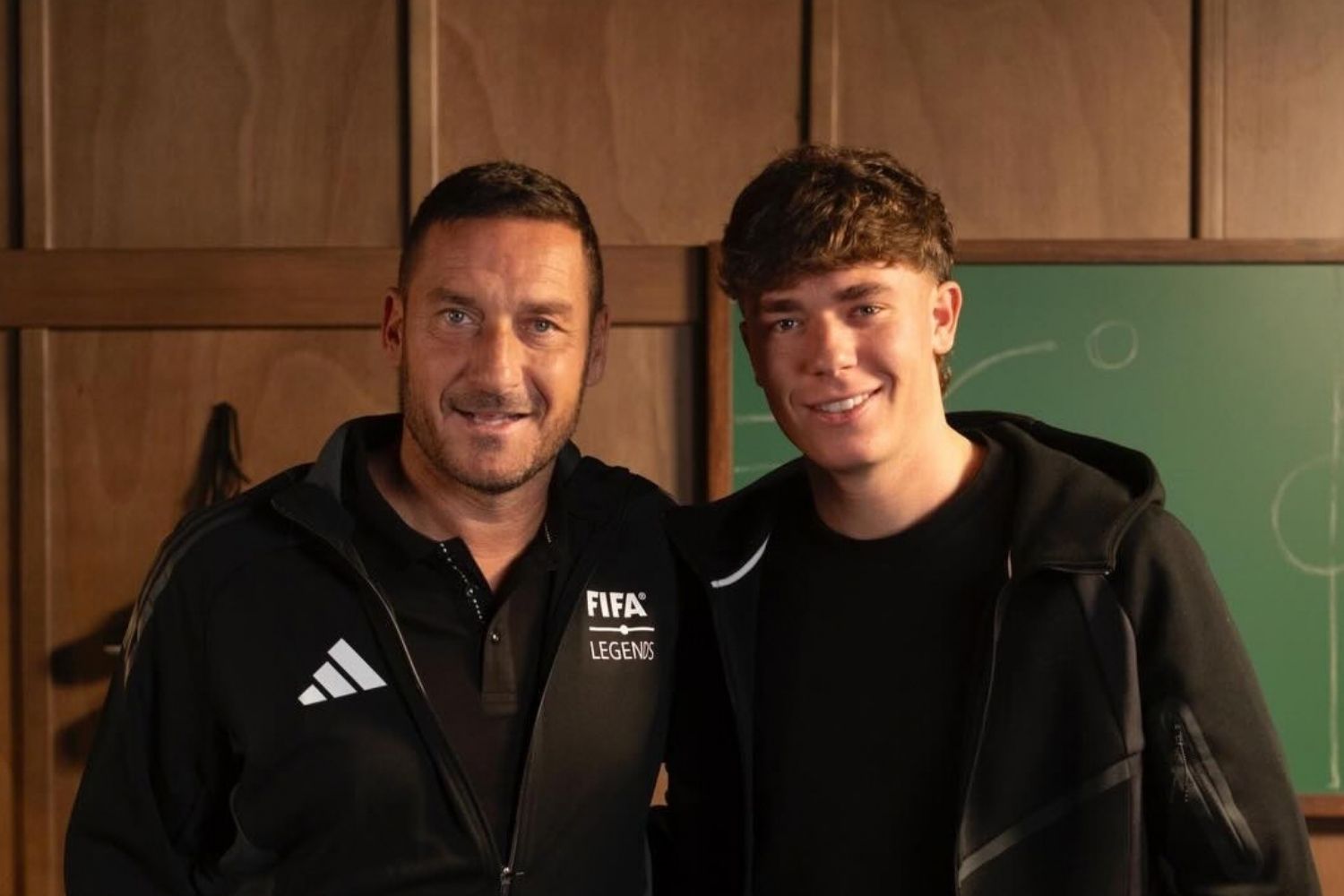
A CT scan of the nose brings to light the real problem. Thus, says Francesco Totti, the cause that distanced his son Cristian from football emerged. The former Roma captain spoke about it in the long interview for his fiftieth birthday with the director of Corriere dello Sport, Ivan Zazzaroni. Since he was a child, the boy had suffered from frequent headaches, which no one in the family had taken too seriously, then came the diagnosis, an occlusion of the aqueduct of Silvius, a case which hinders the passage of cerebrospinal fluid within the brain. The problem, as Totti himself underlines, has been resolved.
The narrowest point of the brain
The aqueduct of Sylvius is a small canal in the midbrain that connects the third and fourth ventricles, the cavities in which cerebrospinal fluid flows. According to the StatPearls clinical sheet, it is the narrowest part of the entire ventricular system. The liquid is continuously produced inside the ventricles and must be able to flow out, therefore if the aqueduct narrows, the liquid is no longer able to pass from the third to the fourth ventricle and accumulates upstream of the obstacle. The ventricles dilate and the pressure inside the skull increases: that’s what doctors call it obstructive hydrocephalusa condition that the MSD Manual defines as an excess of cerebrospinal fluid, enough to enlarge the ventricles or raise intracranial pressure. The same manual places aqueduct stenosis among the most frequent causes of this form. This may be a true narrowing or a thin membrane blocking the canal.
Symptoms that are easy to misunderstand
Flavio Giordano is a neurosurgeon at the University of Florence and at the Aou Meyer Irccs, and spoke to Adnkronos Salute explaining that it is a rare and subtle congenital malformation, because the signals can easily make one think of something else. The estimate it provides, one case in every 5 thousand births, coincides with that of the neurosurgery at the Inselspital in Bern, which however indicates strong variations around the world. In the little ones, a skull that grows too quickly should cause suspicion, then later with age, recurrent headaches begin to appear upon waking, vomiting, double vision, difficulty looking upwards and gait disturbances. The test that closes the question is the MRI of the brain, which shows both the hydrocephalus and its cause.
The intervention
For Giordano the solution is an operation with a neuroendoscopic technique, while StatPearls indicates two paths for hydrocephalus due to stenosis of the aqueduct, namely the endoscopic ventriculostomy of the third ventricle and the ventriculoperitoneal derivation. Giordano speaks of success in 90% of cases, while StatPearls reports rates above 80% for ventriculostomy. After the operation it is possible to return to one’s activities, including sport, and from a neurosurgical point of view, assures Giordano, there is no preclusion, not even for professional football.
