
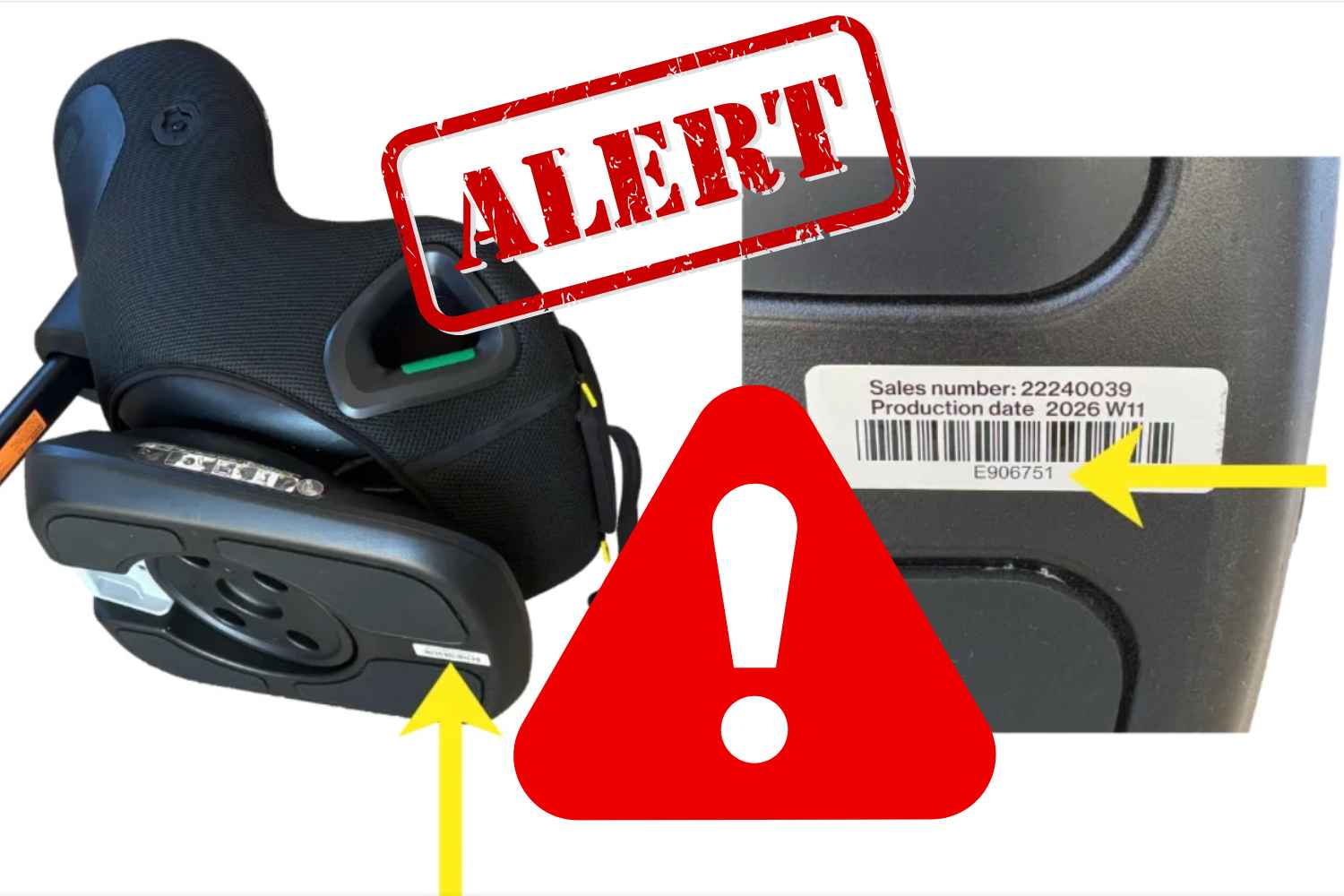
The car seat should be one of the safest items we use for our children. Yet, during a new series of crash tests, serious critical issues emerged that pushed Que Choisirtogether with the main European consumer associations and automotive clubs, to launch an alert even before the publication of the full results, expected for November 2026.
There are two finished models under review: the Britax Römer Baby-Safe Pro, when used with the Vario Base 5Z, and the Axkid Minikid Core.
What did the experts discover? Under certain test conditions, the restraint systems showed very serious failures, up to the breaking of the buckle and the expulsion of the dummy in the case of the Britax and the loss of effectiveness of the support leg in the case of the Axkid.
Second Que Choisirin the event of a real accident the risk of serious injury to the child would be very high.
The problem of the Britax Römer Baby-Safe Pro with the Vario Base 5Z
The first case concerns the Britax Römer Baby-Safe Pro, a baby seat that can be installed directly using the car’s seat belt or attached to the Vario Base 5Z, which is fixed to the vehicle through the Isofix system.
The seat is designed to be used from birth until the child reaches 85 centimeters in height, therefore approximately up to approximately 20 months, and must be installed rear-facing.
The critical issue emerged precisely in one of the configurations designed to increase the child’s comfort. Both the seat and the base allow you to change the inclination of the backrest. But, explains Que Choisir, the more the child is reclined, the less support the body offers and the greater the force exerted on the shoulder straps and harness buckle.
It is under these conditions that the problem manifested itself. During the frontal impact test, with the Baby-Safe Pro installed on the Vario Base 5Z in a reclined position, a Q1½ dummy was used, representing a child of approximately 18 months and 11 kg.
Upon impact, the buckle’s plastic locking tabs broke. The consequence was the opening of the harness and the dummy coming out of the seat.
For Que Choisir this is a particularly serious failure because, in a real accident, the child would no longer be adequately restrained by the safety system.
However, there is an important element to clarify to avoid generalizing the warning to any use of the Baby-Safe Pro.
In Que Choisir’s test, sagging did not occur when the seat was in the normal, non-reclined position. It was not observed even when the Baby-Safe Pro was installed directly using the vehicle’s seat belt, therefore without the Vario Base 5Z base. The anomaly identified therefore concerns a specific configuration: Baby-Safe Pro + Vario Base 5Z + reclining position.
Que Choisir informed Britax Römer of the findings and the company began an analysis to try to understand the source of the problem.
According to what the manufacturer reported to the consumer association, the result is unexpected because no anomalies had been observed in previous crash tests conducted with different vehicles and using different test protocols, nor in tests carried out in the same conditions as those of Que Choisir.
At this time, however, no decision has been made on a possible replacement, product modification or recall. Possible measures will be evaluated once the technical analysis is concluded.
In the meantime, precisely in light of the problem identified, Que Choisir recommends that owners of the Baby-Safe Pro not use it with the Isofix Vario Base 5Z base in the reclined position, at least until the manufacturer has clarified and resolved the critical issue.
Axkid Minikid Core
The other seat finished under the lens of Que Choisir is the Axkid Minikid Core, an evolutionary model designed to accompany the child from birth up to approximately 125 centimeters in height, approximately corresponding to 7 and a half years.
The system has some particular characteristics: it must be used exclusively in the rearward facing direction and is installed using the car’s seat belt, without Isofix. To ensure further stability there is a support leg that rests on the floor of the vehicle.
And it is precisely this element that showed serious failure during the crash test. In the frontal impact test carried out with a Q6 dummy, representing a child of approximately 6 years old, the longitudinal locking system of the support leg failed.
The leg was completely retracted, thus losing its function of support on the floor of the car. The result was an excessive forward movement of the seat at the moment of impact.
The problem did not only occur in one particular adjustment, Que Choisir reports that the failure was observed both with the seat in an upright position and in an inclined position.
A further critical issue emerged in the inclined configuration. In this case, in fact, the harness buckle detached from the seat body. The mannequin’s pelvis was then thrown forward, while the shoulders remained held in place by the harness straps.
Therefore, Que Choisir also considers the risk of serious injury in the event of an accident to be very high for the Axkid Minikid Core.
Axkid has recalled the product
Axkid’s reaction was different from Britax Römer’s. After being informed of the test results, the company withdrew the Minikid Core from sale and initiated a voluntary recall.
Owners are offered the opportunity to replace the seat with an Axkid Minikid 4 Pro free of charge. To obtain the replacement it is necessary to register using the form provided by the manufacturer and provide the serial number of the seat, which is verified as part of the recall procedure. The replacement model is then shipped to the customer free of charge.
Why these crash tests are important
Finally, Que Choisir highlights an important aspect for understanding the scope of the results. Its crash tests on car seats are more severe than the tests required for approval.
The seats are in fact subjected to greater stress, which the association also defines as more realistic. This is industry recognized evidence and considered by manufacturers when developing child restraint systems.
