
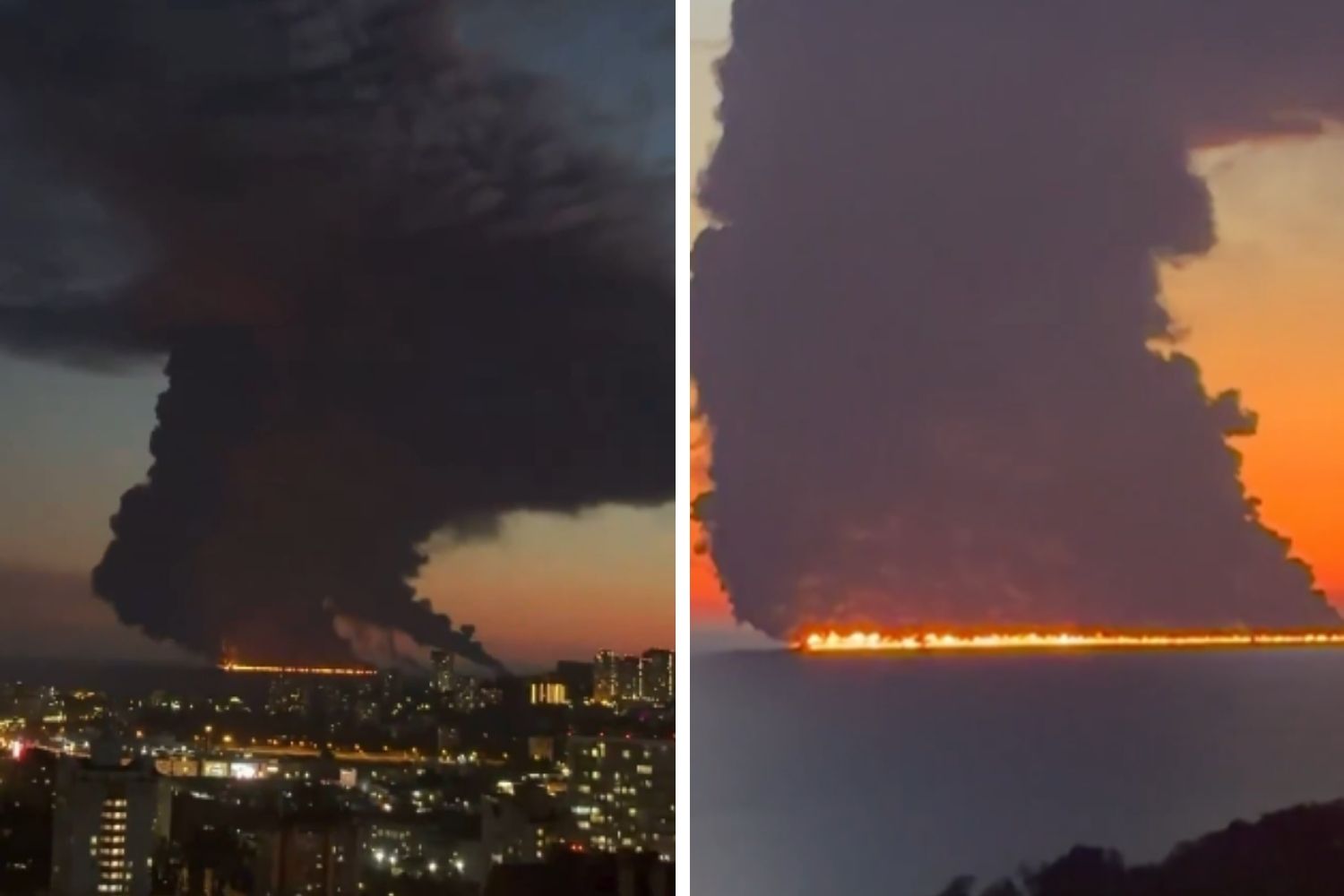
A column of black smoke rising from the sea and stretching towards the coast and, below, a burning oil tanker. This is the image that arrived in the last few hours from Sochi, on the Black Sea, where the Aframax Rioa large Liberian-flagged tanker, was reportedly struck by an unmanned vessel.
The fire broke out in recent hours off the coast of the famous Russian tourist resort and forced the authorities to temporarily close the beaches and seafront. There were 23 crew members on board, all Indian citizens: they were evacuated and no one was injured.
But it is above all what is happening around the ship that is of concern: according to the Russian Ministry of Transport, after the attack, some oil caught fire directly in the waters of the Black Sea and for a long time the intensity of the flames prevented rescue units from safely approaching the tanker.
BLACK SEA | Crude Oil Tanker AFRAMAX RIO Catches Fire Near Sochi, Possible Ukrainian Attack Suspected
Marine Tanks
New Delhi: A crude oil tanker, AFRAMAX RIO (IMO 9273844), caught fire off the coast of Sochi in Russia’s Black Sea region on Tuesday evening. A massive fire and a… pic.twitter.com/jOYgxGA9JD
— Marine Tanks (Voice of Sea) (@MarineTanksInd) October 6, 2026
According to the reconstruction provided by the Russian authorities, the Aframax Rio would have been reached by one or more unmanned naval units, i.e. vehicles that can be used as marine drones. At the moment, however, it has not been independently ascertained who carried out the attack. If Moscow talks about unmanned vehicles, Ukraine has not claimed responsibility and attributing the action with certainty to Kiev would therefore be premature at the moment.
The ship, built in 2004 and with a deadweight capacity of more than 100 thousand tons, has been associated in recent years with the transport of Russian oil to foreign markets. In February 2026, Ukraine included it in its sanctions list, indicating it among the vessels attributable to the so-called “shadow fleet”, the “shadow fleet” used for Russian oil trade. However, it is not included in the sanctions lists of the European Union or Kiev’s other main Western allies.
Meanwhile, the first data released by local authorities indicate that the concentrations of air pollutants detected at Sirius remained below the maximum permitted limits and, according to the administration, do not currently represent a health hazard. However, these are data provided by the Russian authorities and monitoring continues.
Another confirmation that the month-long pause in Ukrainian attacks on merchant vessels in the Black Sea is clearly over.
An Aframax tanker, AFRAMAX RIO (~100K mt DWT), fully loaded with oil for India, was reportedly hit near Sochi this afternoon.#oatt #sizovreport #wheat… pic.twitter.com/FBX2PtNG9x
— Andrey Sizov (@sizov_andre) October 6, 2026
How much oil ended up in the sea?
This is the point on which, at the moment, there remains the greatest uncertainty. The Russian Ministry of Transport has explicitly spoken of “open combustion of oil” in the waters of the Black Sea, but a reliable estimate on the quantity of crude oil that may have leaked from the tanks has not yet been made public.
The images show flames on the sea surface and an enormous column of dark smoke, elements compatible with the presence of hydrocarbons, but talking about a large oil spill or quantifying the spill would be premature.
And this is precisely the part of the accident to be observed in the next few hours.
An oil tanker of this size can transport hundreds of thousands of barrels of crude oil. Its theoretical capacity, however, does not automatically say how much oil was actually present on board nor, above all, how much of it possibly ended up in the sea.
The Black Sea is increasingly involved in war
The Aframax Rio fire comes as the Black Sea is experiencing a new and dangerous escalation in attacks against commercial shipping.
In the same hours, two merchant ships were hit by drones in Bulgaria’s exclusive economic zone: one sank, while the crew of the other was evacuated, with two injured. The Bulgarian authorities specified that the origin of the drones has not yet been ascertained.
In recent days, then, another commercial ship, owned by Turkey and loaded with corn, was hit in Romania’s exclusive economic zone: two people died in the attack and Ukrainian president Volodymyr Zelensky attributed that action to Russia.
European Commission President Ursula von der Leyen called attacks against civilian shipping “unacceptable”, underlining the growing risk to ships and crews in the Black Sea.
Each affected ship brings with it fuel, oils, goods and potentially polluting substances. Every fire in water can also become an environmental problem. And when the war moves to the Black Sea trade routes, it is not just armies that increasingly find themselves in the line of fire.
