
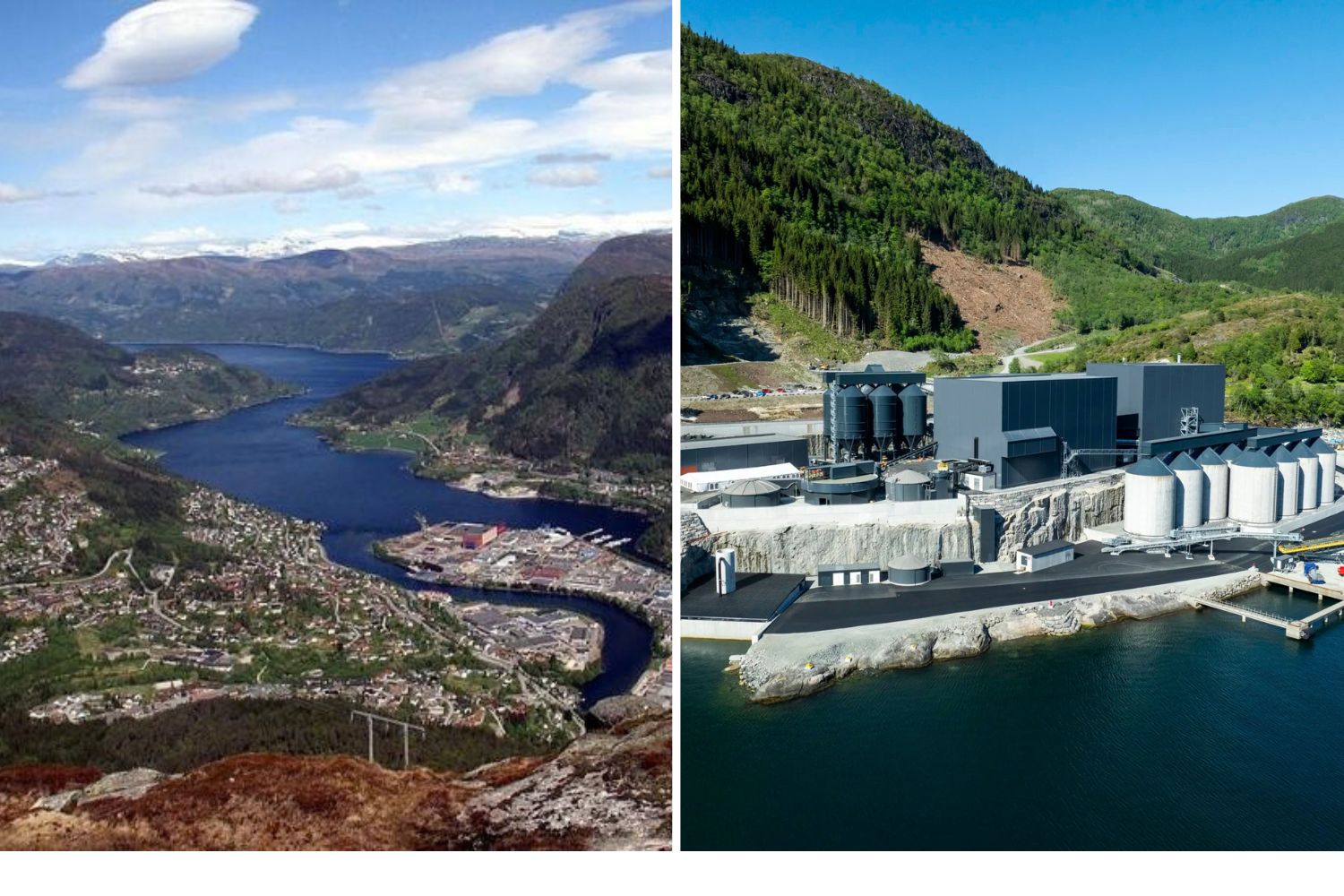
The Førde fjord, on the west coast of Norway, has become a battleground between the protection of the sea and the supply of strategic raw materials. At the end of September 2026, the Norwegian Ministry of Climate and Environment granted a new permit to the Engebø mine to discharge its waste directly into the fjord waters. The decision comes after, on June 17, the Supreme Court ruled that the original authorization was illegal.
For the inhabitants of Vevring and the environmental associations, engaged in a legal battle for 17 years, the ruling should have marked the end of the dumping. Instead, the granting of a new temporary permit reopened the conflict. According to what was reconstructed by the Guardian in the article of 8 October 2026, the authorization allows the Nordic Mining company to continue for another three years.
@Wikimedia
Does the titanium rush justify pollution?
The mine, proposed in 2006, exploits a deposit of rutile, a mineral from which titanium is obtained. The Norwegian government considers the project important for the country and for Europe, also because titanium has been included by the European Union in the list of critical raw materials. According to a ministry spokesperson, Mount Engebø holds one of the largest rutile deposits in the world.
However, the reasoning clashes with the Supreme Court ruling. The judges ruled that the reasons behind the initial permit were not sufficiently robust compared to the European Water Framework Directive, which allows derogations from protection objectives only in the presence of an overriding public interest.
Tarjei Ellingsen Røsvoll, associate professor of administrative and constitutional law at the University of Inner Norway, disputes the possibility of circumventing that ruling through a new authorization. “It’s wrong. A permit either exists or it doesn’t exist, and the Supreme Court decision is quite clear: the permit is illegal,” he told the Guardian.
The question also concerns the functioning of institutions. According to the jurist, allowing a company to continue dumping waste after a ruling against it undermines trust in the legal system. Meanwhile, the Norwegian Financial and Environmental Crime Office, Økokrim, is considering whether to open an investigation into the matter.
Mining dust can enter the food chain
The underwater disposal of mining waste consists of pumping crushed rocks and processing waste into the sea through pipelines that can reach hundreds of meters deep. Proponents present it as an alternative to onshore storage. The Norwegian Institute of Marine Research (IMR), however, warns that fine particles can disperse, accumulate in marine organisms and alter ecological balances.
Terje van der Meeren, an IMR researcher and witness in the court proceedings, compared the residue to a very fine dust. Engebø waste also contains a chemical that degrades into carbon disulfide, a neurotoxin. “What will happen to the fish that spawn in this fjord? We don’t know,” he told the Guardian.
The consequences of past mine dumping show why the concern is not just theoretical. In 2016, Norwegian researchers studied the Repparfjord, where a copper mine had spilled waste in the 1970s. Decades later, they found concentrations of lead, arsenic and chromium in the muscles in haddock cod that were higher than those found in surrounding waters. Other studies have documented contaminants in crabs, plankton and fish eggs.
A battle that also concerns the future of the fjords
The Engebø case fits into a broader picture of pressure on the Norwegian marine environment. A recent report linked fish farms to the release of large amounts of polluting nutrients into coastal waters. Meanwhile, by the start of the 2026 fishing season, more than 150 of Norway’s approximately 450 salmon-rich rivers had been closed to fishing.
The new authorization also risks setting a precedent for other mining projects interested in disposing of waste at sea. Nordic Mining has stated that it intends to continue the activity with the aim of operating responsibly and with respect for the local community. The inhabitants of Vevring and environmental associations are instead preparing for a new legal battle.
For Anne-Line Thingnes Førsund, a third-generation fisherman and activist, the fjord has supported community life for centuries. “It has given us food, income, meaning, music, fish and birds for thousands of years,” he told the Guardian. The government’s decision now tests Norway’s ability to reconcile the extraction of strategic raw materials with the protection of waters that constitute an essential part of its natural heritage.
