
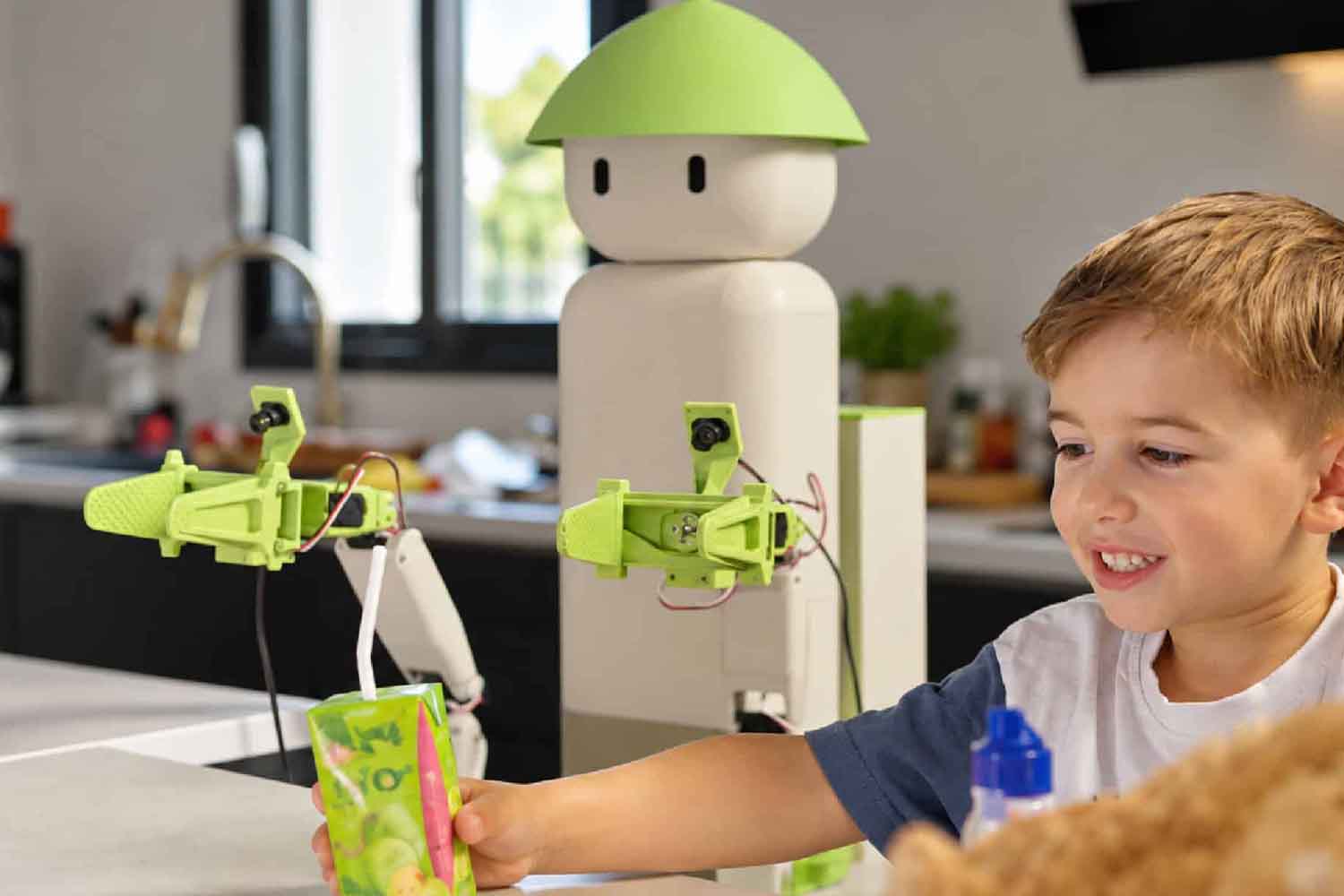
It’s a domestic robot just over a meter tall, it goes around the house on wheels and, if you show it for half an hour where shoes, bowls and litter tray go, it tries to do it again itself. It’s called Flourish 1, it was developed by the French startup Flourish Robots and the first examples are expected in December 2026. No code to write: you guide it from your smartphone, show it a routine several times and it transforms it into a task to repeat independently.
At least, when everything goes smoothly. According to the company, today Flourish 1 correctly completes learned tasks in about 80% of attempts. One time in five, therefore, it is still worth checking where the shoes ended up. The first 50 examples will be numbered 01 to 50. Price is $3,555, with a $1,555 deposit refundable until shipping. More than a butler ready to take home, for now we are still in the early adopter phase with a lot of confidence in the technology and a few things to catch up on manually.
You show him the thing and he tries to do it again
The learning system is probably the most interesting part. In the app, the work is first broken down into the various steps: reaching the entrance, taking a shoe, taking it to the cabinet, leaving it inside, going back. Then you pilot the robot from your phone several times and from different positions for approx 30 minutes. After a processing phase of about an hour, the new routine can be recalled by voice or programmed at a specific time.
The goal is to teach him the habits of that house, including the location of objects and where they should be placed. Flourish shows examples of tidying up shoes, cleaning the cat litterfilling the water bowl and other small daily tasks. Activities created by other owners can also be published in a dedicated store and installed by other users in a few seconds.
The robot is approx 1.09 metersweighs about twenty kilos, moves on wheels and can lift approximately 1.5kg. The declared autonomy reaches 12 hours. The choice of wheels and relatively light arms also serves to contain costs and complexity: Flourish 1 was created expressly for the home, without claiming to have the strength and mobility of robots designed for factories and industrial environments.
Stairs remain out of the program
For now, however, the domestic curriculum has some holes. Flourish 1, doesn’t yet know how to fold laundry, can only carry rather light objects and his hands are not waterproof. The dream of entrusting him with your home and returning in the evening finding everything perfect can therefore wait for some updates.
Then there is that 80% figure. Flourish Robots claims to have been around since 60% success a year ago to 80% nowwith the declared objective of reaching 99%. However, these are numbers provided by the company on a technology that has just arrived on pre-sale: they are not equivalent to an independent test conducted in the homes of hundreds of people. And with only 50 initial examples, field testing has practically yet to begin.
The cameras enter the house, and some of the data goes out
The privacy chapter deserves some more attention, also because Flourish 1 must observe the environment to move and learn. Flourish Robots’ privacy policy specifies that recordings used to teach new activities require user consent and may include images of rooms, objects, people and animals in the home.
During normal operation, however, data from cameras and sensors are transmitted between the robot and the company’s servers to allow the system to make decisions. Flourish ensures that these streams are processed and then discarded, without being retained. Recordings authorized for training can be used to improve models and later deleted from the app.
For European users there is an additional detail: Flourish Robots Corporation declares that it is based in the United States and that its infrastructure is also located there. The data of European users is then transferred to and processed in the USA; the company says it uses the European Commission’s standard contractual clauses for these transfers.
Even the idea of a fully autonomous and local robot should therefore be taken with caution. The price includes six months of cloud processing for advanced AI functions; subsequently the service is indicated at 50 dollars a monthin optional form, or it can be replaced using its own GPU.
In short, Flourish 1 arrives at that curious phase in which the generalist domestic robot begins to resemble a purchasable product, despite carrying with it several asterisks. He can already pick up his shoes and take care of the litter box. For $3,555, however, ironing is still done by humans. Or to those who wisely decided not to.
