
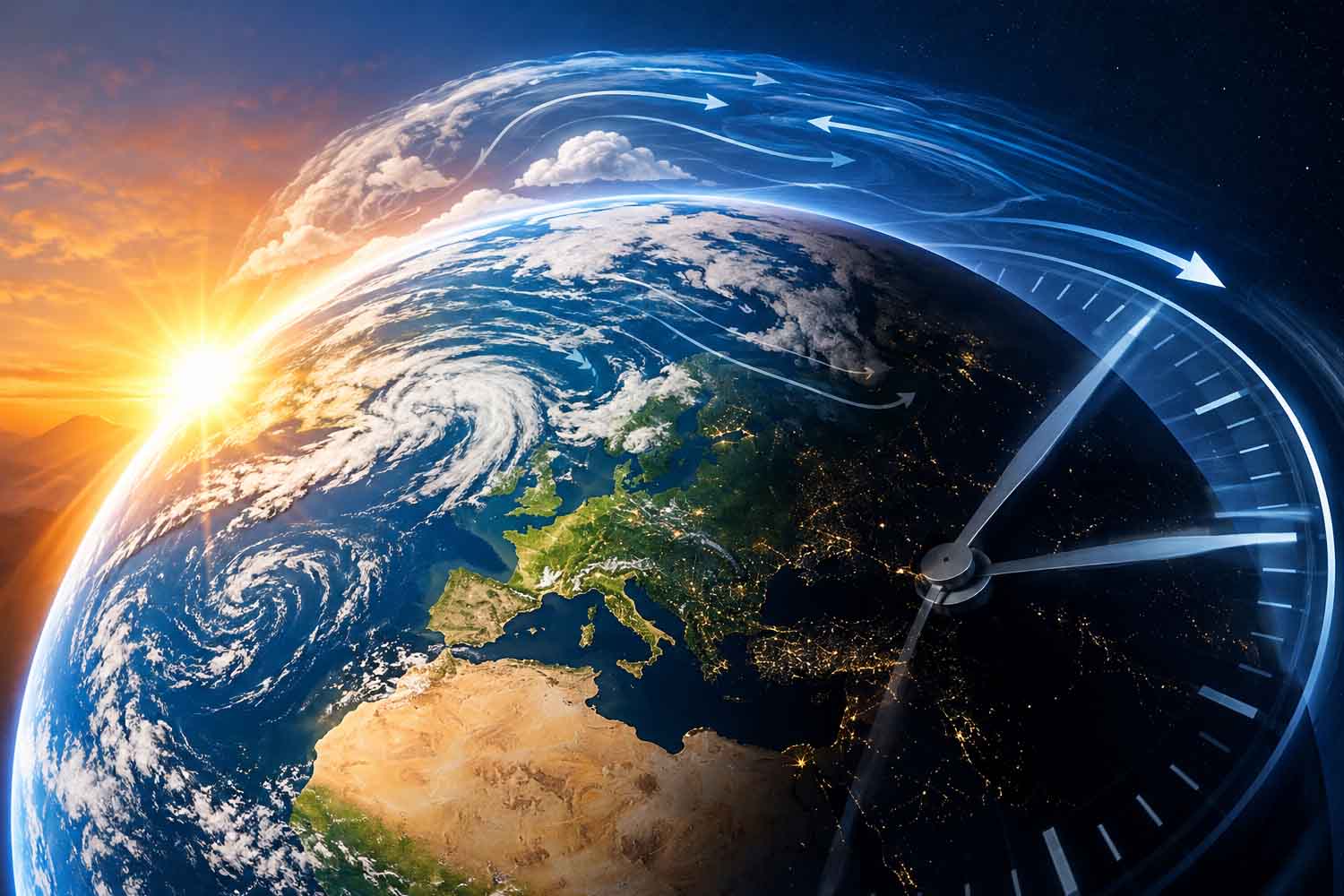
Global warming is even changing the speed at which the Earth rotates. For every degree of increase in the planet’s average temperature, our days could get longer by about a tenth of a millisecond. A difference that no one will notice when looking at the clock, of course, but which tells how much climate change can affect even phenomena apparently far from the climate, such as the earth’s rotation.
This is indicated by a study published in npj Climate and Atmospheric Sciencein which an international group of researchers analyzed how increasing temperatures can modify atmospheric circulation to the point of slightly slowing down the planet’s movement. The mechanism mainly concerns the winds: while the atmosphere gains rotation speed, the Earth tends to lose a very small part of its own.
How do winds slow the Earth’s rotation?
We are used to considering the atmosphere as something that envelops the Earth, almost as if it were a separate layer. Yet, the huge air masses moving around the planet also participate in its rotation. When they change speed or direction, they can change the so-called angular momentum, a physical quantity related to rotational motion.
Earth and atmosphere continually exchange this moment. If the atmosphere gains some, the rotation of the solid part of the planet must compensate, slowing down slightly. It is a phenomenon that has been known for some time, also observed during natural climatic events such as El Niño.
Researchers have tried to understand what can happen when global warming modifies these movements. To do this they used three climate models and 190 overall simulations, considering a scenario in which greenhouse gas emissions remain high until the end of the century.
The simulations indicate that increasing temperatures modify some of the main atmospheric currents. Among these is the Hadley cell, the large air circulation system that affects tropical regions and helps distribute heat to higher latitudes.
With global warming, this circulation tends to widen towards the poles. At the same time, tropical trade winds weaken and some particularly strong currents flowing at high altitudes, called jet streams, strengthen or shift. Taken together, these changes increase the angular momentum of the atmosphere. The pressure distribution also contributes, albeit to a lesser extent. In short, the air modifies its movement around the planet and the earth’s rotation is affected.
Days could get longer by 0.1 millisecond for every degree
The numbers are tiny. According to the three models analyzed, each degree Celsius of global warming would correspond to an increase in day length of between 0.09 and 0.11 milliseconds, considering only the contribution of atmospheric changes. For reference, one millisecond is equal to one thousandth of a second. We are therefore talking about a variation that is impossible to notice in daily life, even if it can be measured with extremely precise scientific instruments.
The phenomenon may become more recognizable during the second half of the century. In two of the three models, the signal attributable to global warming exceeds natural variability in 2057 and 2080 respectively. In the third, however, this threshold is not reached by 2100. The projections also depend on the climate scenario used, characterized by high emissions. With a different trend in emissions, the extent of the slowdown could also change.
Then there is another interesting fact. Between 2050 and 2099, the effect of atmospheric changes on day length could reach a magnitude equivalent to 10-18% of the secular slowdown due to lunar tidal friction. This does not mean that the days will become 10 or 18% longer, but the percentage is used to compare two contributions to the variation of the Earth’s rotation, both very small.
Melting ice is also slowing the planet
The link between global warming and Earth’s rotation had already been identified through another phenomenon: the melting of ice. A study published in PNAS had shown that the loss of ice from polar ice caps and continental glaciers contributes to redistributing enormous quantities of water on the Earth’s surface.
As some of this mass moves from the polar regions to lower latitudes, the planet’s moment of inertia also changes. To understand the mechanism, just think of a skater who rotates on himself: when he keeps his arms close to his body he spins faster, when he spreads them he slows down. The Earth responds to a similar physical principle.
The new study adds to this process the effect of atmospheric circulation, which according to simulations could have an influence comparable to that of the melting of large ice masses. Naturally, the Earth’s rotation speed also depends on other phenomena, including the interactions between the core and the mantle, which will continue to have a predominant role in the variations of the coming decades.
The length of the day, therefore, will continue to fluctuate for several reasons. However, researchers have identified a further contribution linked to human activities, which could become more evident with rising temperatures. For us there will continue to be the usual 24 hours, with all due respect to those who claim they never have enough time. To measure the effects of global warming on the Earth’s rotation, however, we will also need to look at the decimals of a millisecond.
