
The calendar says September, but the global thermometer tells another story. The recently ended September was the second warmest September ever recorded on Earth, surpassed only by 2023. Furthermore, for the second consecutive month, the average global temperature exceeded pre-industrial era levels by more than 1.5°C.
This is certified by the new bulletin of the Copernicus Climate Change Service (C3S), the European service for monitoring climate change, managed by the European Center for Medium-Term Weather Forecasts (ECMWF).
According to published data, the global average temperature in September reached 16.27°C, which is 0.82°C higher than the average for the period 1991-2020 and 1.63°C above the pre-industrial levels of 1850-1900. Only September 2023 was warmer, with a difference of just 0.11°C.
However, this is not an isolated record. August and September 2026 both exceeded the 1.5°C threshold, a sequence that had not occurred since November 2025 and which, according to Copernicus, could continue into 2027, thanks to the strengthening of El Niño.
What does it mean to have exceeded the 1.5°C threshold?
The September data is particularly important because it directly recalls one of the central objectives of the Paris Agreement: to contain the increase in the average global temperature well below 2°C compared to the pre-industrial era, trying to limit it to 1.5°C. But be careful: exceeding 1.5°C for a single month, or even for several consecutive months, does not mean having formally exceeded the long-term limit established by the Paris Agreement. The latter is evaluated by considering the temperature trend over a much longer period of time, not the fluctuations of a few months. In any case, this does not make the current data any less worrying. On the contrary, the recurrence of such high thermal anomalies confirms how close the planet is to a level of warming that the scientific community considers extremely risky for ecosystems, water resources and human societies.
Carlo Buontempo, director of the Copernicus Climate Change Service, underlines this:
September was the second warmest on record globally, with exceptionally high temperatures hitting parts of Europe again after an extreme summer. We are experiencing a new sequence of months above 1.5°C and, with a strong El Niño still intensifying, this is likely to continue into 2027.
Buontempo also warns that exceeding the long-term limit of the Paris Agreement is now only a question of time and adds a fundamental step: by how much we will exceed that threshold and for how long we will remain beyond it will still depend on our choices.
Ever warmer oceans
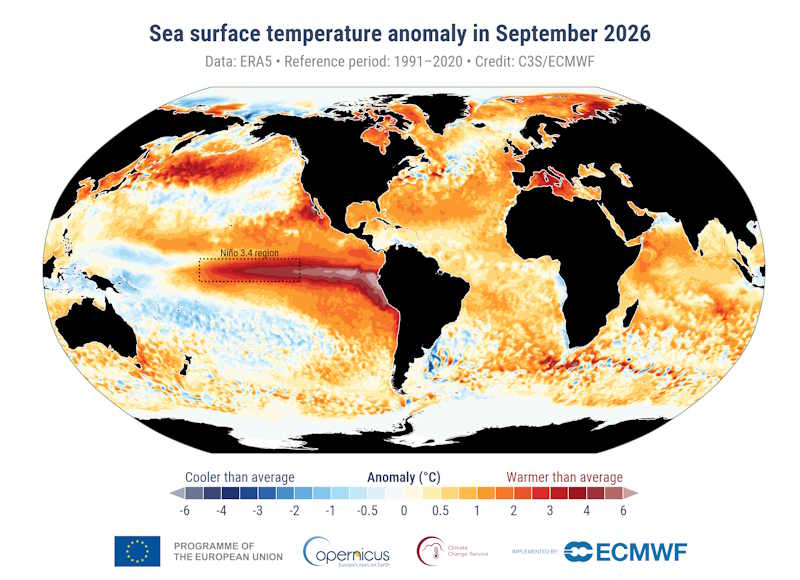
If air temperatures are worrying, those of the oceans do not offer more reassuring signals. In September 2026, the average sea surface temperature between 60° south and 60° north latitude, therefore excluding the polar regions, reached 21.05°C, the highest value ever recorded for this month. The previous record belonged to September 2023, when the average stopped at 20.92°C.
At the center of this anomaly we also find El Niño, the natural climatic phenomenon characterized by a warming of the surface waters of the central and eastern equatorial Pacific, capable of influencing temperatures and precipitation in numerous regions of the planet. The phenomenon is intensifying and could become one of the strongest ever observed.
European seas also recorded notable anomalies: surface temperatures reached record values for September along the Atlantic coast and in the western Mediterranean, helping to keep the surrounding emerged lands particularly warm as well.
Europe, the heat gives no respite
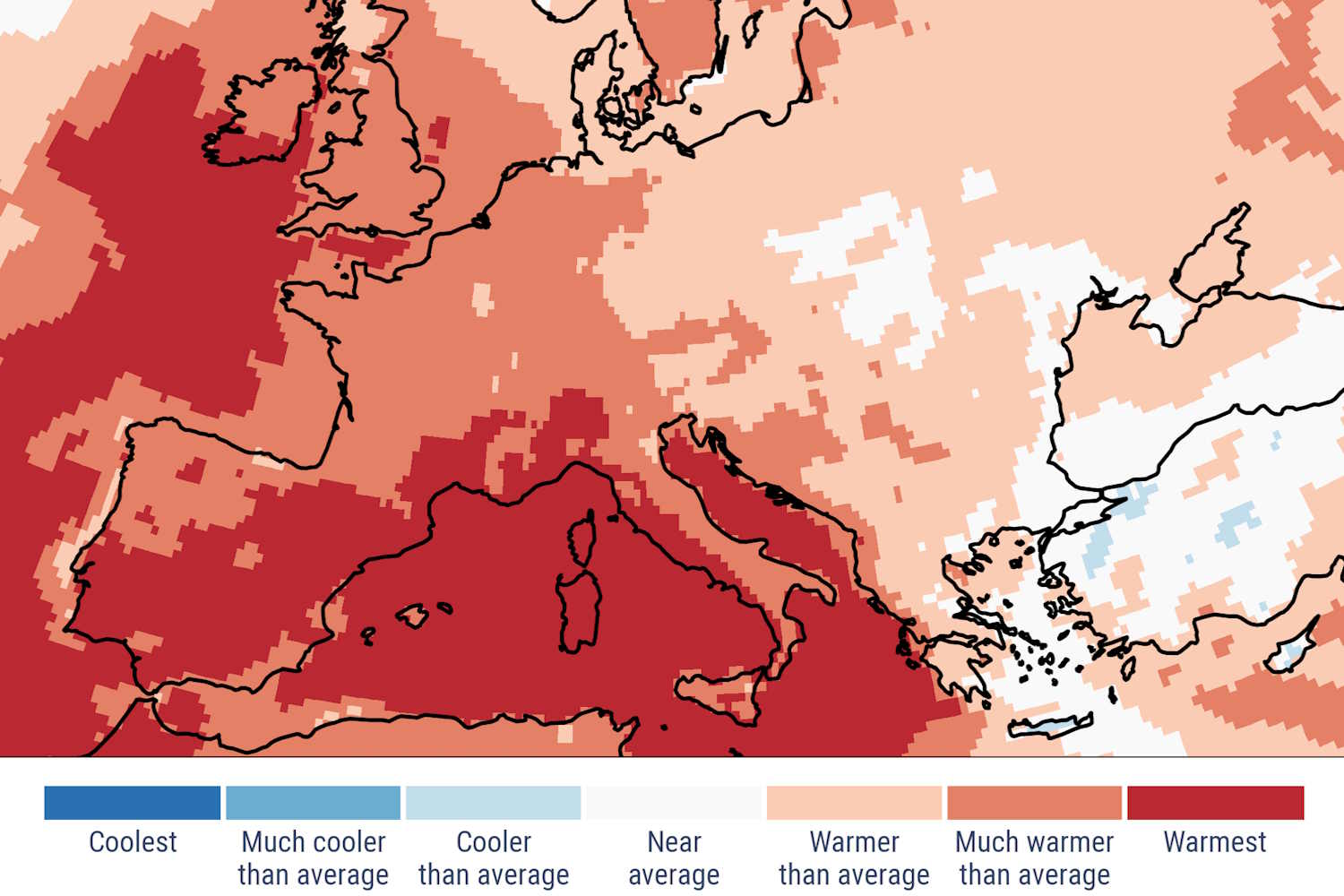
Europe is among the areas of the planet where the September climate anomalies were particularly evident. The average temperature over European land masses reached 16.26°C, or 1.54°C higher than the average for the period 1991-2020. It was the third warmest September on record on the continent.
@Copernicus
Even more significant is the situation in Western Europe, which experienced the warmest September in its historical series, on a par with that of 2023: 2.51°C above the climate average.
A figure that comes after the hottest summer ever recorded in the same region and which confirms the persistence of exceptionally high temperatures.
But the heat wasn’t the only problem. In large areas of western, central and eastern Europe, September prolonged the drought conditions that had already characterized the summer months. Compared to August, the lack of precipitation has accentuated or extended in several areas of the Iberian Peninsula, France, Italy, the Western Balkans and Greece.
From drought to troubled rivers
According to Copernicus, in September 2026 several stretches of the Rhine, Danube, Vistula and the Garonne-Dordogne river system recorded never-so-low flows for this month. It goes without saying that exceptionally low river levels have caused problems for navigation, water supply and agricultural activities in several countries.
Water scarcity, especially when it lasts for weeks or months, can have repercussions on entire territories: it reduces the availability of resources for irrigation, puts pressure on aquatic ecosystems and makes the management of water infrastructure more complicated. Yet, in the same month, some areas experienced the opposite problem.
The rains that arrived towards the end of September brought partial relief to drought-stricken areas, but also caused floods in some regions of France and Spain. Wetter-than-average conditions also affected parts of northern and northeastern Europe and Turkey.
It is the picture of a continent dealing with strong meteorological contrasts, where prolonged droughts and intense rainfall can occur even within a short geographical and temporal distance.
El Niño could push temperatures even higher in 2027
Meanwhile, the new Copernicus report arrives at a particularly delicate phase for the global climate. The strengthening of El Niño could contribute to maintaining high temperatures also in the coming months and during 2027. The natural phenomenon in fact acts on a climate system already heated by greenhouse gas emissions, temporarily accentuating the heat present in the atmosphere and oceans.
This does not mean that every month next year will necessarily be record-breaking, nor that it is possible to predict with certainty the intensity of future weather events, but it undoubtedly means that human-caused global warming and natural climate variability are acting simultaneously, creating conditions favorable to new thermal anomalies.
September 2026 thus leaves a message that is difficult to ignore: while the average global temperature once again exceeds 1.5°C compared to pre-industrial times, the oceans continue to accumulate heat, large European regions face persistent drought and Antarctic sea ice reaches one of the lowest levels ever observed.
