
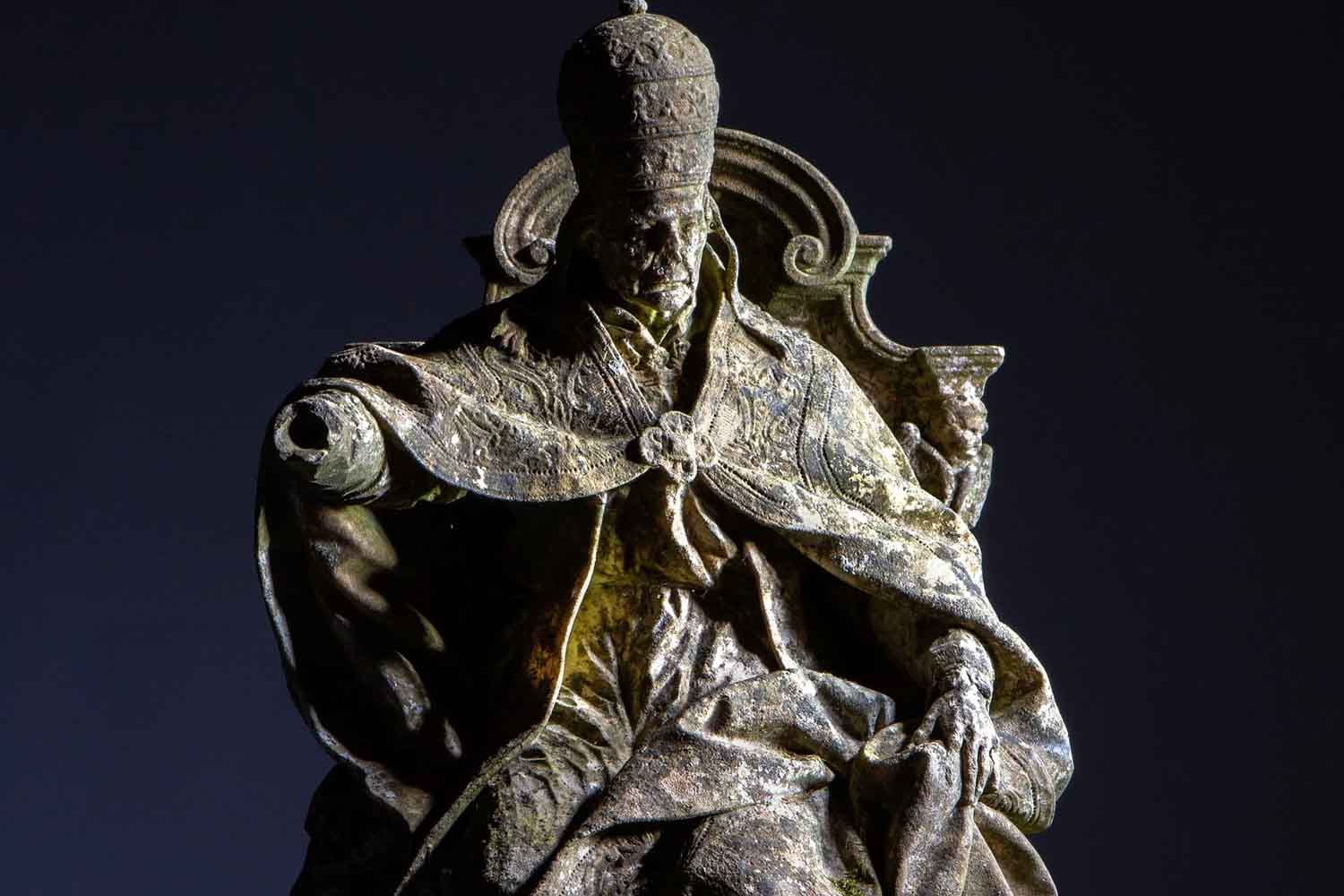
For years it remained outdoors, between rain, lichens and neglect, until it ended up in a salvage yard in Wiltshire, England. There a collector noticed a marble sculpture just 68 centimeters high and decided to buy it for 300 pounds, approximately 345 euros. He had seen something that others had missed: that battered figure of a pope could be worth much more than the asking price.
He was right. According to the experts at the British auction house Woolley & Wallis, it would be a rare preparatory model made around 1736 by Pietro Bracci, the Roman sculptor who would later create the monumental figure of Oceanus in the center of the Trevi Fountain. The work depicts Pope Clement XII sitting on a throne and is thought to be connected to a large bronze statue once kept in the Capitoline Hill, destroyed in 1798.
The marble was included in the auction on October 8, 2026 with an estimate between 5,000 and 10,000 poundsapproximately 5,800-11,600 euros. However, the lot was subsequently reported as withdrawn from sale. The reason was not made public.
Pietro Bracci’s signature on a forgotten sculpture
Little Clement XII wears the triregnum, the traditional papal tiara, and a large cloak decorated with reliefs. He sits on a throne adorned with volutes and winged cherubs. Despite the deterioration of the surface, the details of the clothing and composition are still recognizable. On the right side there is a signature: “P. Bracci, Rom. F.”referring to Pietro Bracci and the creation of the work in Rome.
According to the Woolley & Wallis catalogue, the sculpture is the only known surviving marble model of the monumental statue commissioned by the Roman Senate to celebrate Clement XII. The attribution derives from the research of the auction house and must be distinguished from the historical documentation, which instead confirms the existence of the large bronze monument and its subsequent destruction.
Mark Yuan Richards, a specialist at the auction house who studied the find, defined the discovery as exceptional, especially due to the rarity of the work and the direct link with eighteenth-century papal Rome.
Bracci’s story is well documented in Italy too. Treccani remembers him among the most important sculptors of the late Roman Baroque, author of numerous pontifical monuments and portraits. He participated in the creation of the Trevi Fountain by working on the large central sculptural group, while the architectural design of the fountain was by Nicola Salvi.
The monument to Clement XII that Rome lost in 1798
The large statue of Clement XII was commissioned to celebrate the pontiff’s contribution to the birth of the Capitoline Museums as an institution open to the public.
In the 1733 Clement XII purchased the antiquities collection of Cardinal Alessandro Albanicomposed of 418 sculptures. The following year the Palazzo Nuovo museum was inaugurated, one of the most important steps in the history of the Capitoline collections, as the Capitoline Museums themselves recall.
The bronze sculpture intended for the Capitol was part of that celebratory program. Bracci prepared the model in the 1730s and the final casting was carried out in 1739 by the silversmith and foundryman Francesco Giardoni. The monument was initially placed in the hall of Palazzo Nuovo, in front of the statue of Innocent X by Alessandro Algardi. It was subsequently transferred to the Sala degli Orazi e Curiazi of Palazzo dei Conservatori.
In 1798, during the Roman Republic, bronze was melted. The statue thus disappeared from the Capitoline collections, approximately sixty years after its creation. To reconstruct its appearance, historians had at their disposal above all an eighteenth-century engraving by Stefano and Rocco Pozzi. The English discovery could add something much more concrete: a three-dimensional representation of the composition, with details that a print is difficult to reproduce.
Another Clement XII is still found in Ravenna
The story also has a connection with Ravenna, where another statue of Clement XII sculpted by Pietro Bracci is preserved. According to Treccani’s Biographical Dictionary of Italians, Bracci began working on that sculpture in 1733 and sent it to Ravenna in 1738. The figure has similarities to the one commissioned for the Capitoline Hill, even though they are two distinct monuments.
The Italian documentation also confirms an important detail: the first attempt to cast Capitoline bronze, in October 1738, failed. Francesco Giardoni managed to complete the work on 15 August 1739. A contract dated 10 September 1737, mentioned in the biographical entry dedicated to Giardoni, documents the commission of the Roman Senate.
This information strengthens the historical connection proposed by the auction house, even if an independent specialist evaluation would be necessary to definitively establish the authenticity of the marble found in England.
How she got to England remains a mystery
The provenance of the sculpture still has several gaps. Before arriving in the Wiltshire warehouse, it remained for decades in the garden of a private English property, exposed to the elements and used as a decorative element.
It was not possible to establish when it left Italy, nor who transported it across the Channel. It may have arrived in England through the antiques market or thanks to a collector, but these remain hypotheses.
The economic evaluation also requires clarification. The initial estimate of between 5,000 and 10,000 pounds was that indicated in the sale catalogue. Lot number 470, however, results withdrawn from the October 8 auctionas also reported in the MutualArt sales archive. It is therefore not possible to indicate a hammer price or attribute reasons for the withdrawal that have not been disclosed.
Almost three centuries later, a sculpture purchased among old building materials may have given scholars back a model of a Roman monument that disappeared in 1798. The large bronze statue is lost. The small one, covered in lichens, also withstood a few decades spent in the garden.
