
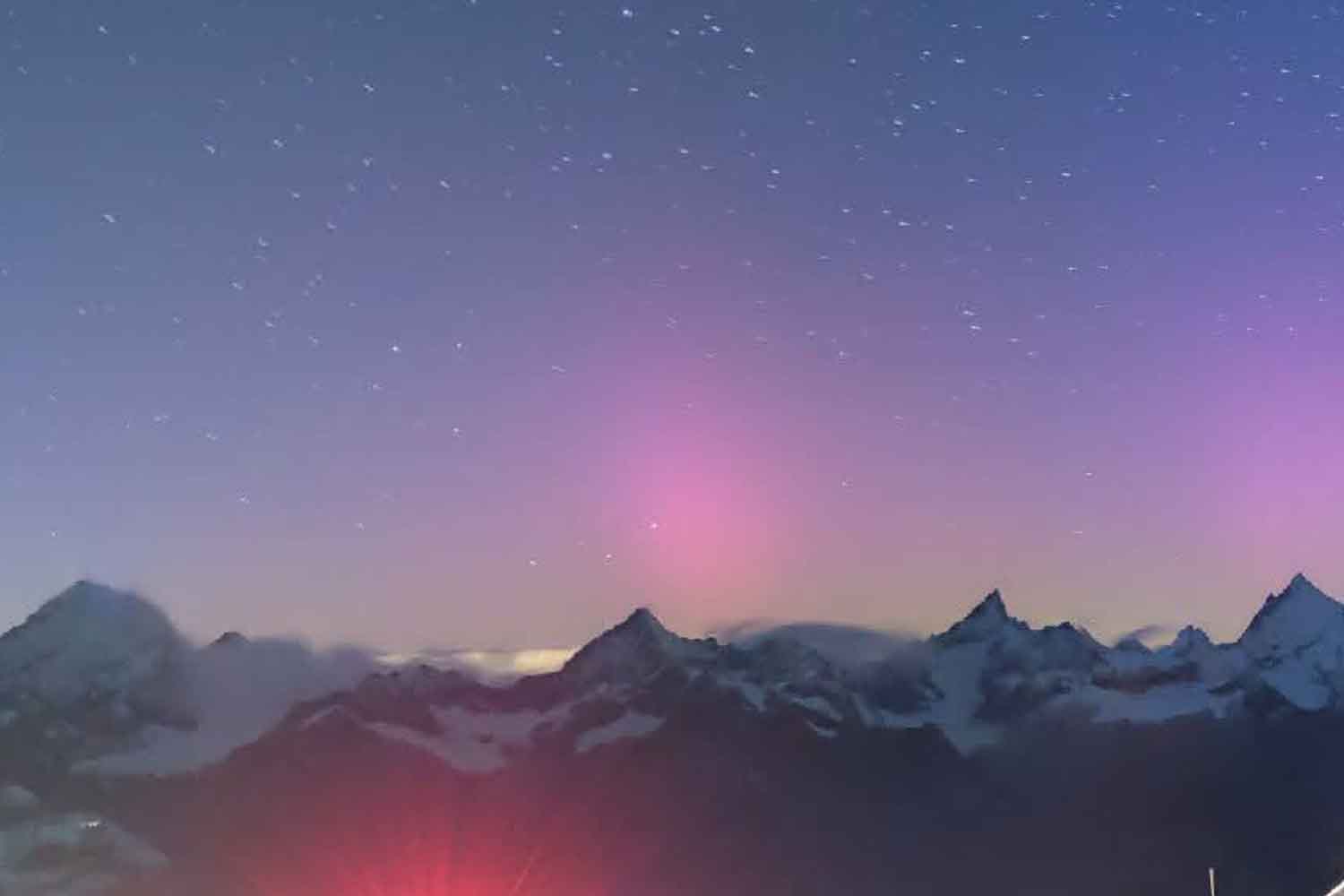
At 7.58pm Italian time on October 10th the geomagnetic storm reached level G3, “strong”on the scale used by NOAA’s Space Weather Prediction Center. Shortly afterwards, a faint red-magenta light appeared on the webcams of the Alps: at Plateau Rosà, above Cervinia, the sky showed a colored band just above the horizon. An auroral phenomenon is among the possible explanations. The National Institute of Astrophysics, however, invites us to leave another door open: that of a SAR, Stable Auroral Red arca stable red arc linked to geomagnetic storms.
It’s a less fussy distinction than it seems. A red photograph of the sky, alone, . We need data on the light spectrum and the particles involved. So yes, the sky was red. It is best to wait a little longer for the name to be written under the photograph.
Two coronal ejections arrived earlier than expected
The origin of the event was reconstructed with greater precision in the following hours. According to the INAF update, the storm was triggered by two coronal mass ejections, or CMEs, departed from the Sun on October 7 and 8. They were initially expected near Earth on October 11; instead they arrived on the afternoon of the 10th. The interplanetary shock was detected at 4.34 pm Italian time and a few hours later the geomagnetic activity reached G3.
A CME is a large ejection of plasma and magnetic field from the solar corona. When material reaches Earth with favorable characteristics, it can transfer energy to the magnetosphere and perturb Earth’s magnetic field. It is therefore not enough that the Sun “shoots” something in our direction: what counts is speed, density and above all the orientation of the magnetic field carried by the solar wind.
On October 10, the activity increased enough to push the optical effects to latitudes much lower than normal auroral regions. And here we are with the Alps colored red.
Because you can really see red
Auroras arise when energetic particles interact with atoms and molecules in the upper atmosphere. Oxygen can emit green or red light at different altitudes and conditions. During intense geomagnetic events, the area affected by the phenomenon can expand towards the south and make emissions observable that normally remain confined much closer to the poles.
Then there is the camera, which on these occasions cheats in a perfectly legal way. An exposure of a few seconds manages to record emissions that are too weak for the human eye. For this reason, a sky that appears barely veiled in person can transform into a decidedly more evident magenta band in the image.
Aurora or SAR? One photo is not enough
The HRH it may look like an aurora and even has “auroral” in its name, but the physical mechanism is different. During a geomagnetic storm, the energy associated with the ring current surrounding the Earth can heat electrons in the ionosphere. Subsequent collisions excite the oxygen atoms, which emit the characteristic red light. SAR arcs are mostly observed during periods of strong geomagnetic activity and can extend over large distances. NASA also describes these structures as red emissions associated with strong warming in the internal magnetosphere.
Some visual clues exist. An aurora can develop beams, curtains and draperies that rapidly change shape and intensity; a SAR tends to be more uniform, slow and persistent. The problem is that nature doesn’t have to pose well enough to allow a diagnosis via Instagram.
INAF is therefore cautious about the images of October 10th: the red-magenta glow observed on the Alpine webcams is real, as is the G3 storm. Establishing with certainty what phenomenon produced that light requires other measures.
What does a G3 storm mean
In the NOAA scale of geomagnetic storms, G3 corresponds to a “strong” disturbance and a planetary index Kp equal to 7. It is the third of five levels: above are G4, severe, and G5, extreme.
The classification also indicates possible technological effectsnot the certainty that they occurred. At the G3 level, NOAA contemplates voltage corrections in power grids, surface charges on satellites, increased atmospheric drag for those in low orbit, and intermittent disturbances to satellite navigation and high-frequency radio communications. The more subtle effects tend to be concentrated at high latitudes.
For Northern Italy, the most photogenic consequence of October 10th remained the one above our heads. The storm is documented, the red glow as well. Definitively calling it the “Northern Lights” still requires that slightly less spectacular step in photography: measuring what that light was actually emitting.
