
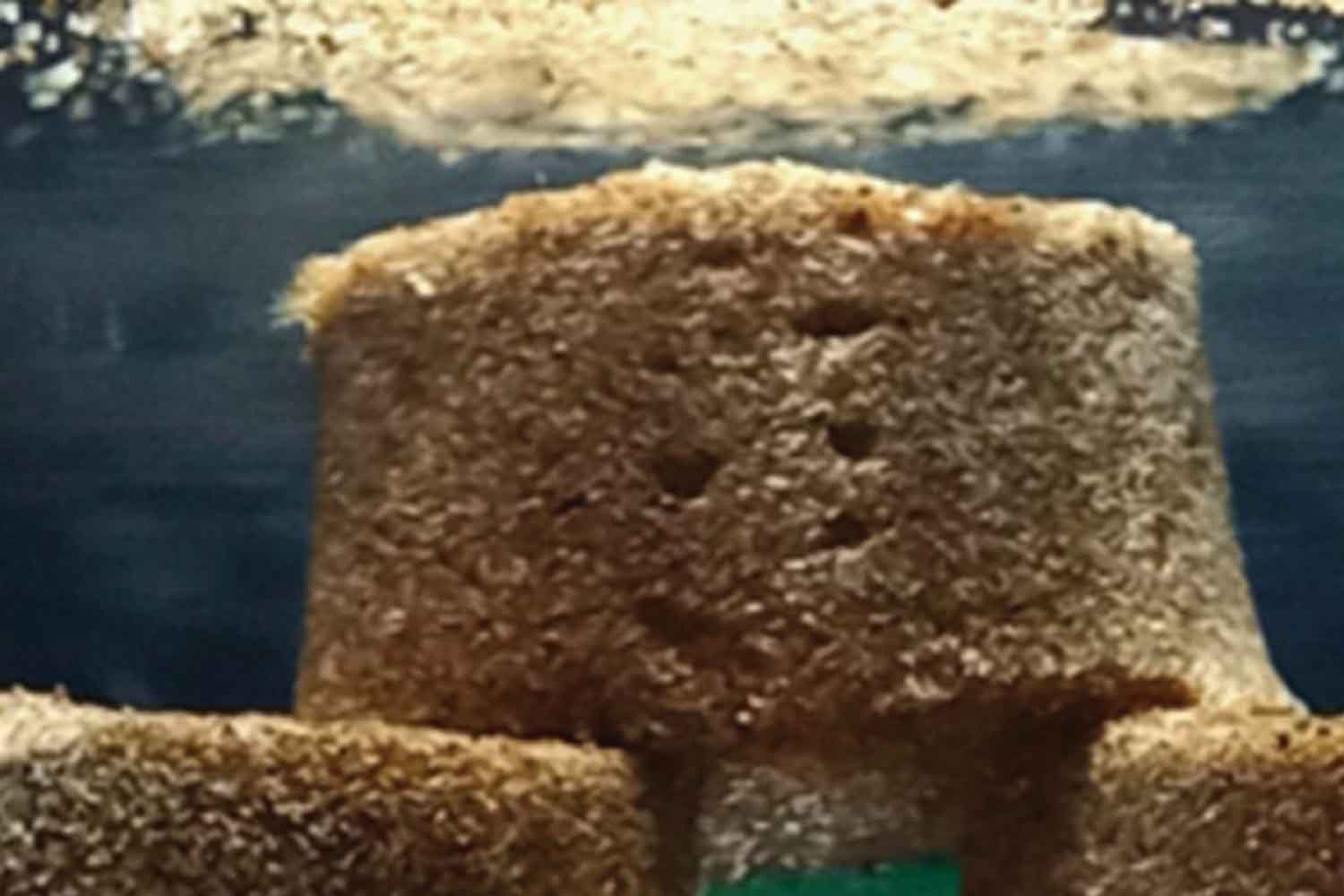
In the laboratory, water passed much more slowly through a column of sand taken from the dunes of Al Ain in the United Arab Emirates. It was slowed down by networks of fibers produced by microorganisms: in the treatment grown directly between the grains, permeability decreased by approximately 83%, while by inserting layers of already produced bacterial nanocellulose it was reduced by over 96%. In the latter case, water passed through the material about 28 times slower than sand left as it was.
It is the so-called “living sand” studied by researchers from Khalifa University in Abu Dhabi and Empa, the Swiss federal laboratories for materials science and technology. The study published on Carbohydrate Polymers appeared online on September 8, 2025; Empa then presented it again in August 2026 as a possible first step towards sandy materials that are more resistant to erosion and capable of better conserving water. First step, exactly. For now, no one has grown tomatoes in the dunes.
A microscopic network holds the grains together
The sand problem is very real. The grains have little cohesion, water passes quickly through the spaces that separate them and the organic component that allows fertile soil to support complex communities of microorganisms and plants is missing.
The researchers tried to modify this structure using three microbial strains. Two were strains of the fungus Schizophyllum commune; the third was the bacterium Komagataeibacter medellinensiscapable of producing nanocellulose. As they grow, fungi and bacteria form fibers that span the spaces between grains and create microscopic connections. The electron microscope images show a network attached to the surface of the sand, almost a tiny biological armor.
The bacterium gave the best results on cohesion: its nanocellulose formed a structure compact enough to allow the samples to be cut and, in some cases, to maintain their shape even immersed in water. The materials obtained with fungi, however, were more fragile.
Twenty-eight times slower does not mean 28 times more water
Number 28 concerns permeability: it describes how much more slowly water passes through a sand structure in which separately produced sheets of bacterial nanocellulose had been inserted, a sort of biological geotextile.
The amount of water actually retained by the material has grown much less. In tests, the retention capacity went from 20.17% in the control sand to 25.53% in the improved treatment with nanocellulose grown directly between the grains. A significant increase, according to the authors’ statistical analysis, but very far from the idea of a sand that conserves twenty-eight times more water.
The “sixfold” associated with direct treatment with microorganisms also concerns the rate at which the water filters. Permeability dropped from 1.05 × 10⁻⁴ meters per second in the normal sand to 1.81 × 10⁻⁵ in the modified material: about a sixth. Permeability tests were conducted on sand columns in the laboratory, with three replicates per configuration.
Plants have yet to enter the experiment
The research stops before the decisive step to really talk about agriculture in the desert. The authors studied structure, strength, cohesion, permeability and water-holding capacity. They did not measure crop yield, germination, field irrigation use, or plant survival in treated soils.
Empa indicates as the next step experiments in the greenhouse or in controlled conditions in the field, necessary to understand whether modifying the sand can really promote plant growth. Nutrients, durability of biological structures, behavior under extreme temperatures and the possibility of applying the system on large surfaces will also have to be evaluated outside of laboratory tubes.
The authors also hypothesize that, in the future, microorganisms could be fed using raw materials from waste streams, such as sugars from food waste or nutrients from green waste. It is a possibility indicated for the development of technology, not a solution already tested in the deserts.
For now the result is a handful of sand modified in the laboratory: grains that stay together more easily and water that takes longer to leave. Before we call it farmland, we’re still missing the pretty important part where something can actually grow on it.
