
@greenpeace
Twelve activists occupied the construction site of a huge poultry farm in Croatia, painting a 500 square meter sign on the roofs. The plant is expected to produce 1.8 million chickens a year, just a stone’s throw from one of Europe’s most valuable wetlands.
A huge sign, impossible to ignore: “Stop this shit!”. Five hundred square meters of protest painted on the roofs of three warehouses under construction in north-eastern Croatia. This is the action with which this morning, 13 October, twelve Greenpeace activists decided to denounce an intensive farming project that risks putting pressure on one of the most important river ecosystems on the continent.
We are near the border with Hungary, a few hundred meters from the Veliki Pažut nature reserve, part of the so-called “Europe’s Amazon”, an immense system of rivers, forests and wetlands recognized by UNESCO for its extraordinary biodiversity.
Here the poultry giant MHP, the largest poultry producer in Europe, is building a plant which, once operational, should produce 1.8 million chickens every year. A project that worries the inhabitants of the area, especially due to the possible consequences of livestock waste on water, soil and air quality.
The protest on the rooftops and the giant chicken in front of the gates
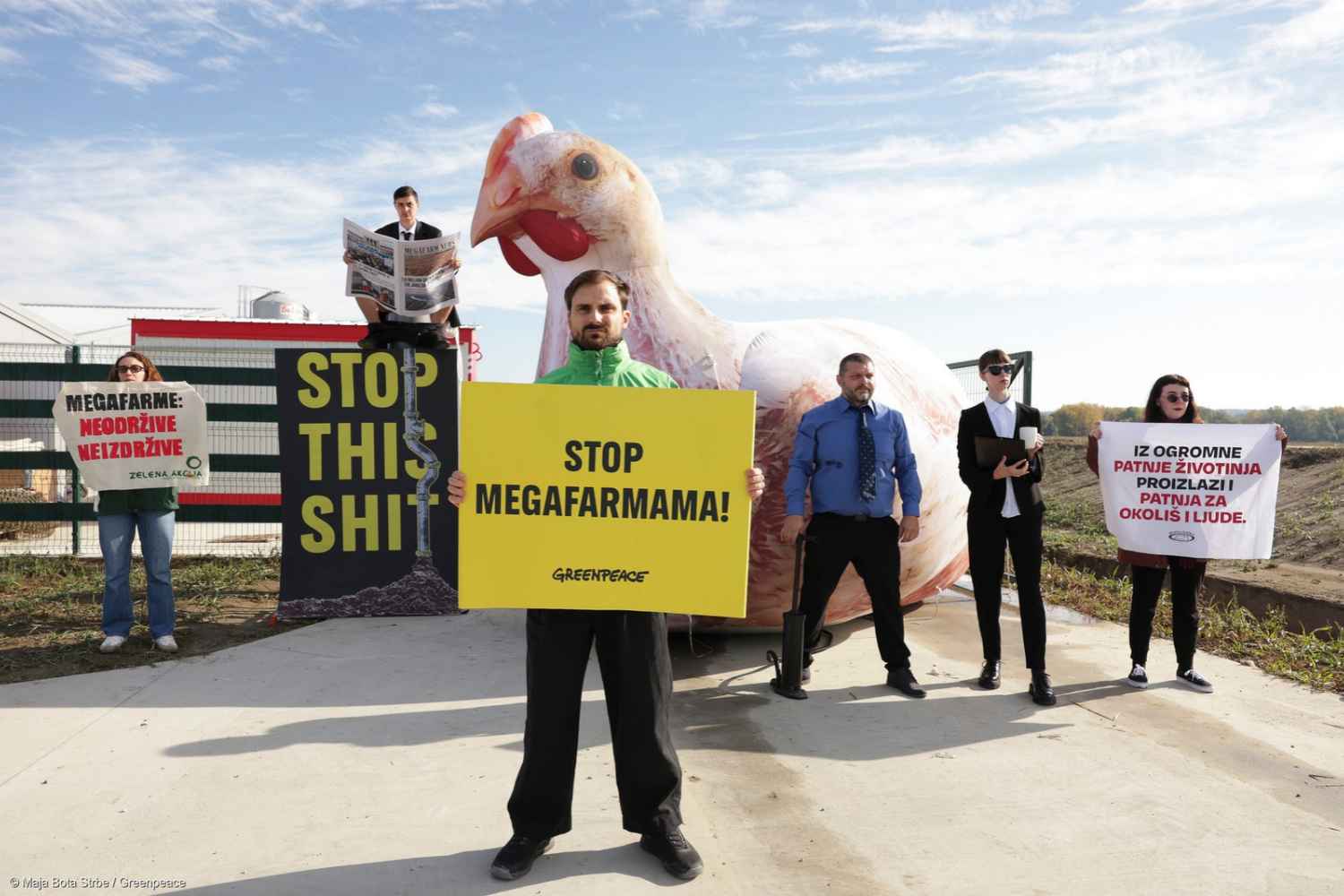
While Greenpeace activists scaled the warehouses to create the giant sign, other protesters from the Croatian environmental associations Zelena akcija (Friends of the Earth Croatia) and Prijatelji životinja (Animal Friends Croatia) blocked the entrance to the construction site.
An inflatable chicken three and a half meters high also appeared in front of the gates, while an activist sat on an improvised toilet: a provocation to denounce what the associations consider the indifference of the meat industry towards the concerns of local communities.
At the center of the mobilization is above all the problem of wastewater. According to estimates released by Greenpeace, the farm could produce around one million liters of liquid waste every year, with possible repercussions on the surrounding ecosystems.
The risk reported by environmentalists is that the substances contained in livestock waste, if not managed properly, could contaminate the land and reach waterways. This is not already confirmed pollution, but a threat which, according to the associations, should be assessed with particular attention given the proximity to a protected natural area.
The Amazon of Europe is a paradise of biodiversity
The Veliki Pažut reserve is part of the Mura-Drava-Danube cross-border Biosphere Reserve, a territory of approximately 930 thousand hectares distributed between Austria, Slovenia, Croatia, Hungary and Serbia.
Recognized by UNESCO in 2021 as the first biosphere reserve shared by five countries, it extends for approximately 700 kilometers along the Mura, Drava and Danube rivers. It is one of the last relatively intact large river systems in Central Europe.
The nickname of the Amazon of Europe is not accidental. Here rivers flow through alluvial forests, islands, wet meadows and ancient meanders, creating key habitats for hundreds of plant and animal species.
The area is home to one of the largest concentrations of nesting pairs of sea eagles in continental Europe and is a resting and refuge area for over 250 thousand aquatic birds. Its alluvial plains also contribute to the natural regulation of floods and the conservation of water resources.
It is precisely the fragility of this balance that makes the construction of an industrial farm in the immediate vicinity particularly controversial.
Industrial meat giants like MHP are expanding aggressively around the world, lining the pockets of billionaires while poisoning rivers and drinking water with toxic farm waste, reports Dániel Nyitray of Greenpeace International.
“Local communities everywhere are fed up, and today these activists have taken action to demand clean air, clean water, and a food system that feeds people, not corporate greed.”
The maxi farm is already in the testing phase: citizens are reporting bad smells
The protest does not come from nowhere, according to what was reported today in the Croatian press, the Veliki Pažut farm has already started an experimental phase of activity, despite not having yet obtained the definitive authorization for use.
The property is located just 320 meters from the protected bird reserve. Some residents report bad odors perceivable up to two kilometers away, while associations ask to suspend activities and review environmental impact assessments.
The case is part of a larger mobilization. In Croatia, citizens’ committees and environmental associations have been opposing 24 large livestock and slaughterhouse projects spread across four regions of the country for about two years. According to Zelena Akcija, pressure from local communities has already contributed to stopping twelve of them.
Chicken production continues to grow. And Italy is no exception
Behind this story there is a much bigger issue: the global expansion of the poultry industry. According to data reported by Greenpeace, since 2006 global poultry production has increased by almost 60%, reaching over 76 billion animals per year.
MHP, the group controlled by Ukrainian billionaire Yuriy Kosiuk, is one of the protagonists of this growth. The company slaughters over half a billion chickens every year and is strengthening its presence on the European market.
And in Italy the situation is not very different. According to Greenpeace, over the last twenty years the number of poultry animals raised has increased by approximately 56%, with an increasing concentration of production in large intensive plants, especially in the regions of the Po Valley.
A production model that raises questions not only on animal welfare, but also on waste management, ammonia emissions and the impact on water resources.
Greenpeace: «We need a law to stop the expansion of intensive farming»
The Croatian mobilization also brings the Italian situation back to the center of the debate, where Greenpeace, together with ISDE – Doctors for the Environment, Lipu, Terra! and WWF Italy, promoted the bill “Beyond intensive farming. For an agro-ecological transition of animal husbandry”.
Deposited in the Chamber in March 2024, the proposal provides for a moratorium on the opening of new intensive farms and the expansion of existing ones, as well as measures to support small farms and accompany the reconversion of the sector. Local communities are no longer willing to suffer the pollution produced by these giant meat factories, in Europe as in Italy, declares Simona Savini of Greenpeace Italia.
For this reason, together with other associations, we have presented a bill to the Chamber to immediately block the expansion of intensive farming and start an ecological transition in the sector. After more than two years of silence on the part of the Agriculture Commission, it is time for its discussion to be scheduled to start a serious discussion on the topic.
What is happening in Croatia, therefore, concerns us too. Because the problem is not just how many chickens can be raised in a shed, but how much land, how much water and how much pollution we are willing to sacrifice to continue producing meat on an industrial scale.
And when a facility of this size rises just a few hundred meters from a protected ecosystem, that question becomes even more urgent.
