
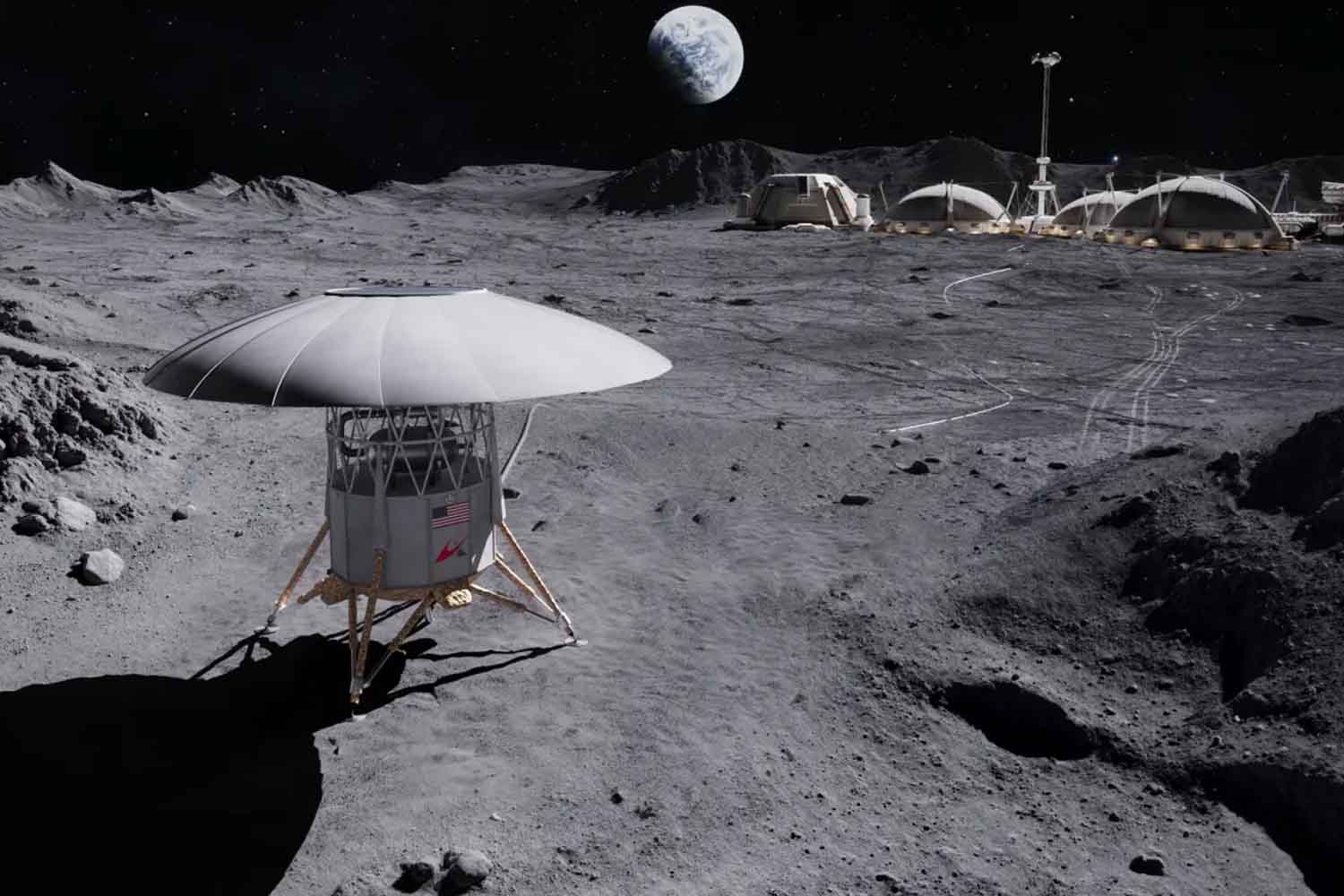
NASA and the US Department of Energy have signed a new agreement to jointly develop space-bound nuclear reactors and fuels. The timetable is already written: a fission-powered spacecraft should leave for Mars at the end of 2028; two years later, NASA wants to land the first nuclear fission reactor installed on the surface on the Moon.
The agreement, called “Accelerating American Leadership in Space Nuclear Power and Propulsion”, will formally come into force on November 1 and covers the entire supply chain: research, fuel production, testing, integration with launchers and space operations. NASA explicitly links the project to future stable human presence on the Moon and, later, missions to Mars.
There are two acronyms to remember. SR-1 Freedom it is expected to fly to Mars in 2028 to test nuclear electric propulsion. LR-1, Lunar Reactor-1is instead the reactor that NASA wants to bring to the lunar surface in 2030 to provide electricity to the future base near the South Pole.
First Mars, then the reactor on the Moon
The sequence seems reversed, but it has a logic. Before putting a reactor on the Moon, NASA wants to operate one in space without also adding the complications of a moon landing. The Space Reactor-1 Freedom mission will therefore be a huge flying testbed. According to the specifications published by the agency, the vehicle should use HALEU uranium and a Brayton cycle system capable of producing approx 20 kilowatts of electricity. The electricity will power Hall effect thrusters: that is, the reactor will not directly push the spacecraft like a thermal nuclear engine, but will produce current for the electric thrusters.
There will be no astronauts on board. SR-1 Freedom will carry SkyFall, a three-helicopter mission derived from Ingenuity’s expertise. NASA expects a first pass near Mars in 2029; the three aircraft should then enter the atmosphere and reach the planet after a second approach, in the autumn of 2030. They will have radar to study the subsurface, cameras and sensors to search for water ice and analyze areas useful for future explorations.
To buy time, NASA is also recovering a lot of already developed hardware. Last May the agency moved the SR-1 into the program Power and Propulsion Elementthe electric and propulsion module that was designed for the Lunar Gateway. In short, the piece already exists in large part: it definitely changes direction.
Why bring a reactor near the lunar south pole
A permanent base has a banal and gigantic problem: the power must be there even when the Sun disappears. On the Moon, dark periods can last for many days, and near the South Pole, the geometry of the illumination becomes even more complicated. There are also permanently shadowed craters, which are particularly interesting because they may preserve deposits of water ice. They are valuable places for exploration and terrible for asking photovoltaic panels to work overtime.
A fission system, on the other hand, can produce electricity independently of sunlight. NASA indicates habitats, communications, scientific instruments, rovers and systems to use the resources present on site among the possible uses of the future LR-1.
The reactor should fit into the new project Moon Basewhich NASA wants to progressively build near the South Pole. In the agency’s current plans, between 2029 and 2032 the first stable infrastructures for energy, communications, transport and logistics should arrive; from 2032 onwards construction of the actual permanent outpost would begin. The 2030 chosen for LR-1, therefore, is not a date placed at random on the calendar.
The lunar reactor, however, is still in the planning phase
A fairly important distinction is needed here. NASA has set the mission and deadline, but LR-1 is not yet a final design reactor. In published documentation for the SPARC program, the agency asked industry for solutions for a system of approximately 20 kilowatts of electricityalso assuming an eight-ton limit for the lander load. However, the same race still concerns the phase 1which must bring the projects up to the Preliminary Design Review, i.e. the preliminary review of the project.
In other words, the 2030 goal is very concrete; several technical details still have to emerge from the drawings and survive testing. American space nuclear power, moreover, is not born today. In the 1965 the United States launched SNAP-10A, still the only US fission reactor to have operated in space. Then it arrived in 2018 KRUSTYthe experiment of the Kilopower program with which NASA and the Department of Energy demonstrated on the ground the functioning of a small fission system intended for space missions.
In the years since, the agency has continued to work on lunar systems in the tens of kilowatt range. Now that path has stopped having a date generically placed “in the early 1930s”: the target is 2030. And four years, when it is necessary to build, qualify, launch and land a nuclear reactor on the Moon, is not exactly an eternity.
The race to the Moon is also a geopolitical race
The American choice is presented as technological, but the policy is written directly in the documents. The executive order signed by Donald Trump in December 2025 is titled “Ensuring American Space Superiority” and calls on the United States to have a lunar reactor ready for launch by 2030, along with the first elements of a permanent outpost on the Moon. The word “superiority”, in this case, does not require great interpretation exercises.
On the other side there is the International Lunar Research Stationthe China-led program with Russia among the key partners. According to the plan published by the Chinese government, the first configuration of the station is expected to be built in the lunar South Pole region by 2035. Same area, permanent infrastructure, resources to study and use. The new race to the Moon has fewer flags planted in the dust and many more cables to run.
Then there is the problem of fuel
SR-1 should use HALEUacronym for High-Assay Low-Enriched Uranium: uranium with a concentration of uranium-235 approximately between 5% and 19.75%, higher than that normally used in large traditional civil reactors. And it is precisely on this supply chain that the program encounters one of its terrestrial bottlenecks.
The Department of Energy recognizes that the commercial availability of HALEU remains limited in the United States. In 2025 Centrus produced approx 900 kilograms at the demonstration plant in Piketon, Ohio, as documented by the Department of Energy; in January 2026 the Government awarded new contracts to expand production capacity.
In September, however, the Government Accountability Office still noted the absence of large-scale commercial capacity in the United States for the enrichment of HALEU and indicated Russia and China as the only countries currently with infrastructure capable of producing it on that scale.
The American lunar nuclear program therefore already has two very visible dates: 2028 for SR-1 and 2030 for LR-1. Fuel, the industrial supply chain and a significant part of the hardware have to run fast enough to reach them. The reactor on the Moon, for now, lives in NASA’s programs, tenders and renderings. The first real test will come sooner, much sooner: in deep space, with Mars ahead.
