
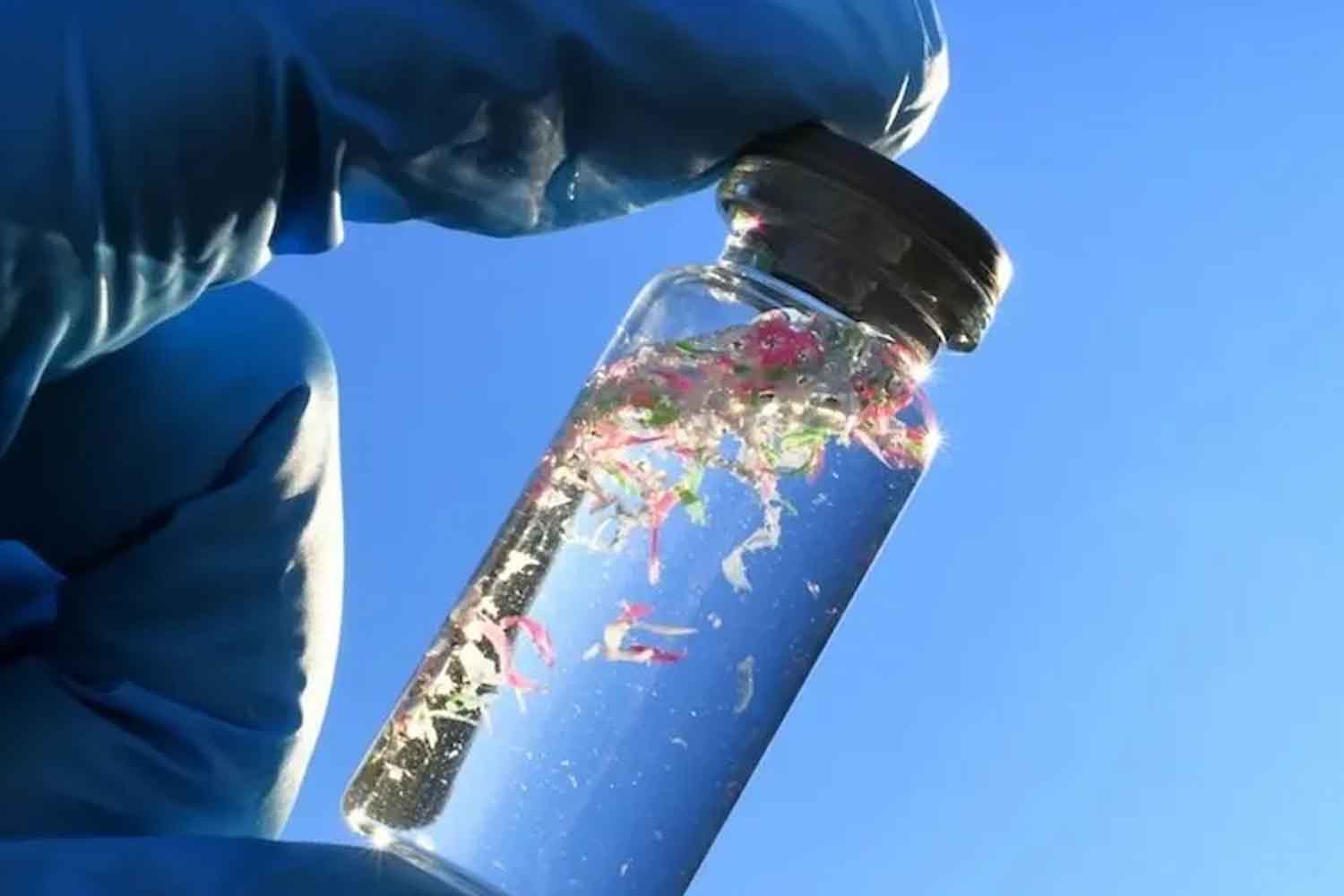
An orange dye, some water and polystyrene particles. After ten days the color had almost disappeared: around 90% of the substance had degraded. In the other solvents used for comparison, however, almost nothing. It’s one of the experiments with which a group of researchers discovered something rather inconvenient about microplastics: when they encounter water, their surface can become chemically active.
The study published on Naturecoordinated by researchers from Columbia University and the University of California at Berkeley, shows that some of the most common plastics spontaneously generate reactive oxygen species, including hydroxyl radicals. Extremely reactive molecules which, in experiments, have also been associated with damage to proteins and cells.
In short, plastic could do more than float, accumulate or transport substances on its surface. Once reduced into tiny fragments and immersed in water, that same surface participates in the chemistry that happens around it.
What happens when plastic and water meet
The researchers analyzed six widely used polymers: polypropylene (PP), polyethylene (PE), PVC, polystyrene (PS), PET and PMMA, the so-called plexiglass. In all six cases they detected the spontaneous production of radicals, albeit with very different intensities.
What seems to make the difference above all is hydrophobicity, that is, how much a surface tends to repel water. The more hydrophobic the plastic, the greater its chemical activity at the interface with water.
And this is where size matters a lot. When a piece of plastic fragments, it greatly increases the exposed surface area relative to its volume. A seemingly stable object becomes thousands or millions of particles with a much greater amount of surface area in contact with their surroundings.
Molecular simulations created by Teresa Head-Gordon’s group at Berkeley help explain the mechanism. Close to the hydrophobic surface of the plastic, the arrangement of the water and the electrical charges present at the interface make the transfer of electrons energetically more favorable. From this process, hydroxyl radicals, indicated with •OH, can be formed.
In simpler words: water doesn’t just wet microplastic. Under certain conditions, the meeting of the two creates a small zone that is chemically much more vibrant than previously thought.
The effects observed on proteins and cells
The trickiest part of the study came when the researchers tried to understand what this activity entailed in a biological system.
Charged molecules tended to accumulate on the surface of microplastics. Using lysozyme as a model protein, the team observed the formation of aggregates near polystyrene particles. When caffeine, used in the experiment as a substance capable of intercepting radicals, was added, aggregation was significantly reduced. Another clue to the role played by the reactive species generated on the surface.
Then came the mouse red blood cells. After contact with some microplastics, some of the cells showed changes in shape and release of hemoglobin, a sign of hemolysis. Again, the intensity of the damage followed the chemical activity measured for the different types of plastic quite closely.
These are important results, but the boundaries of the experiment must be kept clearly visible: we are talking about laboratory tests, model proteins and mouse red blood cells. The study identifies a possible mechanism through which microplastics can damage biological systems; it does not prove that drinking water from a plastic bottle automatically causes these effects in the human body.
The dose, particle size, surface area, exposure time and what happens to plastics in the real world remain crucial variables.
Plastic may need to be designed differently
However, the discovery calls into question a very comfortable assumption: considering plastics as substantially inert materials and focusing above all on the substances they can transport or release. Here the problem also arises from the surface itself.
According to the authors, understanding which characteristics make some plastics more reactive could help design materials with less problematic interactions with water. Columbia University, presenting the research, indicates surface chemistry as a possible way to develop safer plastics; in the article the authors also state that the university has filed a provisional patent application based on the work.
There is still a long way between a controlled experiment and a new generation of bottles, containers or packaging. But one thing is now harder to take for granted: When plastic gets small enough and encounters water, it may be much less passive than its appearance suggests.
