
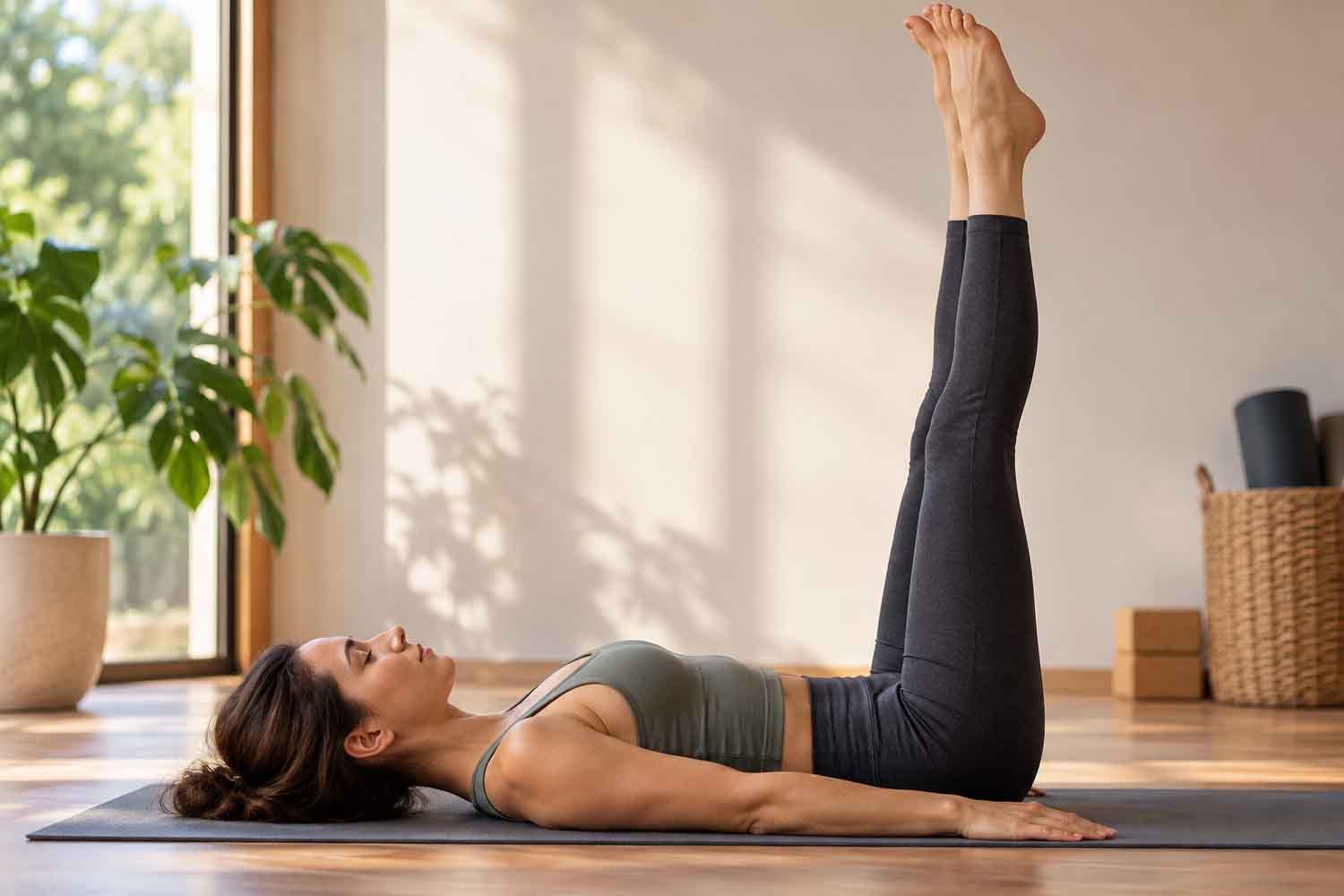
When lying down it almost seems too simple: legs up, legs down. Urdhva Prasarita Padasana starts from the supine position and brings the legs towards the vertical, and then brings them closer to the floor with control. Lifting them is the easy part. Keeping your pelvis still, keeping your lower back from arching, and continuing to breathe requires a lot more precision.
The position is often included in the big cauldron of “abs exercises”. Biomechanics tells something more interesting: the hip flexors, including the psoas, work a lot during the movement, while the abdominal muscles contribute above all to controlling the trunk and pelvis.
What happens when we lift our legs
An electromyographic study of nine healthy men analyzed the active straight leg raise, a biomechanically similar straight leg raise to a portion of the movement performed in the asana. The activation of the psoas major progressively increased during hip flexion and reached the highest values in the final phases of lifting and maintaining the position. The internal oblique and transversus abdominis also increased their activity, contributing to the control of the trunk and pelvis. The sample was tiny and made up only of men: enough to understand the mechanism, decidedly little to transform it into a universal law.
The psoas major originates in the lumbar area, crosses the pelvis and reaches the femur. When the legs are lifted off the ground it then goes directly into the hip flexion work. The abdominals have another important job: to prevent the movement of the legs from dragging the rest of the body with it.
This is also shown in biomechanical research on the active straight leg raise conducted on 14 people without lower back pain: increasing abdominal activation made the spine more stable and reduced lumbar rotation during leg lifting.
It’s precisely that slightly ungrateful feeling that comes when your legs start to go down. The closer they get to the floor, the more difficult it becomes to prevent the back from lifting and all the work from ending up where it shouldn’t.
How to try it without arguing with your lumbar area
To start, you can use a wall. While supine, bring your heels to the wall while keeping your legs at an angle; from here you bend your knees towards your chest and, as you exhale, straighten your legs upwards. Then descend slowly, stopping before control of the pelvis is lost.
@AI generated
The wall also serves as a brake. As you get closer, the corner becomes less challenging; by moving away, the legs can lower more and the work increases. If the hamstrings pull, there is no point in chasing the perfectly vertical and tense leg at all costs. A slight bend in the knees makes the movement more accessible.
The useful signal comes mainly from the back. If your lower back arches noticeably, your pelvis begins to move, or you have to hold your breath to complete the descent, the angle you choose is probably too challenging. The floor does not award medals to those who can get closest with their heels.
For those who have significant back problems, pain during movement or an already diagnosed pathology, it is better to avoid experiments and adapt the position with a qualified teacher or healthcare professional. Even in studies on yoga for back pain, the side effects observed were mainly temporary increases in pain, a good reason to distinguish gradual practice from competition with oneself.
And concentration?
A fairly clear boundary is needed here. We have no evidence that Urdhva Prasarita Padasana, taken alone, improves concentration or produces any particular effect on the nervous system. The mental work of the position arises above all from the need to simultaneously follow the breath, pelvis, legs and muscular tension.
On the more general relationship between yoga and body awareness, however, some data exists. A systematic review published in 2025 collected 33 studies on yoga interventions: among those comparing yoga and control groups, about three-quarters reported favorable results on body awareness. However, the authors describe the evidence as still mixed and call for more rigorous studies and larger samples.
So yes, this asana can become a small exercise in paying attention to the body. Without the need to attribute to it mysterious powers on digestion, internal organs or the “energy” of the psoas that scientific research, at the moment, cannot promise. There remains an elementary movement on paper: two legs going up and down. Then you try to do it while keeping your pelvis, back and breathing in place. Suddenly the floor becomes very educational.
