
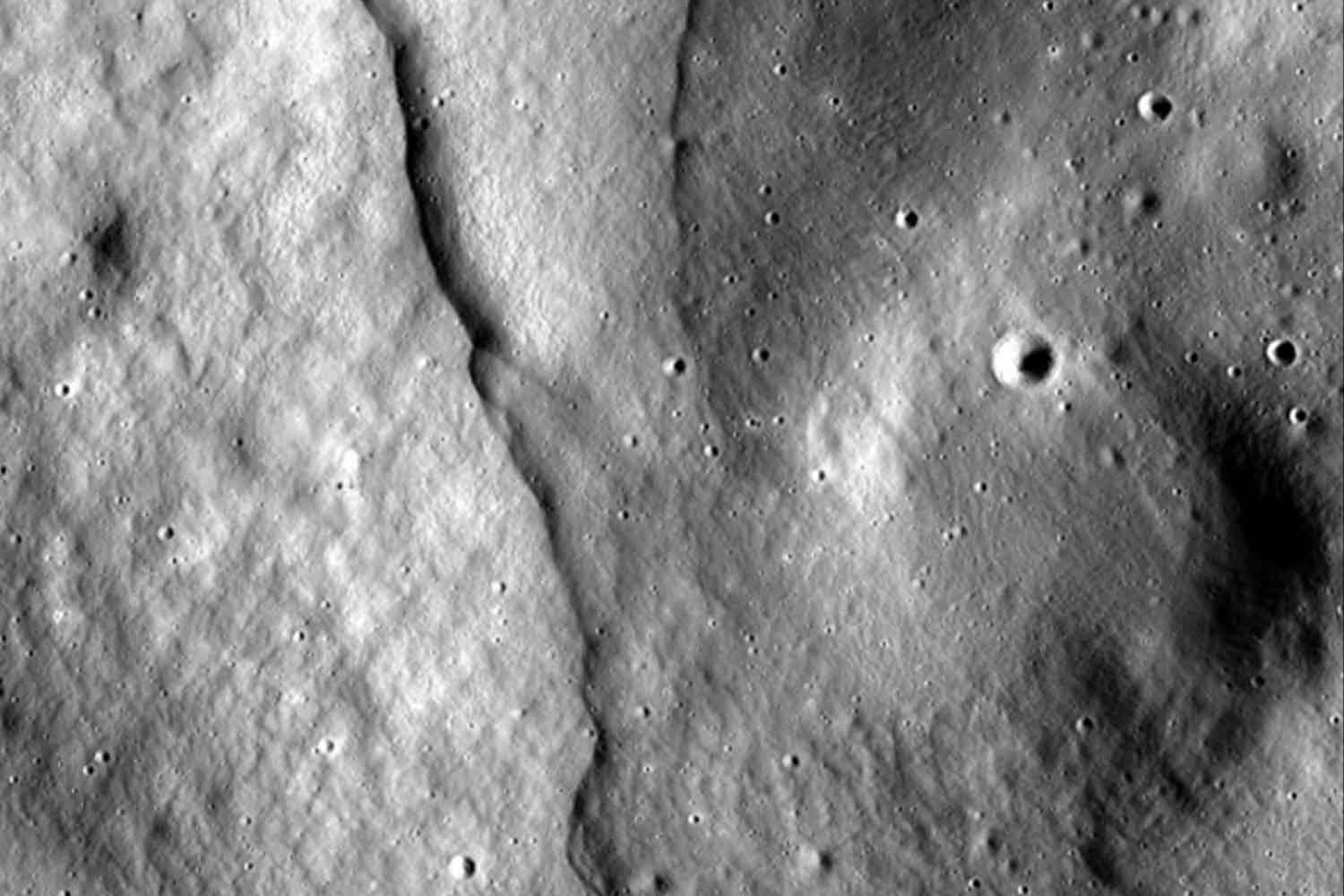
Forty-five meters in hundreds of millions of years. That’s how much the Moon’s radius would have lost as its interior slowly continued to cool and contract. The figure comes from a new study published in The Planetary Science Journalwhich he mapped further 10,000 young faults distributed on the surface of our satellite.
In short, the Moon is shrinking. Very, very slowly. By spreading the estimated contraction over the time interval considered by the authors, approx 6-11 centimeters every million yearsthat is, just 0.06-0.11 micrometers per year. It is an average velocity derived from accumulated strain in the crust, not a direct measurement of actual contraction. And it is a small distinction only in appearance.
Leading the work is Thomas R. Watters, scientist emeritus of the Center for Earth and Planetary Studies at the Smithsonian National Air and Space Museum, together with Maria Banks, Cole Nypaver and Mark Robinson. The authors worked on images collected by the Lunar Reconnaissance Orbiter Camera, which has been observing the lunar surface for over 17 years from NASA’s LRO mission. Millions of images which, one fault after another, have made it possible to reconstruct a much more widespread contraction than appeared a few years ago, as the Smithsonian explains in the presentation of the research.
The Moon has lost about 45 meters of radius
The mechanism starts far below the surface. The interior of the Moon still retains heat, but continues to slowly lose it. As the satellite cools, it decreases in volume and its rigid crust must accommodate that contraction. It can’t just crumple gracefully. In some places it breaks and a block of crust is pushed over the neighboring one, forming reverse faults and slopes that can rise tens of meters.
Among those analyzed in the study are, for example, the Pitiscus escarpment, with a maximum relief of around 56 metres, that of Fowler, around 45 metres, and that of Mouchez, which reaches around 116 metres. Their distribution reveals a deformation that practically affects the entire satellite. The new estimate puts the decrease in the moon’s radius at approximately 45 meters in the last 400-800 million years. A tiny amount compared to the approximately 1,737 kilometers of the Moon’s radius, but enough to leave thousands of scars on the surface.
Over 10,000 young faults
The map constructed by the authors contains more than 10,000 young faults. Watters admitted that their number is much higher than he imagined and believes it is plausible that, as the interior continues to cool, some faults continue to grow and others may still form.
Young, of course, should be read with the calendar of a celestial body. Previous studies on the lunar slopes had already indicated geologically recent structures, some with evidence of activity in the last tens of millions of years.
And here comes the lunar earthquakes. Between 1969 and 1977, seismometers left behind by the Apollo missions recorded 28 shallow earthquakes. In 2019, Watters and colleagues reanalyzed that data: eight events were compatible with the location of young faults and six occurred when the Moon was near apogee, where tidal stresses due to Earth’s gravity can help push an already stressed fault towards slip. This is explained by the study published in Nature Geoscience and NASA’s analysis of lunar earthquakes.
This means that the Moon can still be tectonically activeeven if its functioning is very different from that on Earth. On our planet, most earthquakes are linked to the margins of tectonic plates. The Moon does not have a global system of moving plates comparable to ours: contraction can therefore produce faults scattered across very different regions of the surface.
Some areas of the moon appear more stable than others
The faults, however, are not all distributed in the same way. Comparing their location with maps of the thickness of the lunar crust, the authors found fewer structures in regions where the crust is thicker. The study also proposes an explanation for a quirk of the Moon’s geological history: widespread contraction appears to have occurred relatively late. A very thick, porous and fractured ancient crust may have long functioned as a sort of thermal blanket, slowing the dispersion of internal heat and therefore contraction. Understanding where lunar faults and earthquakes are concentrated is of great interest even outside of planetary geology manuals.
A 2024 study dedicated to the lunar south pole, one of the central regions of human exploration programs, showed that a sufficiently strong surface earthquake could produce significant shaking and encourage landslides of the regolith, the layer of dust and rock fragments that covers the surface. The authors therefore invited seismicity to be considered when choosing sites for any permanent infrastructure.
No alarm, however, for what we see from Earth: 45 meters spread over hundreds of millions of years do not appreciably change either the appearance of the Moon or the tides. For those who one day will have to place modules, instruments and habitats on the lunar soil, those few centimeters every million years are almost irrelevant. The thousands of faults they leave behind, decidedly less so.
