
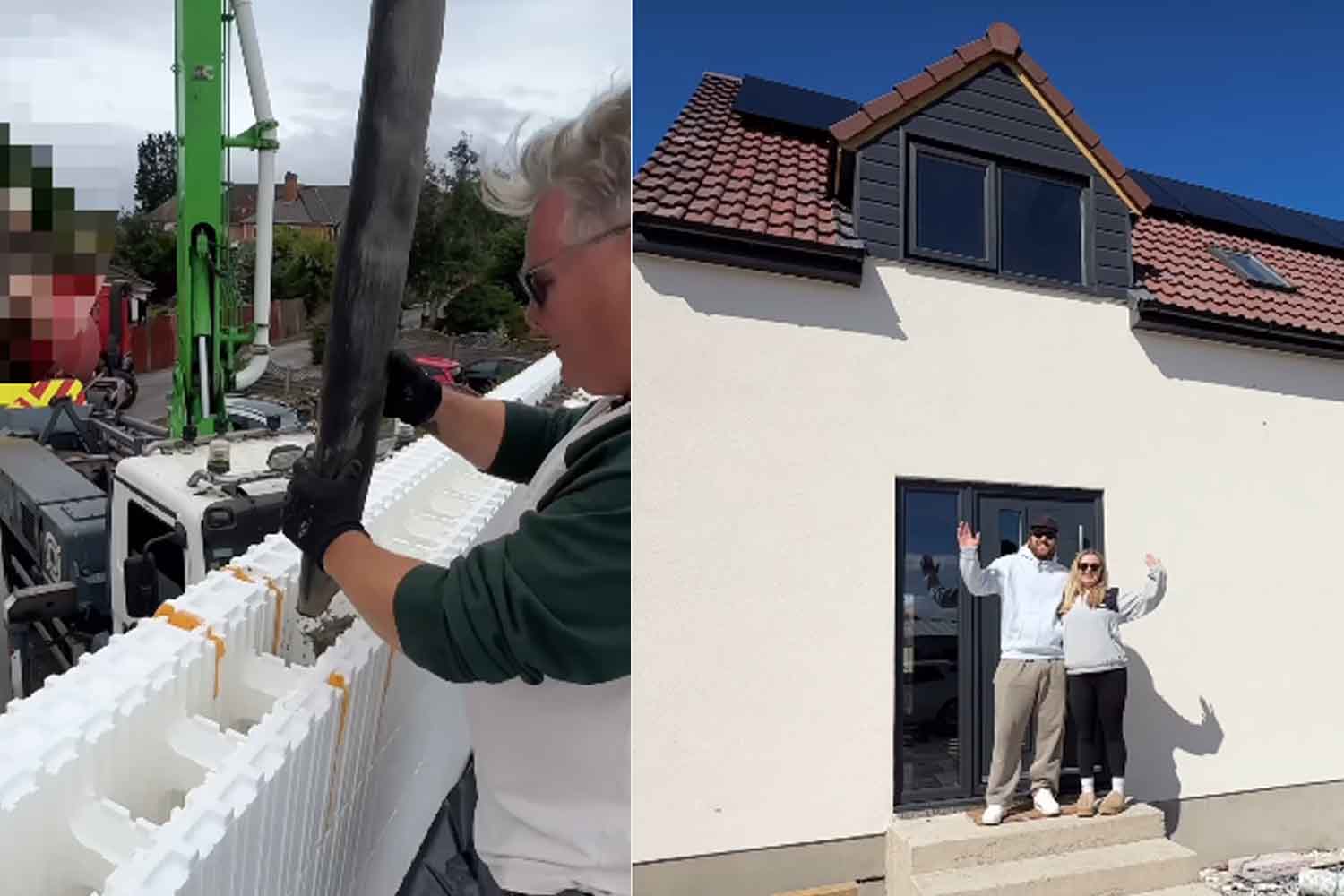
At 26 years old, Hannah and Charlie Bird are putting the finishing touches on a 140 square meter house that, for around 80% of the work, they built with their own hands. It happens in Burnham-on-Sea, a town in Somerset overlooking the Bristol Channel. The bill indicated by the couple is around 190 thousand pounds, just over 220 thousand euros. According to Hannah’s estimates, working on their own would have allowed them to save around 100 thousand, equivalent to over 115 thousand euros.
What makes the construction site very different from that of a traditional English house are above all the walls. From a distance they appear to be assembled with giant white bricks. They are ICF blocks, a system that uses insulating elements in expanded polystyrene to be stacked without mortar and subsequently filled with concrete. So no, the house isn’t exactly “made of Styrofoam”. Fortunately.
Instagram – @thattravelcouple
Inside the blocks there is concrete
ICF means Insulated Concrete Formwork. As the UK’s Insulating Concrete Formwork Association explains, the blocks are made of two layers of insulating material, often expanded polystyrene (EPS), with a central cavity. They are fitted together, reinforced where necessary and then filled with concrete. Once hardened, the material forms the load-bearing structure, while the formwork remains in place and becomes the internal and external insulation of the wall. Hannah commented on her experience like this:
It’s like Lego, it’s idiot-proof. What took a bricklayer a week, the two of us together could do in an hour.
A decidedly enthusiastic evaluation, referring to their experience, which illustrates how much the system has simplified the assembly of the walls. The couple met ICF in December 2023, during a fair dedicated to construction, after having already purchased a plot of land of approximately one thousand square meters for 70 thousand pounds in June 2022.
Other hypotheses had arrived before, explains Hannah:
We’ve always wanted to renovate, but here the houses to fix cost 200 thousand pounds and didn’t even have a roof.
Buying a new house in the area meant, according to prices collected by the couple, starting from around £375,000 for two bedrooms. Also complicating the choice were the less than encouraging experiences of friends and acquaintances with newly built homes, where some problems had already appeared in the first weeks. So they chose to build.
Two years of work, including excavations, concrete and tutorials
Before even putting up the blocks, Hannah and Charlie had to clear and fence the land, arrange access to the property and take care of connections to the electricity and water networks. Operations that required months of work, far from the simplicity of interlocking bricks.
To create the walls they sent the plans to the supplier company, which calculated the necessary material and sent a technician on site to show how to use the system. They learned the rest along the way.
We spent so much time on Instagram and TikTok because we kept asking ourselves: Are we doing this right?
After all, seeing someone put up a wall on the screen is one thing. Finding yourself actually doing it, knowing that it will become your bedroom wall, is another. The result, according to the couple’s story, was nevertheless surprising: in just a few days the walls had already reached one of the first heights foreseen by the project.
The savings lie above all in do-it-yourself
The figure of £100,000 saved is an estimate by the couple, based on the costs they believe they have avoided by building much of the home themselves, and not the result of an independent comparison between two identical building sites. Hannah estimates she has saved around £30,000 on labor alone. The total cost declared for the project comes to around 190 thousand pounds.
The economic advantage derives above all from the possibility of carrying out work directly which, in a traditional construction site, would require the intervention of professionals. In short, polystyrene does not magically transform an expensive house into an affordable one. The British industry association itself explains that ICF materials are generally more expensive than some traditional systems. Savings can come from faster installation, less use of heavy equipment and reduced hours of specialized labor.
View this post on Instagram
For a couple willing to do much of the work themselves, that difference becomes quite real. Of course, some phases still require professional skills, structural checks and compliance with building regulations.
Insulating yes, zero impact no
The system also brings an advantage on the energy front. The insulation layer remains continuous along the wall and the structure can achieve high levels of insulation and airtightness, reducing the amount of energy needed to heat or cool the building. The Insulating Concrete Formwork Association also highlights the possibility of reducing construction waste and improving energy efficiency during the use of the home.
In their two years of work they obtained 140 square meters, two bedrooms, a study, a garage and an eight-space car park. An area which, according to the real estate prices collected by the couple in the area, would have cost significantly more if they bought a new house. Hannah, who works as a travel blogger, and Charlie also talked about the progress of the project on social media, sharing the progress and difficulties of an experience that transformed them, at least for a couple of years, into builders of their own house.
