
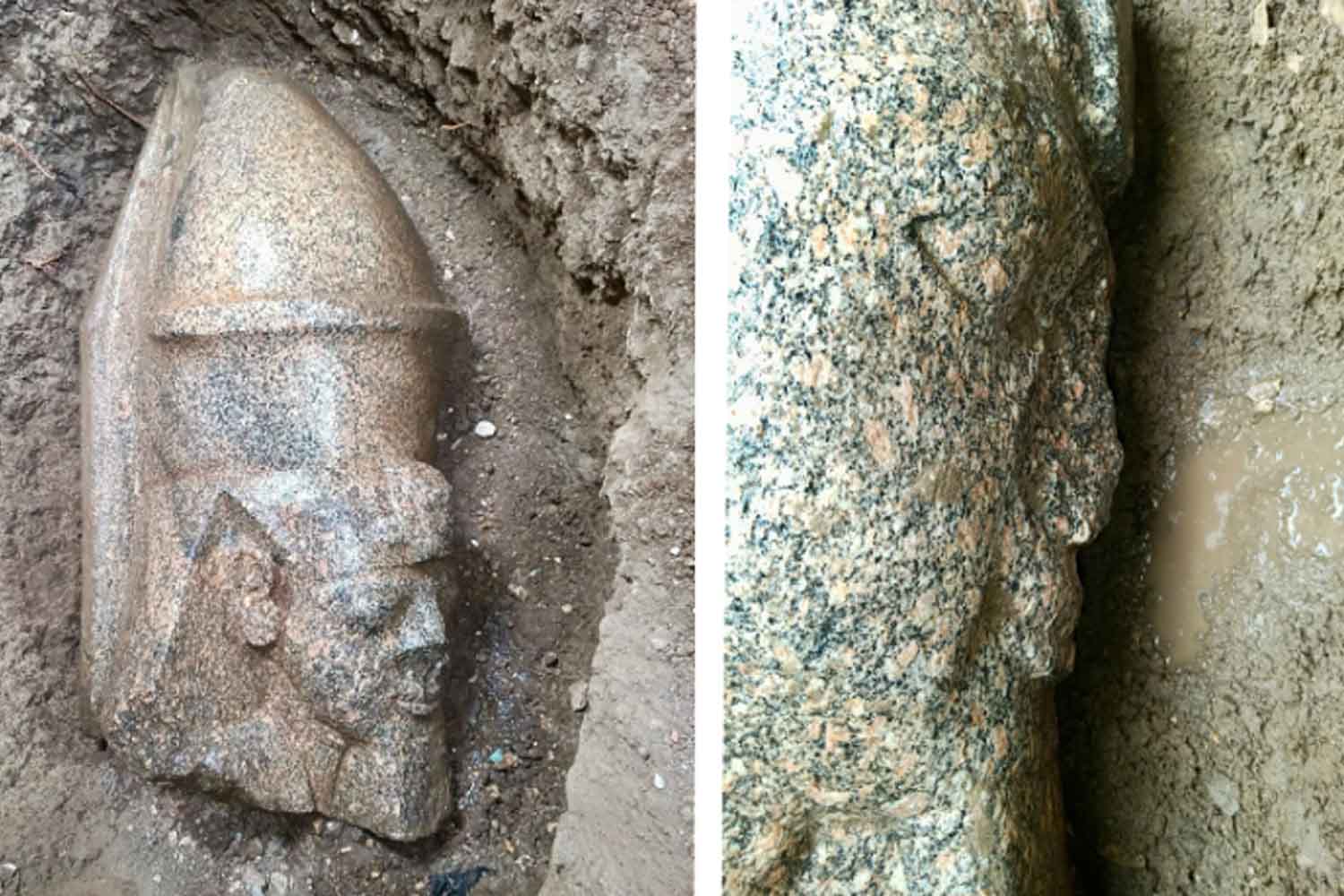
Khaled al-Shahat Khalil was working a piece of land in front of his house in the Egyptian village of Behbeit el-Hagar when he noticed a stone with some engravings. He could have moved it, ignored it, continued working. He called archaeological inspectors instead. From that report they emerged with their heads held high 1.60 metersthe remains of a second royal statue and a block of pink granite with the titles of Ramesses II.
The discovery was announced by Egyptian Ministry of Tourism and Antiquitiesafter emergency excavations initiated by the Supreme Council of Antiquities. Archaeologists certainly attribute one of the two statues to Ramesses II; the second, due to the characteristics and similarities of the face, is also probably considered a representation of the pharaoh himself.
A 1.60 meter head for a statue perhaps 8.5 meters tall
The most spectacular piece is difficult to confuse with an ornament. The head of Ramesses II measures approx 1.60 meters tall and shows the double-crowned ruler of Upper and Lower Egypt. Next to it, the remains of the upper part of the statue’s rear pillar emerged, inscribed with the pharaoh’s name Horus, “Hor Ka Nakht Mery Maat”.
It is above all the size of the head that gives the measure of what is missing. According to Hisham El-Leithy, secretary general of the Supreme Council of Antiquities, the complete statue, including the base, it may have reached around 8.5 metres. The conditional is useful: archaeologists have important fragments, not the colossus recomposed before our eyes. The original height is an estimate obtained from the proportions of the find.
A good part of one appeared not far away second royal statue approximately 2.40 meters long. Missing legs, base and an upper portion of the nemesthe characteristic pharaonic headdress. The face, however, is preserved well enough to show similar characteristics to those of the first statue. For this reason, scholars believe that this figure could also represent Ramesses II.
The pink stone that started it all
The discovery had begun with something far less monumental: a block of pink granite approximately 1.30 meters long. It was located about a meter north of the second statue and preserves hieroglyphic inscriptions with two titles associated with Ramesses II: “Nesw-Bity”, i.e. “King of Upper and Lower Egypt”, and “Sa-Ra”, “Son of Ra”.
When Khaled al-Shahat Khalil found it, he notified the relevant archaeological inspectorate. The officials carried out the first inspection, recognized the possible archaeological value of the block and started the required procedures. From there the rescue excavations began which led to the major finds.
The area, after all, already had a lot to tell. Behbeit el-Hagar is located in the governorate of Gharbia, in the Nile Delta, and is an archaeological site known above all for the remains of a large temple dedicated to the goddess Isiswith numerous architectural elements in granite. The new statues therefore add material to an already important place, without allowing us to establish for now what exactly their original context was.
The excavations will continue precisely to reconstruct the relationship between the finds, understand the nature of the structures present and study the architectural evolution of the area. The Ministry talks about clues that could lead to other discoveries, but to find out what’s really underneath we’ll have to keep digging. Archaeologists, fortunately, work better than prophecies.
The farmer was rewarded for calling the authorities
The story also had a rather concrete sequel. Egyptian Minister of Tourism and Antiquities Sherif Fathy personally went to the village to meet Khaled al-Shahat Khalil. According to the official communication from the Ministry, he and his wife received a certificate and a trip to perform the Umrah, the Islamic pilgrimage to Mecca. The recognition was motivated by the speed of reporting and the choice to hand over the find to the competent authorities.
The less flashy part of the discovery is perhaps all there. The first find did not come from an archaeological mission, from a radar or from some documentary technology. It appeared during daily work on agricultural land. The rest arrived because whoever had it in front of them decided not to take it home. Now, beneath that field, archaeologists continue to search. A five foot tall head has already come out. It’s hard to argue that the pink stone was just a stone.
