
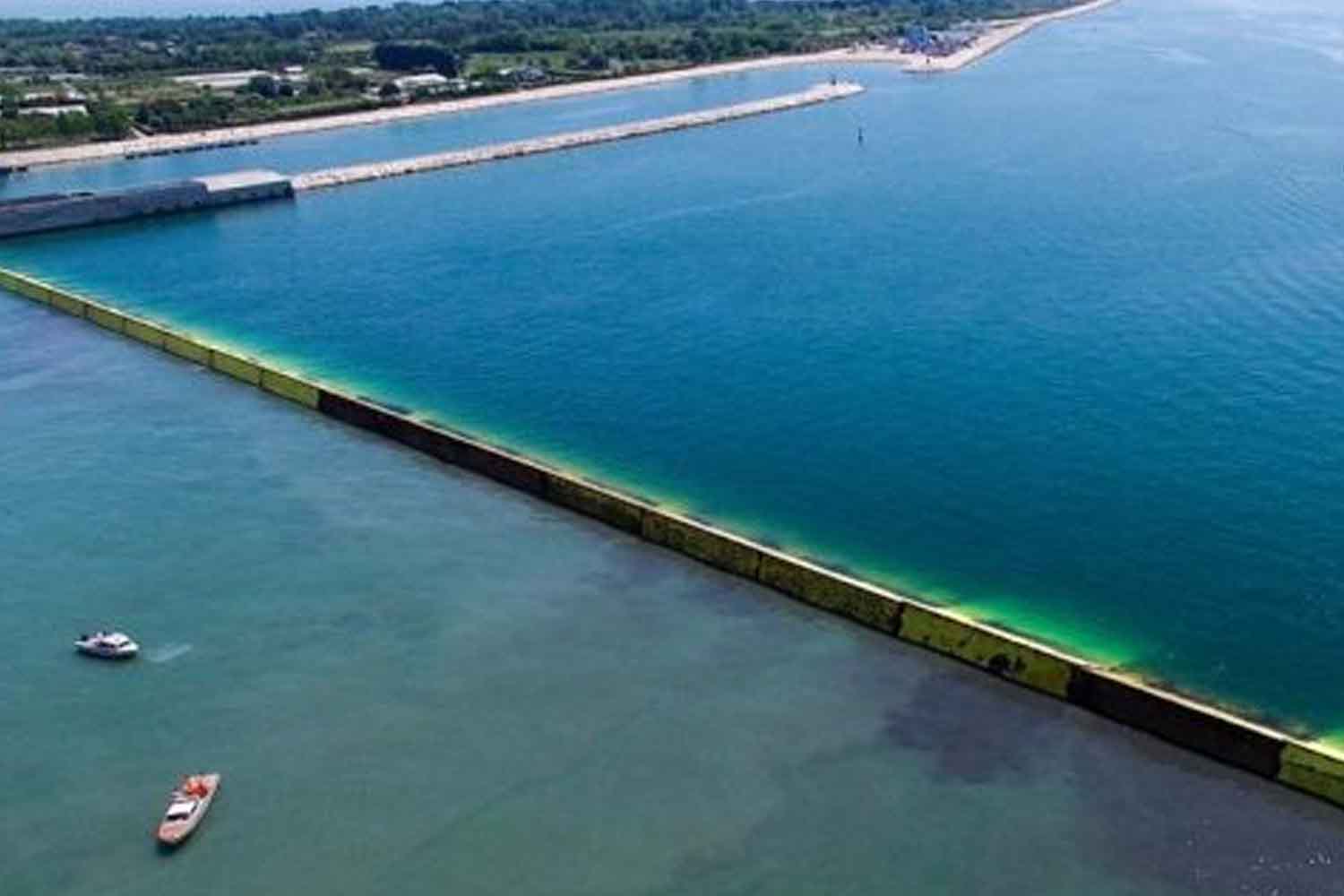
Two hundred and forty-eight days a year with the mouths of the lagoon closed to the sea. It is the most critical scenario calculated for Venice by the end of the century: the MOSE could have to operate for almost two days out of three, protecting the city from high water and leaving less and less time for the lagoon to renew its waters. The sea would remain outside. With him, however, also a good part of the natural exchange that keeps this ecosystem in balance.
This was calculated by a study by the National Institute of Oceanography and Experimental Geophysics (OGS), published on 9 October 2026 in the scientific journal Scientific Reports. Simulations show that as sea levels rise due to climate change, closures of mobile barriers could become so frequent that water circulation could significantly slow down. In the worst case, more than a third of the lagoon would take more than 20 days to renew. A rather complicated prospect for a work that has the task of defending Venice from water.
The MOSE could remain closed almost two days out of three
The MOSE is made up of 78 mobile gates, distributed in four barriers at the three port inlets of Lido, Malamocco and Chioggia. Normally they remain lying on the seabed, allowing the Adriatic Sea to exchange water with the lagoon. When a particularly high tide is expected, they rise and prevent sea water from entering.
The system has demonstrated its ability to protect Venice from flooding. The question is how often it will be necessary to activate it in the coming decades. In fact, with the sea rising, even an ordinary tide can reach levels sufficient to require the closure of the barriers. And what today represents a temporary intervention risks becoming an increasingly habitual condition.
To understand how much, the researchers used a model that reproduces the circulation of water in the lagoon, applying it to two climate scenarios: one with lower greenhouse gas emissions (RCP4.5) and one with high emissions (RCP8.5). They then compared two periods, from 2045 to 2049 and from 2095 to 2099, simulating conditions with the MOSE operational and without its closures.
In the most critical scenario, the one with high emissions, by the end of the century there would be approximately 248 days of closure per year. They are projections linked to precise climatic hypotheses, of course, and not a pre-written calendar. But they convey the dimensions of the problem well.
A third of the lagoon could take more than 20 days to renew its water
The Venice lagoon lives thanks also to continuous exchanges with the Adriatic. Tides move water in and out, transport nutrients, help disperse pollutants and regulate environmental conditions in different areas.
When the gates are raised, this movement is interrupted or severely limited. A closure for a few hours is one thing. Repeating this for most of the year is another thing entirely. The researchers measured the so-called water renewal timei.e. the time necessary for the water present in a given area to be replaced through lagoon circulation.
In the most extreme conditions simulated, over a third of the lagoon surface would require more than 20 days for water renewal. Such a prolonged stay can favor the accumulation of nutrients and contaminants, creating conditions more favorable to the proliferation of algae and a reduction in available oxygen.
Be careful, though: the study measures the slowdown in water exchange, without demonstrating that those areas will necessarily become deprived of oxygen or that fish deaths will occur. There are possible ecological consequences of increasingly limited circulation, which must be evaluated together with the other factors that influence water quality. The risk, in short, concerns a balance that depends on continuous movements, even when from the surface they seem almost imperceptible.
The lagoon could exceed 30 degrees for more than three months of the year
Added to the increasingly frequent closures is the heat. And on this front the projections are equally worrying. In the high emissions scenario, simulations indicate water temperatures above 30°C for more than three months of the year, accompanied by frequent and prolonged marine heat waves. The MOSE can stop the high tide, but of course it cannot lower the temperature of the lagoon.
Warmer waters and slower turnover are a tricky combination. As the temperature increases, all other conditions being equal, the maximum quantity of oxygen that can dissolve in water decreases. Meanwhile, the reduced circulation can make it more difficult to disperse the substances arriving from the rivers, discharges and activities present in the lagoon basin.
The effects will depend on local conditions, the amount of nutrients and pollutants present and the response of organisms. But it is precisely the overlap of these phenomena that worries the researchers: the warming affects the water while the closures of the MOSE progressively limit its movement. A double stress for an environment that is home to salt marshes, shallow waters, seagrass meadows and numerous animal and plant species.
With fewer emissions, the effects would be roughly halved
The research also contains a less gloomy result, and it depends directly on greenhouse gas emissions. In the RCP4.5 scenario, characterized by lower emissions than the worst one, the simulated impacts are approximately halved overall. The frequency of closures, the slowdown in water exchange and the intensity of water heating change.
The difference is important because it shows how much the future conditions of the lagoon depend on the evolution of the climate. The barriers remain the same, while the amount of time you will need to use them changes.
The authors of the study therefore indicate the need to combine the global reduction of emissions with local adaptation measures, capable of limiting the effects of increasingly prolonged closures. The research does not identify a single ready-made solution: it highlights the problem that future management strategies will have to address.
Venice will continue to need protection from high water. The MOSE was built for this reason and the simulations confirm its effectiveness in containing the rise of water within the lagoon.
But there is a huge difference between closing the barriers during an exceptional tide and having to do so for 248 days a year. In the second case, for almost eight months, the natural exchange with the Adriatic would be severely limited. And the sea from which Venice must defend itself is also what its lagoon needs to continue to live.
