
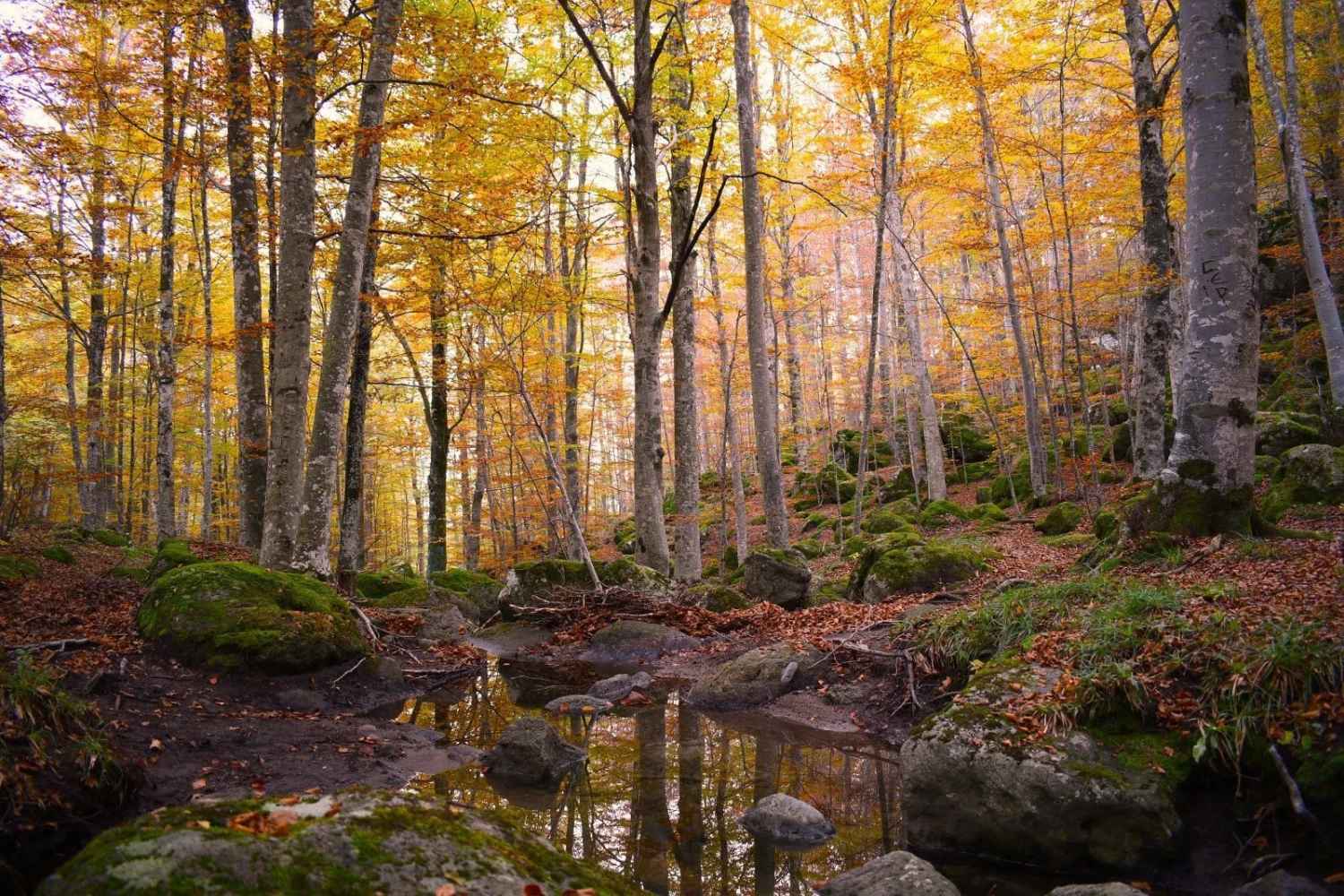
There are places in Tuscany that we all know, and others that still manage to surprise us. Monte Amiata belongs to the second category. Far from the postcard hills of the Val d’Orcia and the most popular art cities, this ancient volcanic mountain preserves a landscape made up of woods, small villages and roads that climb between chestnut and beech trees.
We went to discover it in autumn, when the vegetation begins to change color and the beech woods transform into a mix of yellow, orange and copper shades. It is precisely the forest that makes this part of Tuscany special.
Mount Amiata reaches 1,738 meters and is located between the provinces of Siena and Grosseto. A mountain that lends itself to being explored slowly, without necessarily undertaking long excursions: a few hours are enough to immerse yourself in the beech forest, while those who love walking can choose more challenging itineraries.
Inside the beech forest of Monte Amiata
The first thing that strikes you upon entering the beech forest is the size of the trees. The trunks of the beech trees rise almost vertically, allowing light to filter through the branches. On the ground, a layer of leaves covers the paths, interrupted here and there by emerging roots and volcanic rocks.
The landscape changes as you go up, at lower altitudes you encounter mainly chestnut trees, while higher up the beech trees dominate. In autumn this difference becomes particularly evident, with colors varying even at a distance of a few hundred metres.
One of the most interesting places to explore is the Macchia Faggeta, on the Abbadia San Salvatore side. It is a large wooded area managed by a historic local company, which deals with the protection of the forestry heritage and its valorisation.
Here among the vegetation you come across springs, boulders of volcanic origin and traces of the history of a mountain which for centuries has represented a fundamental resource for local communities.
Where to go to see the foliage: the routes that are worth knowing
To organize an excursion in the beech forest, one of the most convenient reference points is the Primo Rifugio Amiatino, reachable by car from Abbadia San Salvatore following the road that climbs towards the summit.
From here several paths start that allow you to immediately enter the woods. It is also an interesting solution for those who have little time and want to dedicate only part of the day to walking.
Among the possibilities is the Sasso de’ Merchi route, a ring of approximately 2.8 kilometers that crosses the beech forest and passes near Fonte Barbara. Along the way you also come across an ancient inscription on a rock, dated 1876, testimony to the history of the woodland properties of Monte Amiata.
For those who prefer a short itinerary, there is also the short ring of the cross-country track, which can be covered on foot when there is no snow. It extends for approximately 2.25 kilometres, with a limited height difference of 65 metres. The longest variant reaches 5.35 kilometres.
Those with more experience can consider the Scalettaia path, which climbs towards the top of the mountain through steeper sections, or the Fosso di Rigale, one of the itineraries that cross the Macchia Faggeta.
Our advice is not to necessarily focus on conquering the summit. In autumn, some of the most interesting views are found right inside the forest, where the beech trees create a continuous covering over the paths.
Cross the beech forest by bicycle: MTB routes between woods and refuges
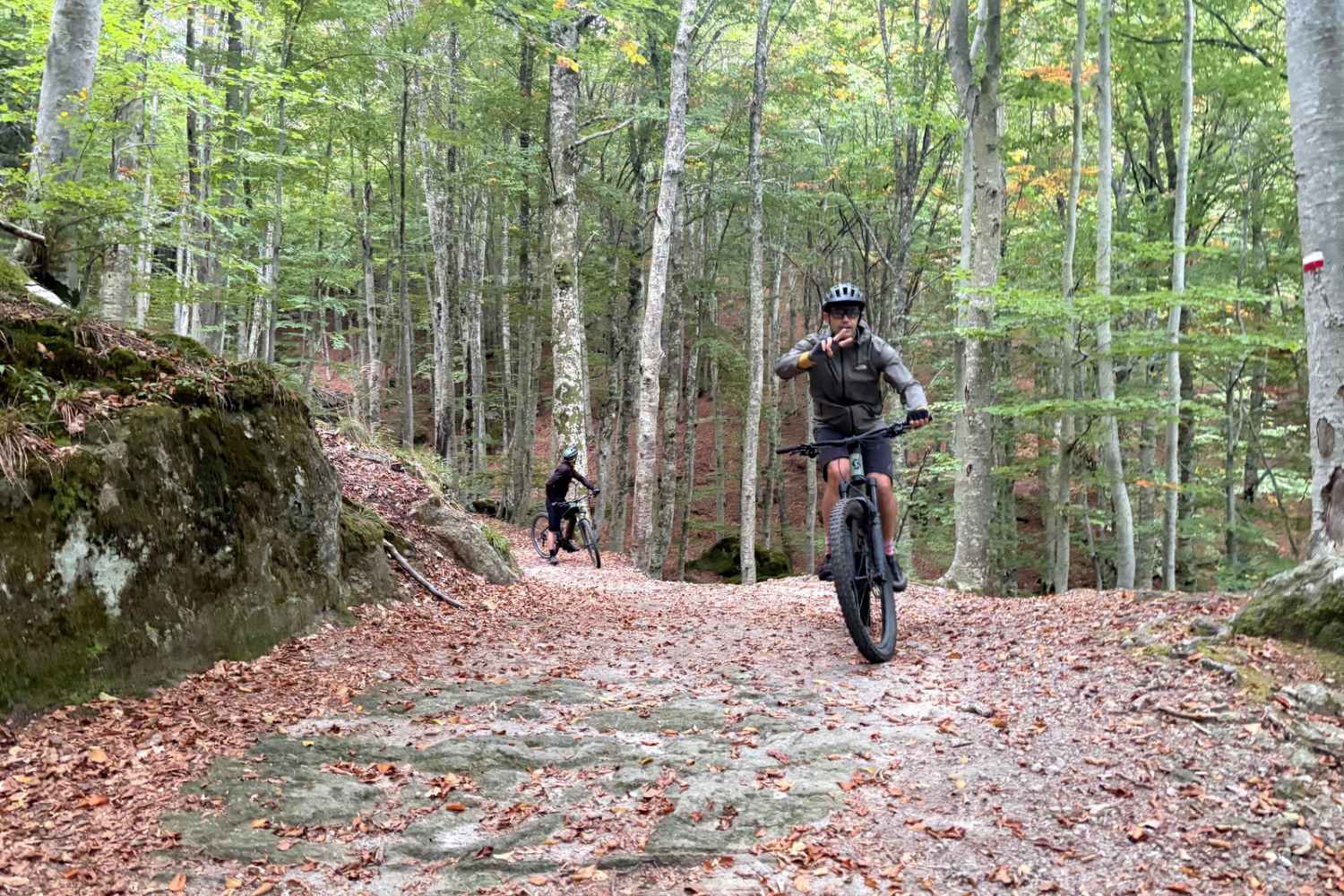
Monte Amiata is also a destination for mountain bike enthusiasts. In Prato delle Macinaie there is the Amiata Freeride Bike Resort, with routes that cross the mountain woods and activities for different levels of experience. They range from educational areas, where children and beginners can learn basic techniques, to enduro and downhill tracks, designed for those with greater preparation.
But you don’t need to be an expert cyclist to discover the beech forest by bicycle. The mountain also offers less demanding itineraries, which allow you to cycle among the beech trees, reach the refuges and admire the autumn landscape.
The Ring of Amiata Refuges
One of the routes worth knowing is the Anello dei Rifugi dell’Amiata, a mountain bike itinerary of around 10.5 kilometers that starts from Prato delle Macinaie and crosses the woods passing by the Capanna del Guardiano, the Primo Rifugio and the Rifugio Cantore.
Along the way you can also find traces of ancient forestry activities, such as the areas where charcoal was once produced using beech wood. The route presents a medium technical difficulty and requires a fair amount of preparation, especially in the uphill sections.
From Prato delle Macinaie to Prato della Contessa
Those looking for a simpler excursion can choose the route between Prato delle Macinaie and Prato della Contessa, which passes through the forest and is also suitable for families and less experienced cyclists.
It is an interesting alternative especially in autumn, when the paths are covered in leaves and the foliage of the beech trees changes colour. The route allows you to immerse yourself in the forest environment without tackling particularly long itineraries.
Mountain bike rental and guided tours: how to organize
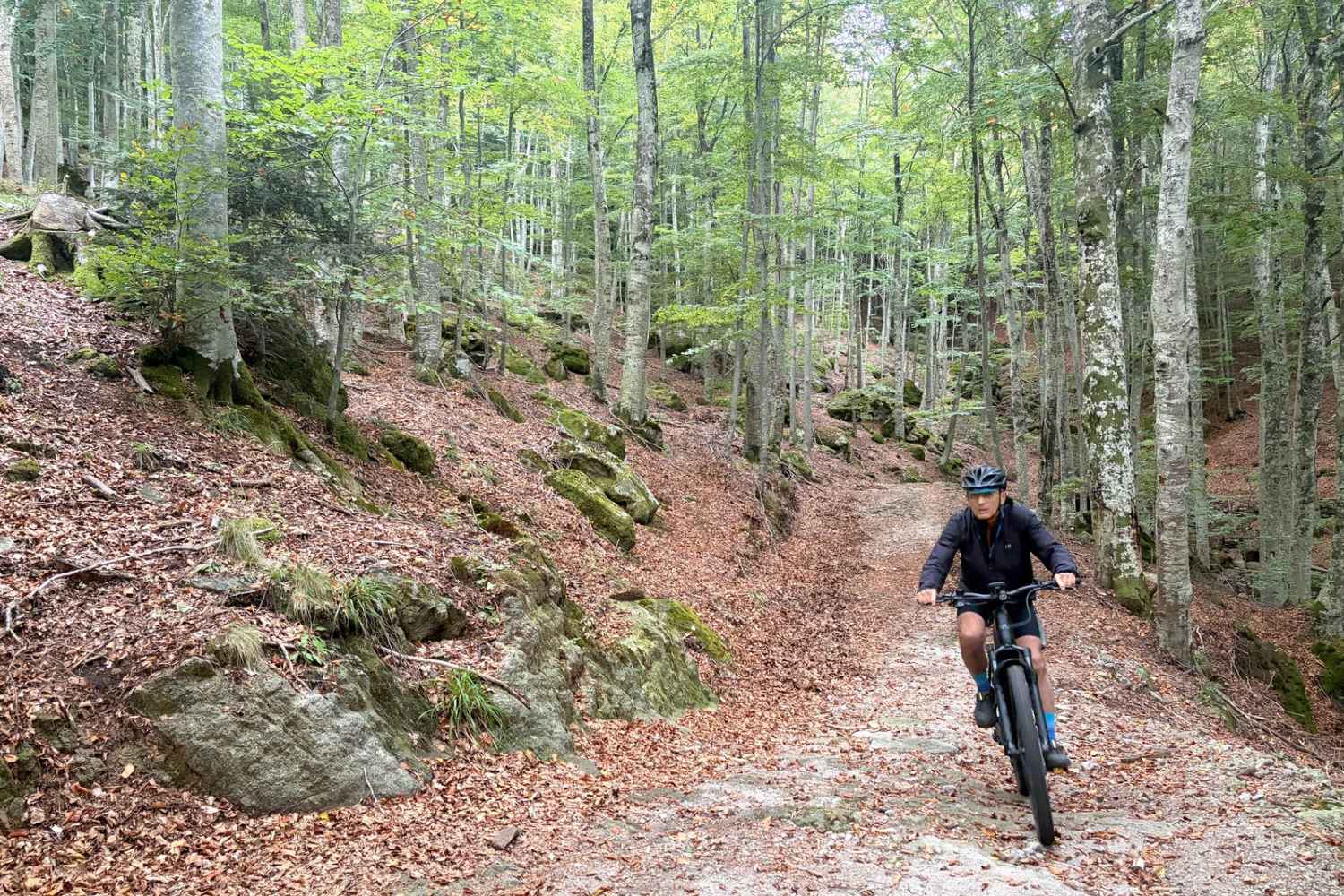
To explore Monte Amiata by bicycle it is not necessary to bring your own equipment. In Prato delle Macinaie, Amiata Freeride offers a mountain bike and protection rental service, as well as an equipped workshop.
Those who prefer to be accompanied can participate in the tours organized by the Bike School, with qualified instructors and itineraries chosen based on the technical level of the participants. An interesting possibility especially for those visiting the mountain for the first time and not familiar with the trail network.
The bike park services follow a seasonal calendar, so it is important to check availability before departure, especially in autumn. The ground conditions also deserve attention: wet leaves, mud and roots can make some sections slippery, even along the simplest routes.
Two areas of the forest dedicated to forest bathing
One of the peculiarities of the Macchia Faggeta is the presence of two areas certified according to the PEFC standard for ecosystem services linked to tourist use and forest wellbeing.
The first is called Fonte Barbara and extends for approximately 12.6 hectares, less than 300 meters from the First Amiatino Refuge. Here there are large beech trees, a spring and stretches of undergrowth where it is possible to closely observe the characteristics of the forest environment.
The second is Pian delle Mandrie, an area of 13.5 hectares reachable via the Rigale path. It is distinguished by large trees, moss-covered rocks and some small plateaus.
They are places also valued for forest bathing activities, the practice of spending time in the woods paying attention to the surrounding environment, sounds and sensations. It does not require special equipment or intense sporting activities.
When to go to the beech forest of Monte Amiata to see the most beautiful colors
If the goal is to admire the foliage, the period to keep an eye on generally runs from the second half of October to the first days of November. Naturally there is no valid date every year: the color of the leaves depends on the temperature trend, rainfall and altitude.
Also for this reason, during the same day you can encounter areas with still green leaves and others that are already completely coloured.
For an autumn visit we recommend trekking shoes with good soles, especially after rain, when the leaf-covered ground can become slippery. It is also useful to bring a waterproof jacket and check the weather conditions before leaving.
The roads that go up towards Monte Amiata allow you to reach different starting points of the paths, but it is always advisable to check any traffic restrictions and choose an itinerary suitable for your preparation.
After the walk, a stop in Abbadia San Salvatore
One of the most interesting aspects of a day on Mount Amiata is the possibility of combining nature with the discovery of the villages.
Abbadia San Salvatore, on the Sienese side of the mountain, is worth a visit especially for its medieval historic centre. The streets develop around the ancient Abbey of San Salvatore, which preserves a crypt with 34 columns, all different from each other.
The village also has an important past linked to the extraction of cinnabar, the mineral from which mercury is obtained. Today this story is told by the Mining Museum Park, where it is possible to learn about the working conditions of the miners and visit an underground tunnel.
For those who want to continue the journey, not far away is Piancastagnaio, recognizable for its Aldobrandesca fortress and the chestnut groves that surround the town. In autumn, chestnuts are the protagonists of local cuisine and festivals, starting with the Crastatone, one of the best-known events in the area.
Why it is worth discovering Monte Amiata in autumn
Monte Amiata allows you to organize a weekend in nature without having to build a complicated itinerary. The paths of the beech forest can be explored in a few hours, the villages are a short distance away and the mountain offers routes suitable for different levels of experience.
But it is above all the autumn landscape that makes the trip interesting. The beech forests, springs and volcanic rocks tell of a different Tuscany from that of the cultivated hills and the most photographed villages.
A destination to be explored on foot or by bicycle, choosing signposted routes and respecting forest environments, without leaving waste or going off authorized routes. This also means traveling slowly: dedicating more time to an area, instead of crossing it just to reach the next stop.
