
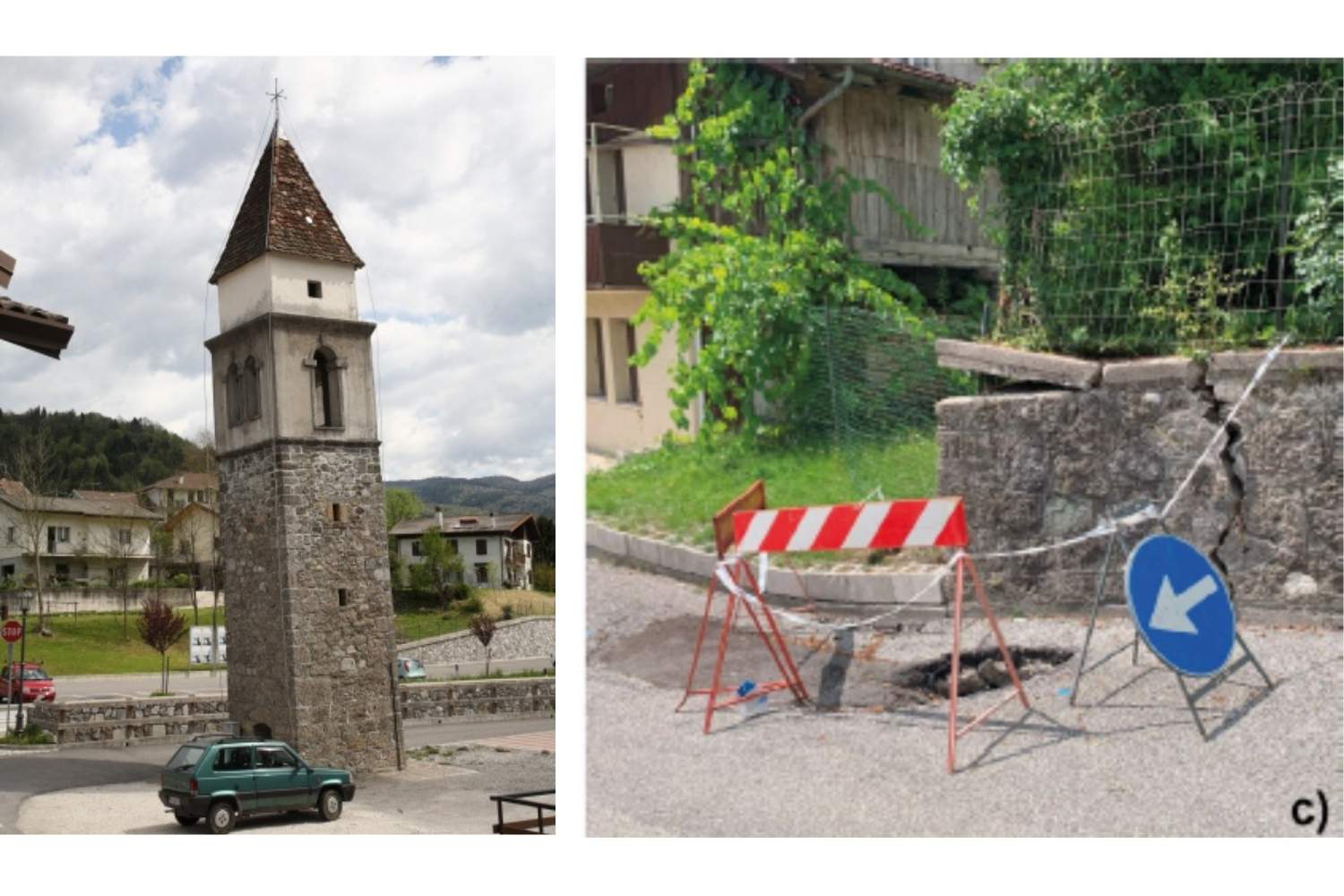
On the leaning bell tower of the hamlet of Enemonzo (Udine), the Municipality has mounted a siren to be sounded in case of emergency. The country’s subsoil is emptying. Seven buildings, including the bell tower, must be checked to establish whether they are still safe, one house is already uninhabitable.
Via Tarquinis is closed due to a sinkhole, a chasm that opens up in the ground, here right in the middle of the road. The Municipality’s geologist, Valerio Lupieri, reports this to L’AltraMontagna.
@Italian Geological Society ETS, 2026
A rock that water dissolves
Under the gravels of the Tagliamento river there is chalk. Unlike many rocks, it dissolves in water. When rain infiltrates, it digs out voids in the subsoil that widen. The ground cover resists up to a certain point, then suddenly gives way or slowly lowers, tilting houses and bell towers.
Lupieri says that researchers from the University of Trieste inserted blocks of gypsum about 10 centimeters wide inside the piezometers. They are tubes installed in the ground which are used to measure how much the water table rises and falls, i.e. the water that flows beneath the surface: “After a few months, the plaster parallelepipeds were no longer there.”
What the studies say
The first, published in 2015 by Luca Zini and colleagues from the University of Trieste in the Descriptive Memoirs of the Geological Map of Italy, is the subsoil map of Quinis. The researchers drilled 25 holes and installed 22 piezometers, the tubes that measure the groundwater level. They then integrated the data with ground penetrating radar and seismic, geophysical methods that emit waves into the ground and analyze their return to reconstruct the structure of the subsoil. They also put tracer substances into the water to follow its path. In the area between Enemonzo and Quinis they registered 64 sinkholes: 38 were sudden collapses, concentrated towards the river, and 26 gradual collapses, due to the water removing material from below, more frequent towards the hills. In one drilling, the layer deeper than 18 meters sank more than 40 centimeters in three years. The authors identify four risk areas, including the one around the bell tower. They attribute the strong fluctuations in the water table, up to 15 metres, to the reservoirs on the Tagliamento and increasingly intense rainfall over the last twenty years.
The second study, released in January 2026 on the Online Reports of the Italian Geological Society by Iqra Yaqoob, Alice Busetti and colleagues, checks how the country is moving today. It is based on two tools. The first is radar data from the European Sentinel-1 satellites (EGMS programme), which record ground movements of a few millimetres. The second is the 3D ground penetrating radar, which scans the first few meters of underground. From 2019 to 2023, the southern part of Highway 52 lowered four times faster than the northern one, with peaks of 30 millimeters, and the bell tower there continues to bend. To the north the rock is shallower and the collapses are too rapid for the satellite. In July 2023 in via Tarquinis the cracked asphalt revealed a cavity measuring approximately 2 by 1 metres. The ground penetrating radar, repeated over time, showed a deformed pipe in December 2023 and broken by at least 4 meters in September 2024. The authors conclude that today there are no practical solutions to significantly reduce the danger.
An old phenomenon that accelerates
Friuli-Venezia Giulia has 1,491 documented sinkholes. Enemonzo has 212, of which 30 have been in the Quinis area since 1964. Already in the 1960s, the 2015 study recalls, hydroelectric dams on the tributaries of the Tagliamento had caused collapses over 20 meters deep. Lupieri links the current acceleration to water withdrawals from the river, but warns that these are “empirical observations, there have been no studies on the matter”.
Meanwhile, the Municipality monitors the town with inclinometers, which measure how much a building tilts, and strain gauges, which record the widening of cracks. The data arrives in real time from a control unit on the bell tower. “But we are ready. Even if we cannot stop this phenomenon,” says Lupieri.
