
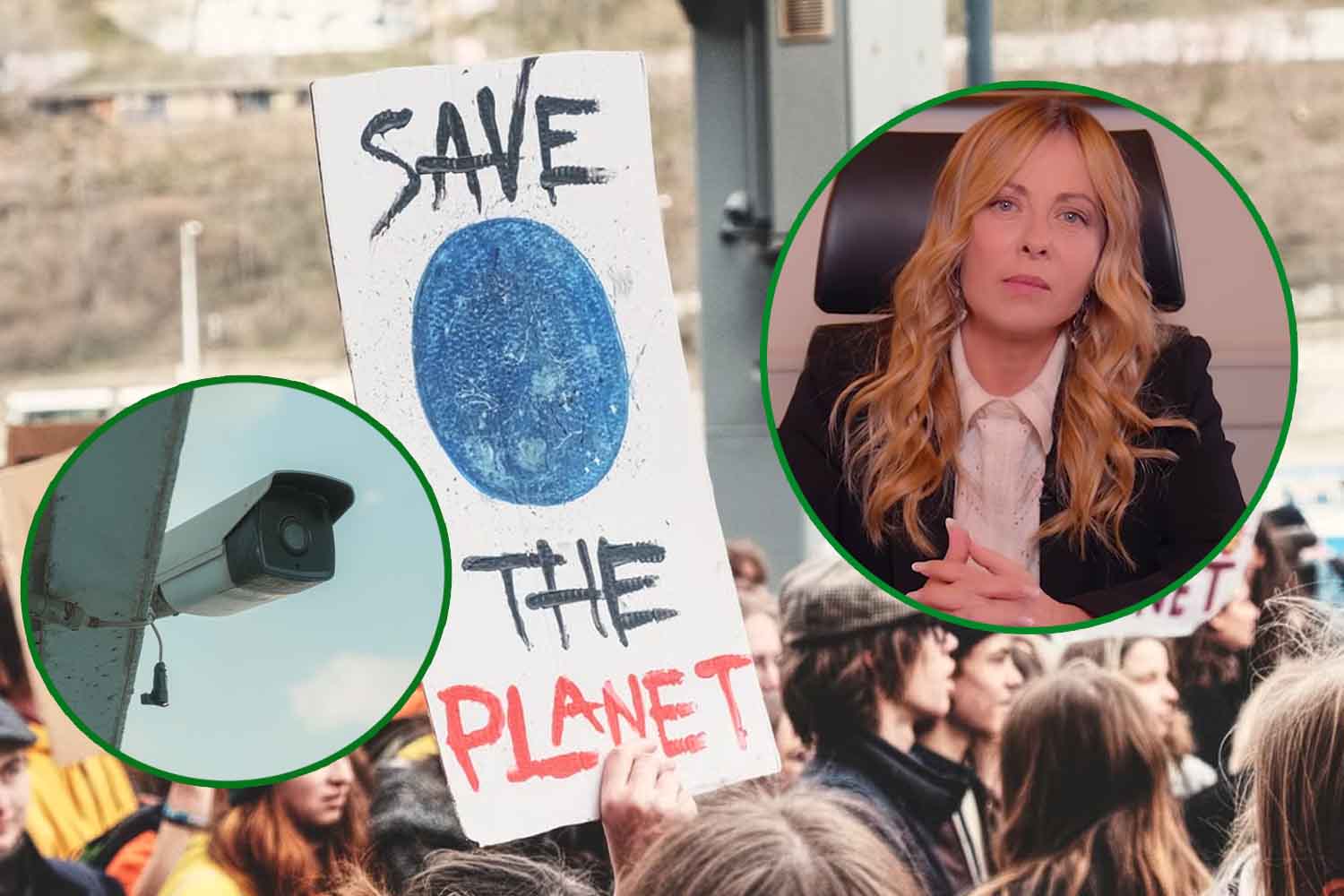
After the clashes in Milan and the approval of the new Security decree, Giorgia Meloni wants to give a name to those who commit violence while hiding behind a hood. To do this, it invokes biometric recognition with artificial intelligence. The legislation approved by the Government, however, also regulates the conservation of images of the faces of people unrelated to the crimes. In certain places and public events they can be collected and kept for seven days, even before an episode of violence occurs.
The Prime Minister spoke about it in the video message of 20 October 2026, where she recalled biometric recognition among the measures already approved in previous months and assured that she wanted to distinguish those who commit violence from those who demonstrate peacefully. A necessary distinction, also because the Privacy Guarantor had already raised doubts about the use of these technologies during demonstrations.
Images retained for seven days
Article 10 of Legislative Decree 160 of 9 September 2026 regulates a posteriori facial recognition: the images are acquired first and the biometric comparison can take place subsequently, under precise conditions. Generalized and indiscriminate recognition is prohibited.
Paragraph 4, however, provides that, in places and events identified according to specific public safety criteria, the systems can also collect and store images of people unrelated to any crime, without immediately processing their biometric data. If a crime is committed, those images can be used for subsequent comparison, according to the limits established by law.
Retention lasts seven days, with automatic deletion upon expiry, subject to further provisions on data processed for police purposes. Privacy controls and guarantees are provided. To understand where these systems can be used, it is necessary to check the ministerial criteria established by law.
The Guarantor had already mentioned the demonstrations
In the opinion of 14 July 2026, the Guarantor had examined a preliminary version of the rule which provided for the automated processing of biometric data of people present in certain places or events. The opinion was favourable, subject to modifications to strengthen guarantees on the processing of personal data.
The Authority had contested the risk of preventive and indiscriminate collection of biometric data, asking to limit the processing to targeted searches following a crime. Among the potentially interested contexts he had indicated stadiums, concerts, stations, large events and urban areas. Even the demonstrations.
The definitive text has been modified: it now distinguishes the initial storage of images from subsequent biometric processing. It is a substantial correction, which incorporates part of the Guarantor’s observations. The reference to demonstrations, explicit in the opinion on the draft, does not appear in the final wording. However, the broader category of places and events characterized by particular needs for public order and safety remains.
The rule contemplates the storage, together with the images, of the personal data acquired through the electronic scanning of the entrance tickets and, when required, the number of the assigned place. A layout that immediately recalls concerts, stadiums and events with registered entrances.
An environmentalist procession hardly includes turnstiles, electronic tickets and numbered seats in front of the prefecture. But this does not mean that all the events involved must necessarily have controlled access, nor does it allow us to establish whether and which street demonstrations may fall within the norm. The law entrusts the Minister of the Interior with the task of establishing the rules: where to use these systems, how to store and use the images and how to protect them. To do so you must consult the Privacy Guarantor.
It is also envisaged that site managers, event organizers and local authorities can also take care of the installation and maintenance of the technologies for the respective video surveillance platforms. The systems are then given free of charge to the police headquarters, which acquires exclusive availability.
When facial recognition does not require judge’s authorization
Article 10 provides that, to search for a person suspected of a crime through facial recognition, the public prosecutor must request authorization from the judge for preliminary investigations within 48 hours of the start of the system. The judge must rule within the following 48 hours.
However, there is an exception. If the technology is used after a crime, exclusively to initially identify a potentially suspect person and on the basis of objective and verifiable elements linked to the fact, that specific judicial authorization is not required. The other legal limits and the responsibility of the officers identified by the law remain. Results obtained by violating those conditions cannot be used. Furthermore, no decision with negative legal effects can be based solely on the outcome of facial recognition.
In 2021, the Guarantor expressed an unfavorable opinion on the SARI Real Time project, a system designed to identify wanted people through cameras. To find one, however, he would have processed the biometric data of all those present, including participants in political and social demonstrations unrelated to the investigations. The Authority also reported the risk of false positives, i.e. incorrect identifications. And mistaking one person for another during a police investigation has very different consequences than a bad photograph.
SARI Real Time provided for real-time recognition, different from the a posteriori recognition governed by Article 10. The 2026 decree also contemplates some real-time uses, in Articles 8 and 13, with specific conditions. The precedent does not demonstrate that the new systems have the same problems, but it clarifies why checks on the reliability and protection of people unrelated to the crimes are needed.
The protests, the restrictions and the promises of listening
In the video message Meloni also talks about the economic and social difficulties that push people to protest. He mentions – finally – farmers, hauliers and workers of the former ILVA, claiming the Government’s willingness to listen to those who demonstrate peacefully.
In presenting the new Security decree approved on 20 October, the Government insists above all on measures against violence: a new crime linked to violent participation in demonstrations, more severe penalties and sanctions, extension of preventive detention also to certain situations involving minors. Measures that the Government justifies with the need to combat violence and which must be distinguished from the rules on biometric recognition approved in September.
The reasons for the protests receive recognition in the words of the Prime Minister. To describe the response to the clashes, however, the vocabulary becomes much more concrete: arrests, fines, new criminal cases, preventive interventions. Regarding the difficulties reported by those who take to the streets, the solutions mentioned in the video remain much less detailed.
This does not mean that the new measures are aimed at all protesters without distinction. The Government presents them as tools against violent behavior, and that distinction must be maintained. But while further powers of intervention and more severe consequences for certain behaviors are announced, the question of how to concretely guarantee the freedom to demonstrate also remains open. And it is an issue that also concerns surveillance technologies.
Who protects those who demonstrate peacefully?
The right to assemble peacefully is guaranteed by the Constitution. The legislation on facial recognition prohibits indiscriminate biometric checks, but allows, in the cases foreseen, the preventive conservation of images that may also belong to people unrelated to the crimes. The September legislative decree regulates the use of these systems, without documenting their use during demonstrations. The Guarantor had already reported how delicate it was to apply similar technologies in contexts in which people exercise fundamental rights.
Meloni explained who he wants to identify: those who commit violence by hiding their faces. The law also regulates the collection of images of those who have not committed crimes. To find out if and when this system could concern a peaceful demonstration, it is necessary to verify the ministerial criteria and the concrete application of the measure.
