
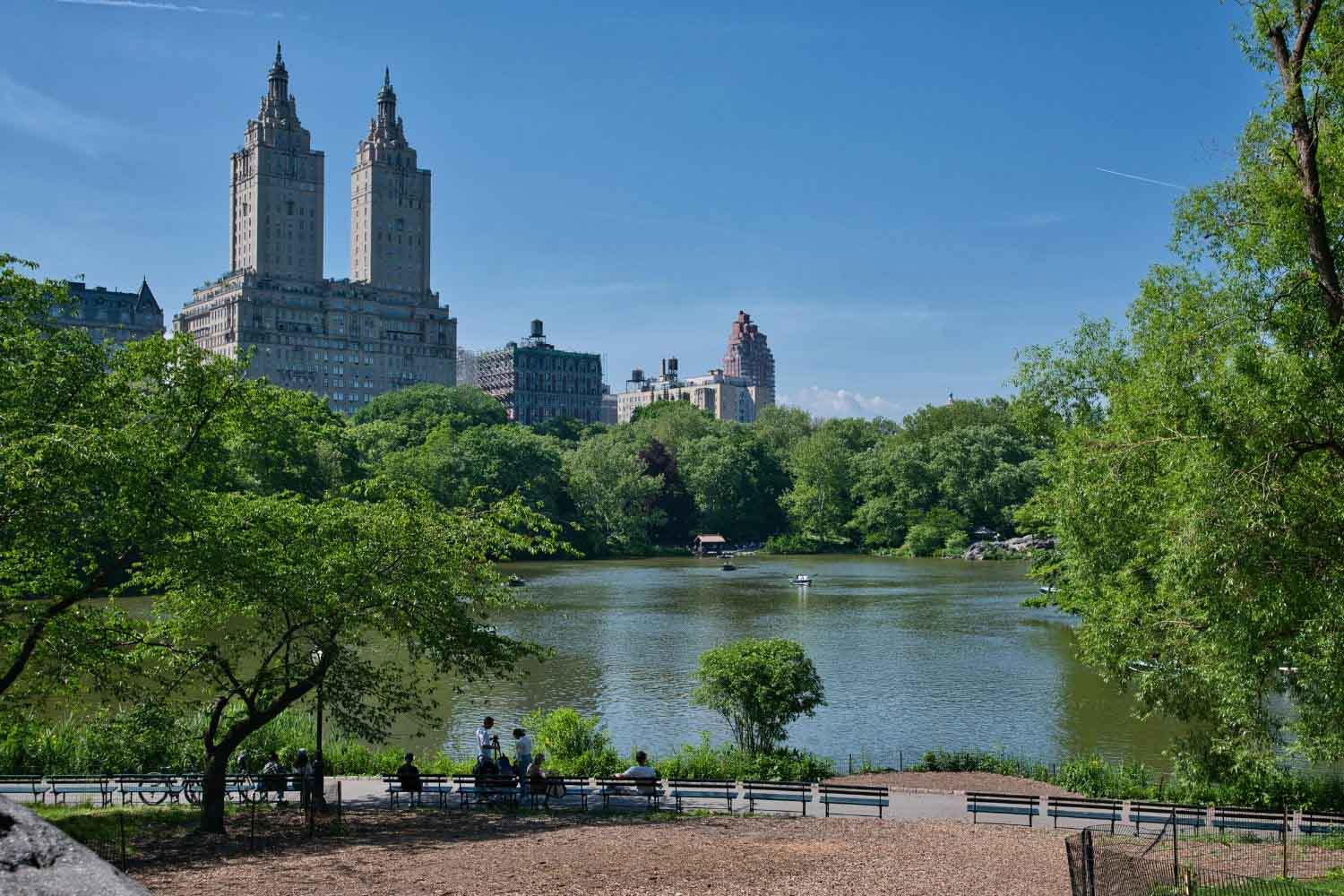
You recognize urban parks first with your body rather than with numbers. You enter under the trees on a hot day, your pace slows down, the noise of the cars loses strength, the air seems less bad. A very normal, almost banal sensation, one that those who live in the city know well. The interesting part comes when that sensation ends up within a precise measurement, meter after meter, and stops being just “you feel better” to become useful data for designing cities.
A new study published in City and Environment Interactions he tried to quantify the real effect of parks on heat, air pollution and noise. The researchers worked around Stoke Park, in Guildford, Surrey, an English town southwest of London. We are talking about a large green space of around 50 hectares, made up of lawns, gardens and mature trees, surrounded by quite ordinary residential streets. No unattainable postcard scenery: a real city park, with traffic just outside and houses all around.
Instead of the classic control units stationary in one point, the monitoring was done with instruments carried in a backpack along a pre-established route. The route started from the heart of the park and reached the roads built around it, repeated in the morning, in the afternoon and in the evening during the late summer. A kind of science walk, only with sensors instead of a water bottle. Air temperature, particulate matter, carbon dioxide and noise levels were recorded, so as to understand how long the benefits last once the green edge has been passed.
The coolness walks
The first fact is the most immediate: inside the park it was constantly cooler than on the nearby streets. Overall, the statistical models confirmed lower temperatures in the green, with the strongest effect in the afternoon, precisely when the heat weighs most on the body. The average difference indicated by the study reaches approximately 1.89 °C compared to built areas. In the morning and afternoon the air in the park was around 1.3°C cooler, while in the evening the gap dropped to around 1°C.
What’s most useful, though, is what happens outside the gate. The cooling of urban parks also reaches the nearby streets: for every 100 meters traveled from the edge of the park towards the built area, the temperature increased by more than 0.5 °C, with a detectable effect up to approximately 300 meters from the border. Inside the park, the opposite happened: as we approached the center, the air cooled by about 0.2°C every 100 meters.
Translated into normal life, it means that a large and well-planted park can also influence the streets around it. A home, school, bus stop or sidewalk within a few blocks of greenery can receive a portion of that benefit. In increasingly hotter cities, this detail matters. Because designing a park also means deciding what type of summer the people who live nearby will have.
Trees beat the lawn
The study also measured thermal comfort, that is, how hot the body actually feels. This is where PET comes in. Physiologically Equivalent Temperaturean index that takes into account the perceived temperature in a way that is closer to human experience than the simple thermometer. The researchers compared three fixed points: a shaded area under trees, an open meadow and a built road.
The result is quite clear. In the afternoon, shade from trees reduced PET by 8.5°C compared to the street, while open grass reduced PET by 4.5°C. Green helps, of course. Trees help more. The foliage blocks direct sun, creates shade, retains humidity, breaks the radiation that an open field allows to reach us. In another measure of comfort, the UTCI, tree areas outperformed grass by about 2.9°C during the hottest hours. Over the entire day, shaded areas reduced PET by up to 28.8%.
This changes the way we look at urban parks quite a bit. A large mowed lawn can look beautiful, tidy, “clean”. During a heat wave, however, an expanse without shade can become almost unusable at the worst times. A path under the trees, however, allows people to walk, stop, cross the space without feeling crushed by the sun. Urban greenery works when it is designed for bodies, not just for photographs from above.
Cleaner air, with some complications
On the pollution front, the picture is less linear. Fine particles were generally lower inside the park, especially in the morning, when the traffic on nearby streets made its weight felt more. PM10, i.e. particles with a diameter equal to or less than 10 micrometres, was over 11% lower in the park during the morning hours. PM2.5 and PM1 also followed the same direction, with drops of around 10.9% and 4.2% respectively. CO2 remained lower in the green, with reductions between 2.3% and 3.3% in the morning and afternoon.
Caution is needed here. The models considered temperature and CO2 data robust, while differences in fine particles were more variable and time-dependent. In the morning the contrast was more evident because emissions from traffic near the roads were still concentrated. In the evening, with the stiller air, a cleaner gradient appeared: moving away from the edge of the park towards the built area, PM10 increased by approximately 1.63 micrograms per cubic meter every 100 metres, while PM2.5 and PM1 rose more slightly.
The point is concrete: a cool place may have better air at certain times of the day, but the two things always travel together with the same precision. Wind, traffic, air stability, particle size and the shape of the greenery change the result. Trees can filter, retain, disperse. They can also create areas where the air stagnates, if placed badly or in streets that are too closed. Green design matters a lot.
The noise goes down
Then there is the noise, the one that often remains in the background in conversations about greenery and instead changes daily life. In the study, built streets were the noisiest areas, especially in the evenings. In that time slot, the average noise reached 69.5 decibels in the built urban area, compared to 45.6 decibels inside the park. A difference that a person perceives immediately, without the need for tools.
Sound levels decreased by approximately 5.41 decibels every 100 meters upon entering the park, more rapidly than the decline measured along the streets. For those who cross intersections, scooters, buses, delivery trucks and nervous horns every day, this reduction means a very simple thing: a piece of the city where the nervous system lets its guard down.
Here too the park works as an infrastructure. Cools, partially filters, cushions. It does very concrete things, which have to do with health, sleep, stress, walking and staying in public spaces. For years urban greenery has been treated as decoration, as a filler between one building and another, as a gentle voice in urban planning plans. Numbers like this move it into another category.
Designing fresh
The most usable part of the study lies precisely in the distance measurements. Knowing that the temperature increases by more than half a degree every 100 meters moving away from the edge of the park allows urban planners and administrations to think in a less vague way. Where to put new trees. Where to pass the pedestrian paths. Where to create shaded corridors. Where it is best to place seats, play areas, cycle paths, crossings.
The researchers suggest practical solutions: running paths in the shaded areas, creating circular routes that keep people in cooler areas, making better use of existing space without necessarily having to add hectares. A park can work better even with the same surface area, if it is designed thinking about the real heat, the real noise, the real journeys of people.
For Italian cities the matter comes straight away. Rome, Milan, Bologna, Florence, Turin, Naples: dense neighborhoods, asphalt, long summers, increasingly hotter nights, often discontinuous trees, precious parks and sometimes managed as if they were a nuisance to be contained. Instead, urban parks are pieces of climate adaptation already present in the area. We need more trees, more shade, more continuity between greenery and streets. We also need maintenance done well, because a park let go loses part of its function and becomes the usual alibi for saying that greenery creates problems.
You might also be interested in:
