
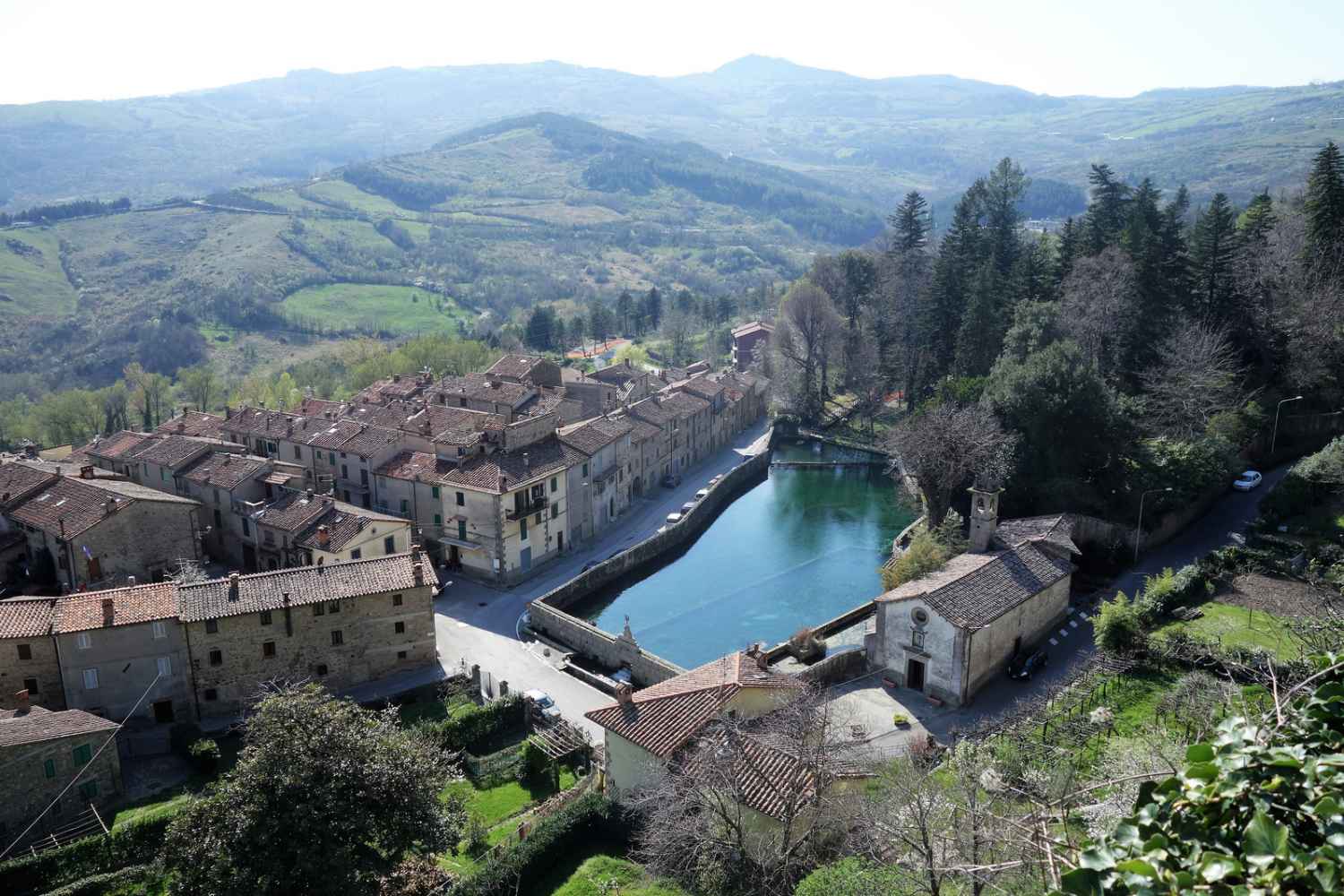
In Tuscany there is a village where you just need to enter a small church to discover that water from a spring flows beneath the floor. It is not a metaphor: in Santa Fiora, on the Grosseto side of Monte Amiata, some glass sheets allow you to observe what lies beneath the building, between ancient structures and the waters that feed the Fiora river.
It is one of the surprises that make this medieval town interesting, included among the most beautiful villages in Italy and awarded the Orange Flag of the Italian Touring Club.
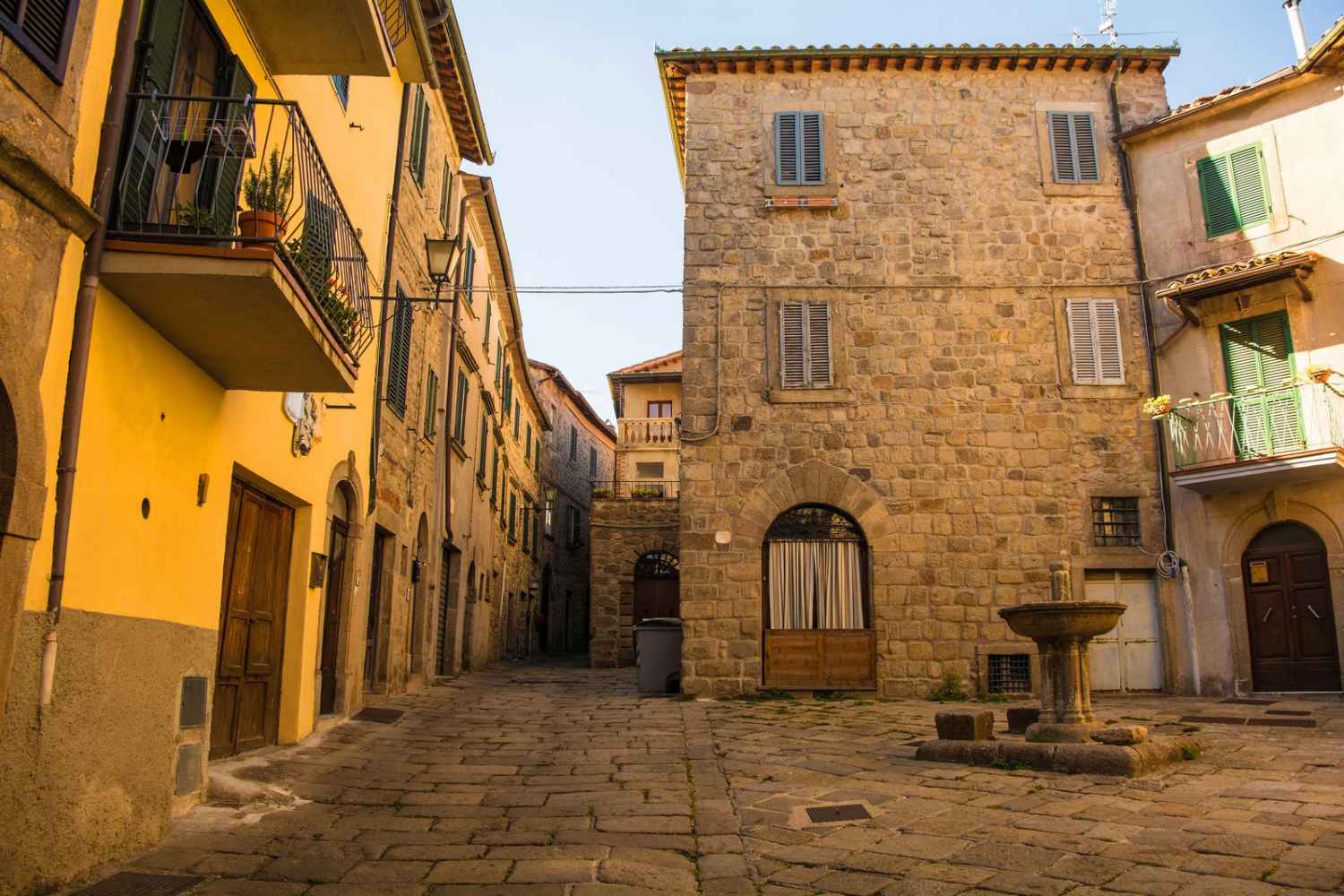
Santa Fiora is located about 700 meters above sea level, in an area dominated by chestnut groves and the woods of the ancient volcano. Its historic center is compact and can be explored comfortably on foot, following the narrow streets that connect three ancient neighborhoods, called tertieri: Castello, Borgo and Montecatino.
But more than the size, what is surprising is the quantity of stories concentrated in a few kilometres: from underground springs to ancient mercury mines, up to a convent where what for centuries was considered the skull of a dragon is preserved.
The Peschiera of Santa Fiora
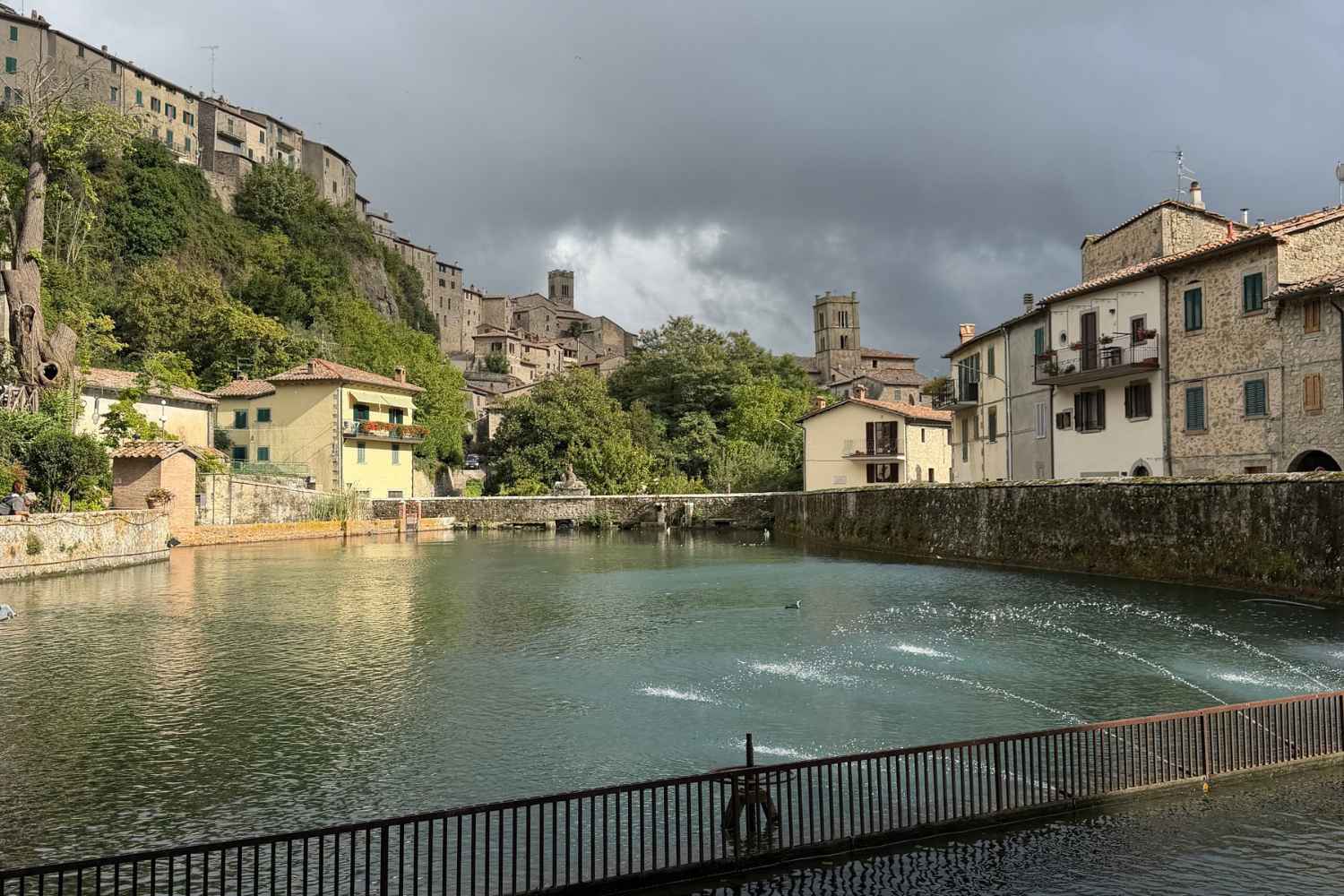
The starting point is Peschiera, in the lower part of the village. It is a large pool of water surrounded by trees and historic buildings, which was once part of the system of gardens and spaces linked to the Sforza family, lady of Santa Fiora.
The Peschiera dates back to the Renaissance period and is fed by the spring waters of the area. Today it is one of the most photographed corners of the country: the surface reflects the surrounding trees and buildings, while the public park allows you to walk around the body of water.
Its value is not only scenic. For centuries the abundance of water has influenced the life and economy of Santa Fiora, favoring artisan activities, mills and supply systems that exploited the springs of Monte Amiata. Next to the Peschiera there is also the Guardian’s Garden, part of the historical and environmental heritage of this complex.
The church of the Madonna delle Nevi: here you walk above the springs
A few steps from the Peschiera there is one of the most particular places of Santa Fiora: the church of the Madonna delle Nevi, also known as the little church of the Piscina.
At first glance it is a small religious building, with frescoes inside. The surprise comes when looking downwards: during the restoration work, ancient structures emerged under the floor, including a paved road, remains of hydraulic works and traces of buildings that were probably linked to the processing of water.
Some portions of the floor were made of glass, so as to allow visitors to observe these remains and the waters of the springs that flow beneath the church.
It is a detail that tells the relationship between Santa Fiora and its territory better than any explanation. Here water is not just an element of the landscape: it literally runs through the history of the country.
A small village with an extraordinary collection of works by Andrea Della Robbia
From the Montecatino district, where Peschiera is located, you can go back towards the historic center crossing the Borgo district and reaching that of Castello, the oldest part of Santa Fiora. Here the Parish Church of Saints Flora and Lucilla is worth a visit, documented as early as the 12th century.
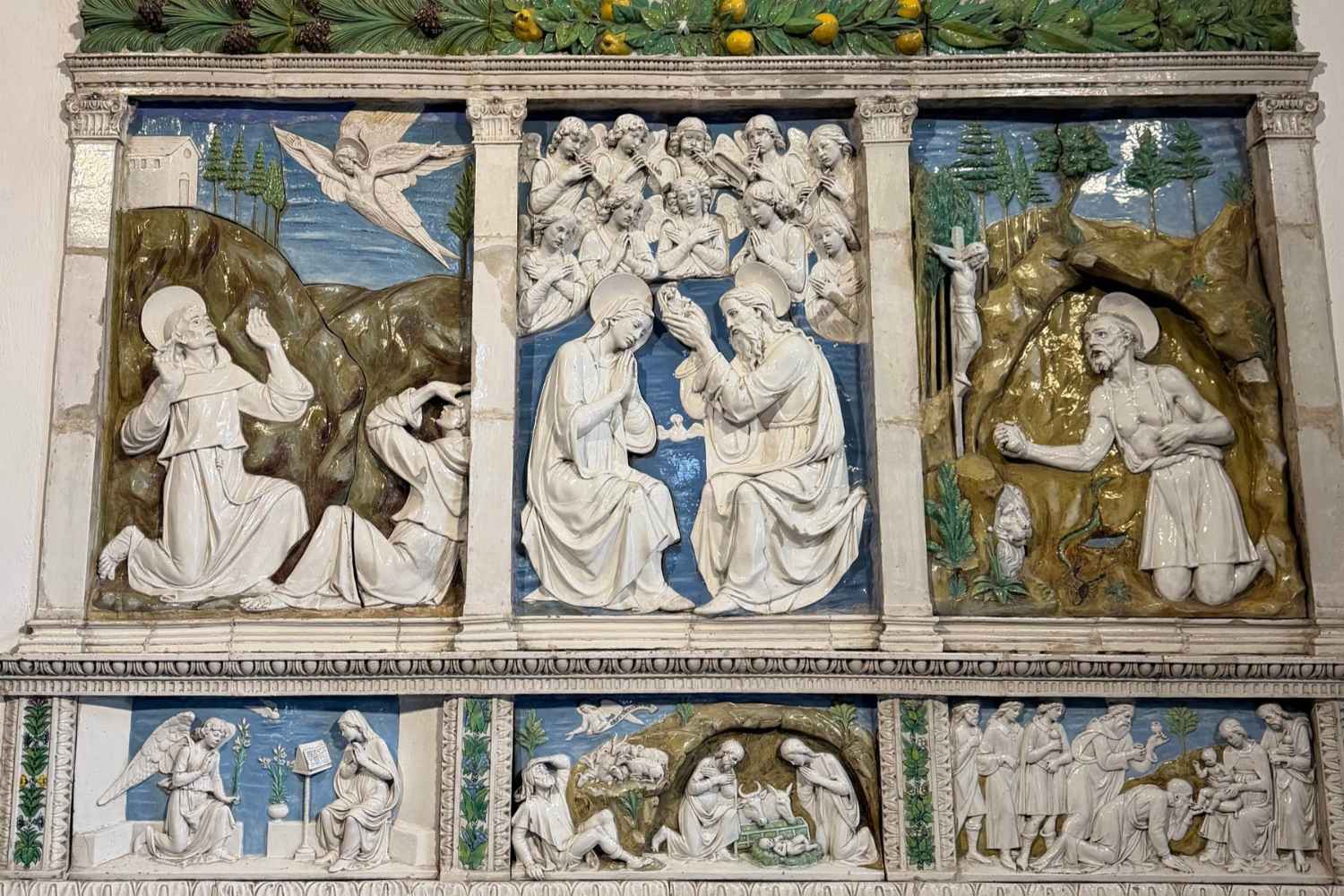
The exterior is that of a medieval church with a rather sober appearance, but inside there is one of the most important collections of glazed terracottas created by Andrea della Robbia.
The works date back to the second half of the fifteenth century and include religious scenes, altarpieces and decorations characterized by the colors and the particular ceramic technique of the Florentine family.
The collection is indicated by national tourist sources as the largest in the world of Della Robbia terracottas preserved in a church. A little-known record, especially considering the size of the country.
Among the works to observe are the Baptism of Jesus, the Madonna della Cintola and the scenes of the Resurrection and Ascension that decorate the pulpit.
The mystery of the dragon of Santa Fiora: a legend with a truly preserved skull
One of the most curious stories linked to Santa Fiora leads outside the town, to the hamlet of Selva, where the convent of the Santissima Trinità is located.
According to a legend set at the end of the fifteenth century, the woods in the area were infested by an enormous snake, described as a monstrous creature that terrified the inhabitants.
It would have been killed by Count Guido Sforza, who would have faced the animal and kept its head as a trophy.
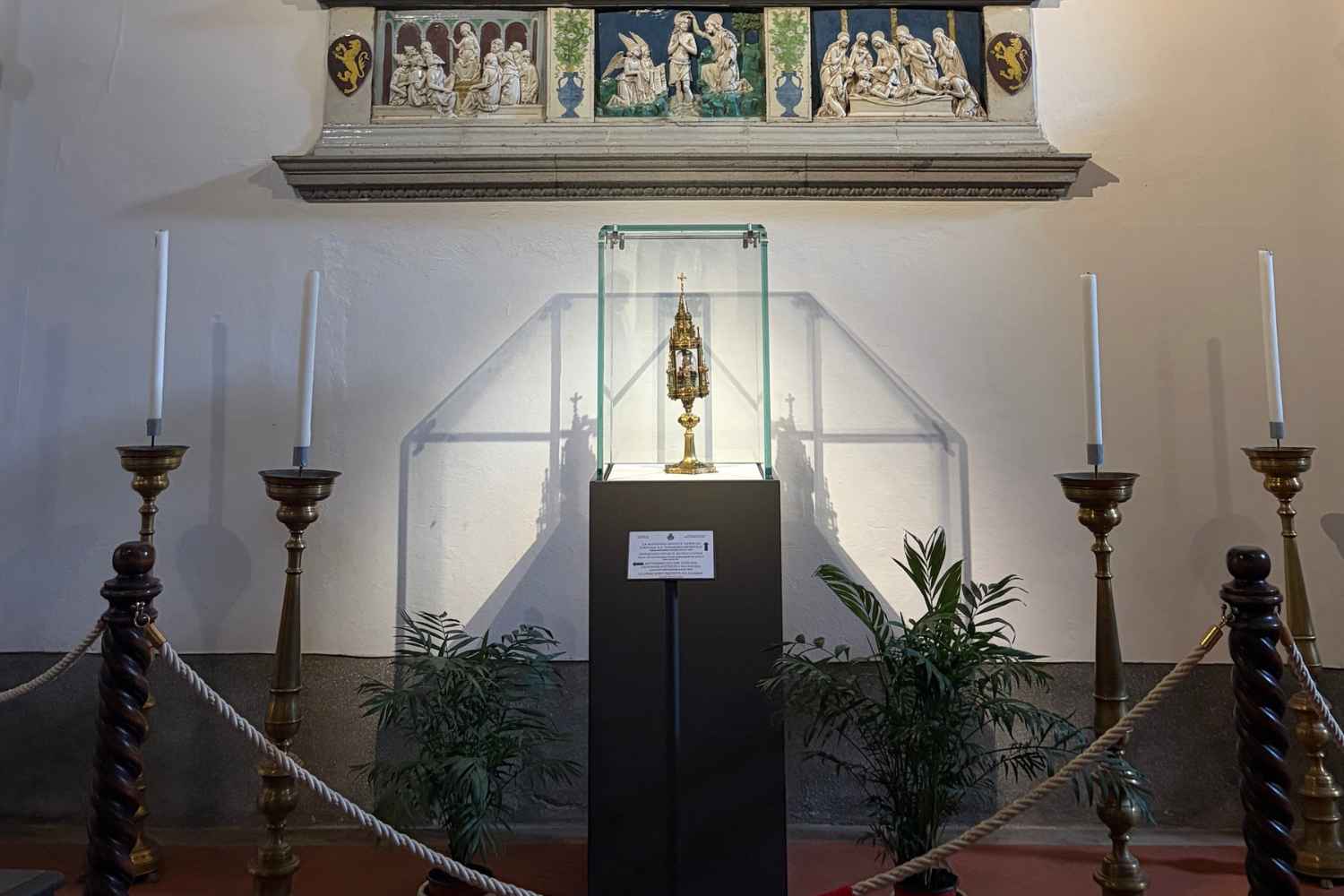
The most interesting part is that in the convent there is actually a shrine containing a portion of a skull, long associated with the legendary dragon.
Of course, this is not proof of the existence of a fantastic creature. Studies conducted on the find have traced it back to a crocodile. However, the curiosity remains open as to how the skull of a similar animal arrived in this mountain area of Tuscany.
The legend is still part of local tradition today and makes the convent an unusual stop for those who also want to explore the surroundings of the village.
Santa Fiora and the mercury mines: the lesser-known history of Monte Amiata
Santa Fiora also preserves an important testimony to the industrial history of Amiata. For many decades, in fact, the economy of this mountain has been deeply linked to the extraction of cinnabar, the mineral from which mercury is obtained. An activity that has provided work to generations of inhabitants, but which has also entailed serious health and environmental risks.
To learn about this part of local history you can visit the Museum of Mercury Mines of Monte Amiata, housed in the Palazzo Sforza Cesarini, in Piazza Garibaldi.
The exhibition itinerary presents work tools, documents, reconstructions and testimonies of the life of the miners. A section is also dedicated to the consequences of the extraction and processing of mercury on the health of workers and the struggles to improve working conditions. It is a visit that adds a social dimension to the trip and helps to understand how the territory has sought new development possibilities after the closure of mining activities.
How to visit Santa Fiora in one day
To discover the historic center it is enough to dedicate a few hours to the visit, although it is worth stopping longer to explore the surroundings.
A walking itinerary can start from Piazza Garibaldi, in the Castello district, where Palazzo Sforza Cesarini and the Mercury Mining Museum are located. From here you reach the Pieve delle Sante Flora e Lucilla, before descending through the narrow streets of the Borgo district to the Peschiera and the church of the Madonna delle Nevi.
The route allows you to cross all three historic districts, alternating medieval buildings, panoramic views and places linked to the presence of water.
Those who have an extra half day can reach the hamlet of Selva and the convent of the Santissima Trinità, checking the visit methods in advance.
For nature lovers, the area also offers paths through chestnut groves and woods, while during autumn you can combine walks to discover local products, such as chestnuts from Monte Amiata, mushrooms and mountain cuisine specialities.
Santa Fiora is also an interesting destination for a weekend: it is in fact located in a position that allows you to reach other villages in the Amiata, such as Arcidosso, Castel del Piano and Seggiano, without traveling long distances.
It is a small town, but with an unusual concentration of places to discover. And between a spring hidden under a church, an ancient art collection and the legend of a dragon, it offers many more reasons to visit than its size suggests.
