
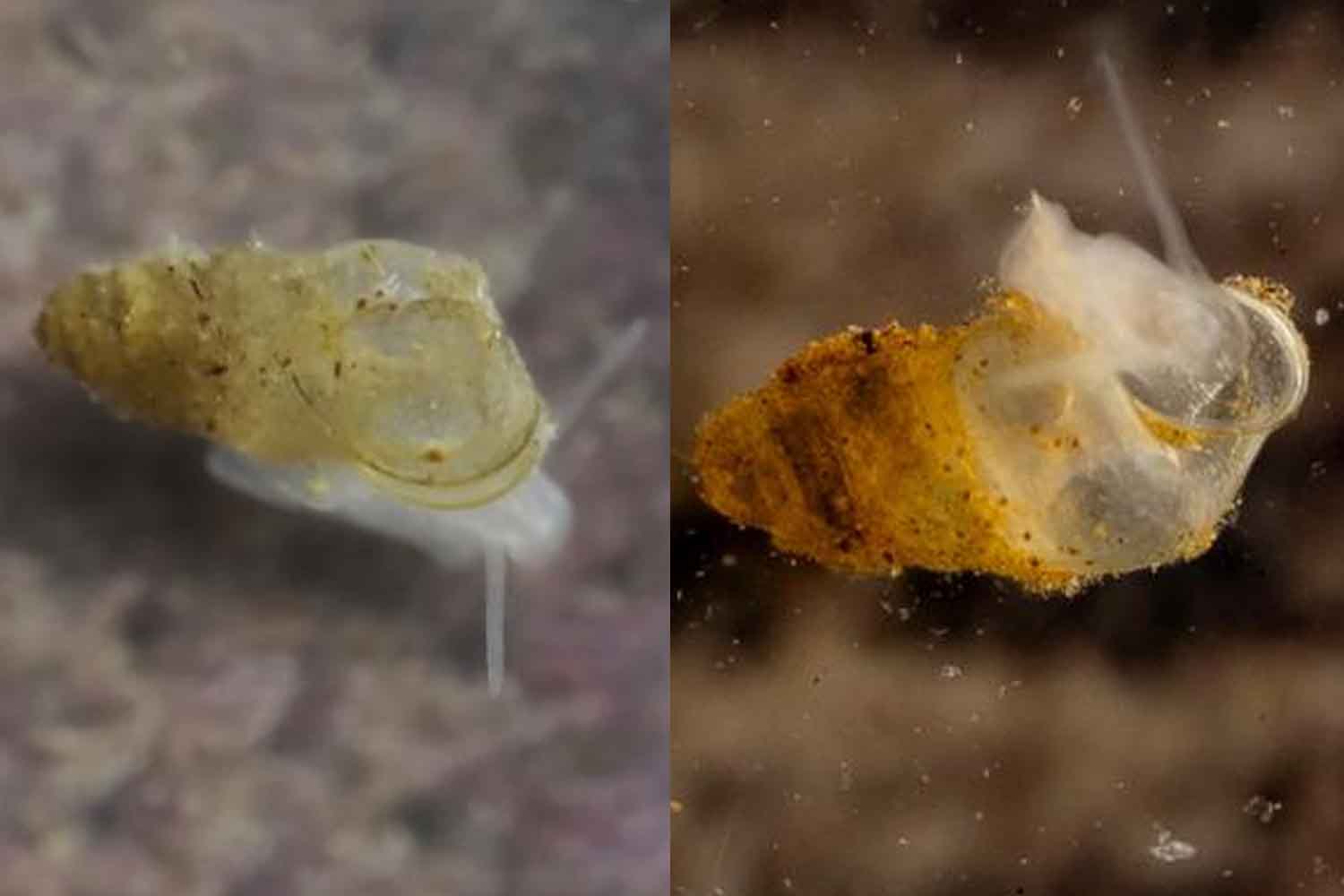
Three live snails, an empty shell and a species never described before. This is what some researchers found in August 2025, exploring a cave in Yunnan, in southwestern China. The small mollusc, just two millimeters long, has an almost transparent shell, a body without pigmentation and no eyes. They called him Erhaia dijiangborrowing the name of a creature from Chinese mythology that, coincidentally, was depicted without a face.
The discovery, described in a study published in the scientific journal Subterranean Biology on May 29, 2026, represents the first documented case in China of a freshwater snail adapted to life in caves. And it comes from a rather unusual place: a karst cavity located at 2,062 meters above sea level, the highest altitude recorded so far for a cave-dwelling species of the Erhaiidae family.
An eyeless snail running away from the light
Erhaia dijiang belongs to a group of tiny freshwater molluscs widespread in various Asian regions. Its particularity is linked to the environment in which it lives: the ocular structures are completely degenerated, the body is devoid of pigmentation and the shell, thin and conical, allows light to filter through. Characteristics that have led researchers to consider it an organism closely linked to the underground environment, where sunlight is absent or very limited.
The name chosen by scholars is a reference to Di Jiang, a creature from Chinese mythology described in Classic of the mountains and the seasan ancient collection of geographical and mythological tales. A faceless figure, just like this tiny eyeless snail. Yet, in laboratory observations, the specimens showed a marked aversion to light: when illuminated, they sought refuge in the dark cracks under the stones.
In the cave, however, they live among submerged gravel and rock fragments, in waters less than a meter deep and with a temperature close to 20 °C. In the laboratory they have been observed feeding on diatoms, tiny algae present on rocky surfaces, also accepting fish food. An existence confined to a very small space. During the rainy season, the current can drag some individuals out of the cavity, but the specimens found outside were all within two meters of the entrance. No trace of the species in nearby waterways.
Three live specimens and many questions about survival
The discovery also required rather careful identification work. The researchers compared the characteristics of the shell and analyzed a portion of the mitochondrial DNA, identifying enough differences to recognize it Erhaia dijiang like a new species. However, the material collected was very scarce. During the August 2025 inspection, two individuals were found alive inside the cave, a third near the exit and an empty shell. No young specimens. This has prevented scholars from carrying out a complete anatomical examination and still leaves several unknowns about the biology of the mollusc.
Its conservation is also of concern. The authors report an apparently very low density and an extremely limited known distribution. Three specimens, of course, does not mean that only three exist: much more extensive investigations would be needed to estimate the population.
The discovery shows how poorly understood China’s underground aquatic ecosystems still are. Prior to this study, no cave-dwelling freshwater snails had been formally documented in the country, although other species in the same family were already known from caves in Japan. Scientists are therefore calling for new explorations in the cavities of Yunnan and protection measures for these endemic molluscs, particularly linked to the conditions of their environment.
For Erhaia dijiang the actual distribution, population size and reproduction methods still remain to be clarified. For now we know that he lives in a cave over two thousand meters above sea level, that he has lost his eyes and that, when the light comes, he prefers to crawl under a rock. The researchers managed to find three of them. To understand how many more there are, they will have to look again.
