
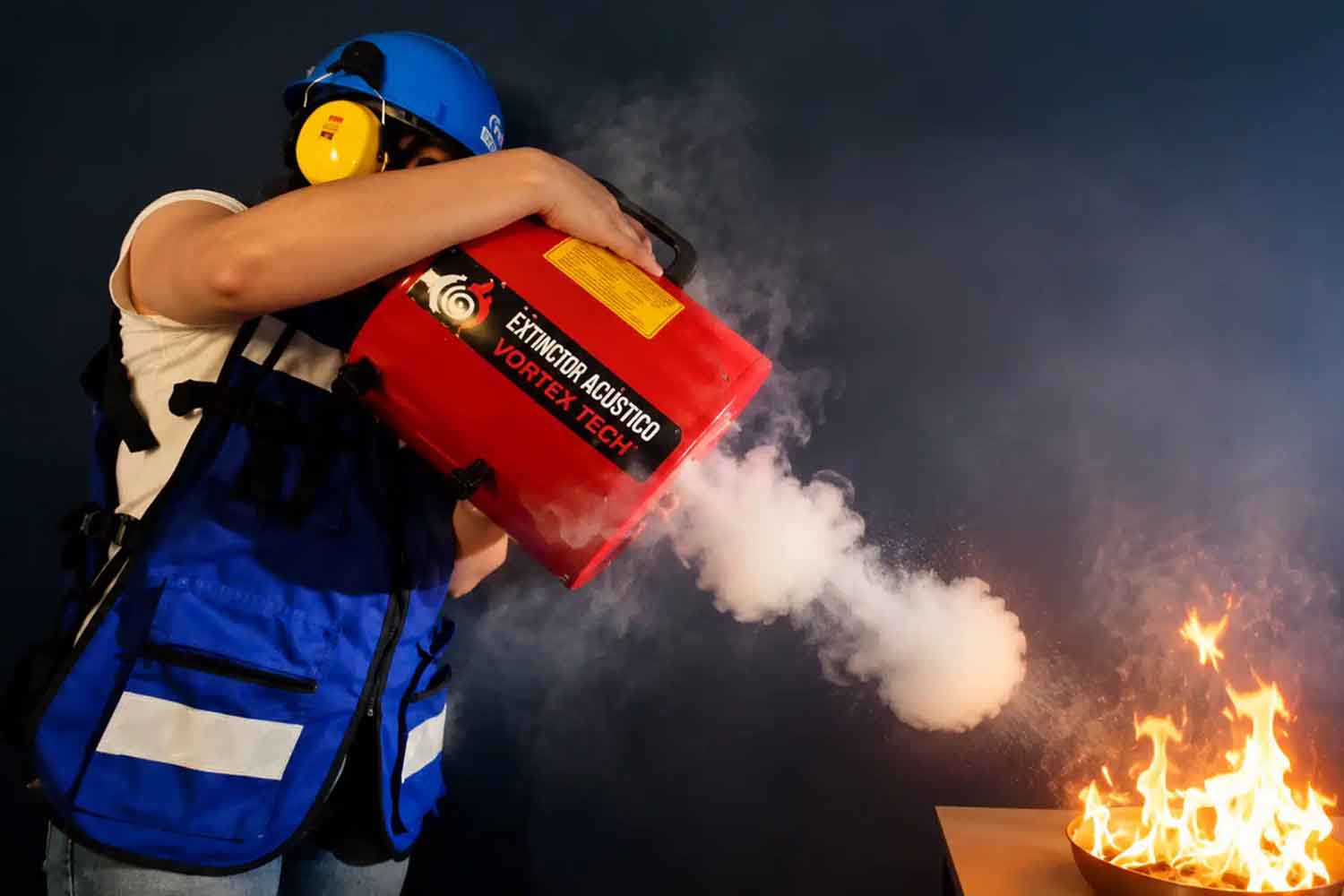
A battery, a speaker and a red cone pointing towards a flame. A few seconds later, the fire goes out. Without water, without foam and without chemical powder. That’s how it works Vortex Tech, the portable acoustic fire extinguisher developed by the young Mexican student Ángela Karime Hernández Venegaswho with his project has just won a gold medal in an international scientific competition in Indonesia.
Ángela studies electronics at CETis 78 in Altamira, in the Mexican state of Tamaulipas. Its device was awarded in the Technology category, secondary school level, at the International Science and Invention Fair (ISIF) 2026, held in October. This was confirmed by the Secretariat of Education of the State of Tamaulipas, which also announced a second recognition, the IYSA Semi Grand Award.
The result is interesting above all for what the girl managed to build. The extinguishing of flames through sound waves had already been experimented with by other researchers. Ángela tried to transform that principle into a transportable device, to be used on small fire starters.
How the fire extinguisher that puts out the fire with sound works
It all started with a candle. The initial objective was to be able to put it out without blowing and without using extinguishing substances. An apparently simple experiment, which required months of work, several prototypes and numerous attempts, with the help of teacher José Arturo Hernández Muñoz.
The device works thanks to a 12 volt battery, a frequency generator, an amplifier and a speaker. The latter produces sound waves at around 30 hertz, a very low frequency that causes oscillations and movements of the air. The particular exit duct helps to generate vortices that reach the flame and disturb its combustion.
The effect is reminiscent, at least in part, of what is obtained by blowing on a candle: the flame is destabilized until it goes out. Of course, just turning on a song with a lot of bass isn’t enough to get the same result. Precise conditions of frequency, intensity and air movement are needed.
The physical principle has documented precedents. Already in 2012, DARPA, the US defense technology research agency, demonstrated an experiment in extinguishing flames through acoustic fields. In that demonstration, two speakers produced sound waves capable of modifying the movement of air and the combustion of a small amount of liquid fuel.
A study published in Scientific Reports investigated the phenomenon, observing how a loudspeaker could extinguish small propane flames, between 5 and 25 millimeters high. The researchers highlighted that the movement of the air generated by the speaker membrane can have a decisive role, even greater than the propagation of the sound wave alone.
Over 100 tests, but the fire extinguisher is still experimental
Ángela says she carried out more than 100 tests with his prototype, moving from the candle to small fires fueled by wood, flammable liquids and cooking fats. According to his statements, the device manages to put out some flames in approximately 5-8 seconds.
These are encouraging results, but they must be read for what they are: tests reported by the young inventor. There are no published independent experimental data sufficient to evaluate the effectiveness of the device in different fire conditions, nor certifications that authorize its use as an alternative to traditional fire extinguishers.
Scientific research also calls for caution. Putting out a small flame under controlled conditions is very different from responding to a spreading fire. The distance from the sound source, the power needed, the size of the flames and the possibility that the fire will reignite are aspects that still need to be evaluated. The same applies to the acoustic safety of those who use the device.
The absence of water and chemicals could offer advantages in specific applications, especially where residues from traditional fire extinguishers can damage equipment. Even these benefits, however, should be compared with energy consumption and the actual shutdown capacity. For now, therefore, Vortex Tech cannot replace an approved fire extinguishermuch less be considered a solution for large fires.
The next step is an automatic fire extinguisher
Ángela’s work continues. The student is developing an automatic version that uses infrared thermal sensors to detect the start of a fire and activate the acoustic system without the direct intervention of a person. The objective is to create a device that can be installed in strategic points, capable of intervening promptly on the first flames.
An application that will require further verification of its ability to locate fire and reliably extinguish it. Meanwhile, the prize obtained in Indonesia has guaranteed her access to another international scientific competition, the Indonesia International Applied Science Project Olympiad, scheduled online from 14 to 17 December 2026.
Ángela managed to bring a scientific experiment from school to an international competition. To transform it into a usable fire protection device, tests, measurements and certifications will still be needed. Meanwhile, he demonstrated that even a simple candle can be an excellent starting point.
