
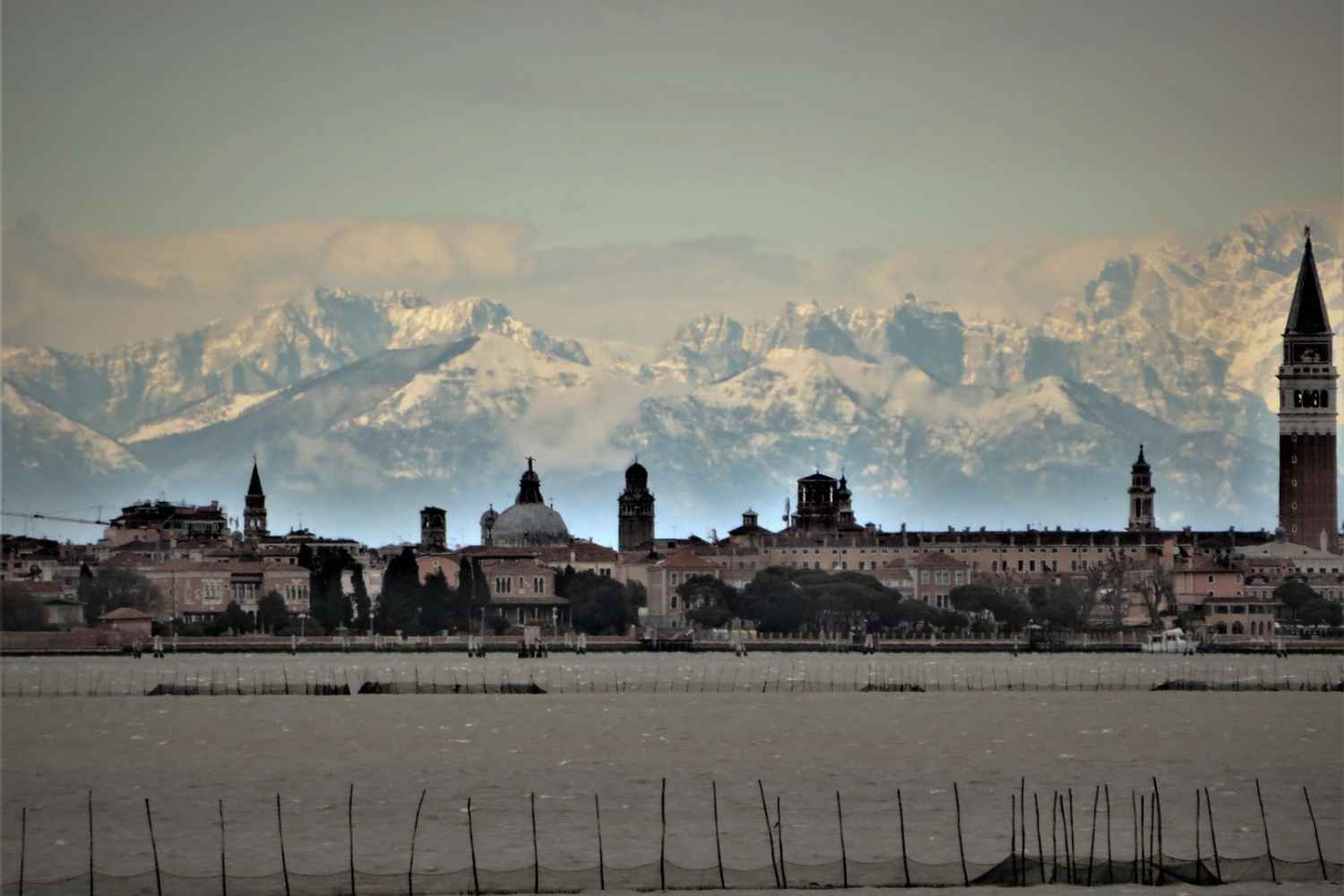
Imagine finding yourself in Venice, looking out over the lagoon, and seeing the snow-capped peaks of the Dolomites on the horizon. Not a barely visible outline, but a surprisingly clear profile, with mountains that seem much closer than they really are.
At first glance it might seem like a retouched photograph, yet it is all true. This is stravedamento, an atmospheric phenomenon that under certain conditions allows you to see mountains that are even more than one hundred kilometers away from Venice.
The name comes from the Venetian dialect and indicates the possibility of seeing exceptionally far. A spectacle that unites two apparently very distant landscapes, that of the lagoon and that of the Belluno Dolomites.
What is doting and why does it occur
The secret is in the air, normally, between Venice and the mountains there is humidity, mist and suspended particles which reduce visibility, making distant reliefs barely distinguishable or completely invisible.
However, when particular weather conditions arrive, the landscape changes. The Bora, the wind that blows from the north-east and which, when it brings drier and cleaner air, helps to disperse the haze and improve the transparency of the atmosphere, may have an important role.
With low humidity, reduced aerosol concentrations and a sufficiently clear sky, mountains can appear on the horizon with much more defined outlines.
It doesn’t mean that the Dolomites have gotten closer, of course. It is simply the atmosphere which, on those days, lets the light pass through with less diffusion and allows our eyes to distinguish details normally hidden by the haze.
What mountains can you see from Venice?
Among the hills recognizable on days of greater visibility are Monte Civetta, the Pale di San Martino and, closer to the plain, Monte Grappa.
Some of the most evocative views can be observed from the Lido of Venice, where the gaze can sweep towards the hinterland without the obstacles of the buildings in the historic centre.
Of course, the result also depends on the exact point from which the landscape is observed. Not all peaks are visible from the same position and recognizing them with the naked eye requires a certain familiarity with the profile of the mountains.
It is especially in photographs taken with a telephoto lens that the effect becomes surprising: the perspective compression makes the mountains appear enormous and very close to the Venetian buildings, despite being at a great distance.
When can doting be observed?
Autumn and winter are particularly interesting times for those hoping to witness the phenomenon. Bursts of cold, dry air, especially after the passage of a disturbance, can create ideal conditions for seeing very far.
However, there is no precise timetable. Doting can occur at different times of the year and a sunny day alone is not enough.
To increase your chances of observing it, it is best to pay attention to the weather forecasts, especially when they announce northerly or north-eastern winds, dry air and good visibility.
Light also plays its part. At dawn and towards sunset, the sun’s rays can highlight the shapes of the mountains, making the contrast between the lagoon and the peaks even more striking.
To photograph them, a telephoto lens allows you to visually bring the background closer and enhance the profile of the reliefs. But on the best days the show can be appreciated even without a camera.
The Dolomites and Venice have a connection that goes back a long way
Then there is a curiosity that makes this panorama even more interesting. The Belluno Dolomites are not just the mountains that can be seen from time to time from the lagoon: they have also played an important role in the history of Venice.
For centuries, in fact, the woods of Cadore, Cansiglio and other areas of the Belluno area have supplied wood to the Serenissima. That wood was used for the structures of buildings, the pilings of the foundations and the construction of the boats of the Venetian fleet.
A relationship made up of trade, work and transport routes that has linked the mountain communities to the lagoon city for a long time. It is no coincidence that today the Belluno Dolomites are also referred to as The Mountains of Venice.
And perhaps this is precisely the most beautiful part of the doting: for a few hours, when the air allows it, two territories united by centuries of history become visible again in the same landscape.
