
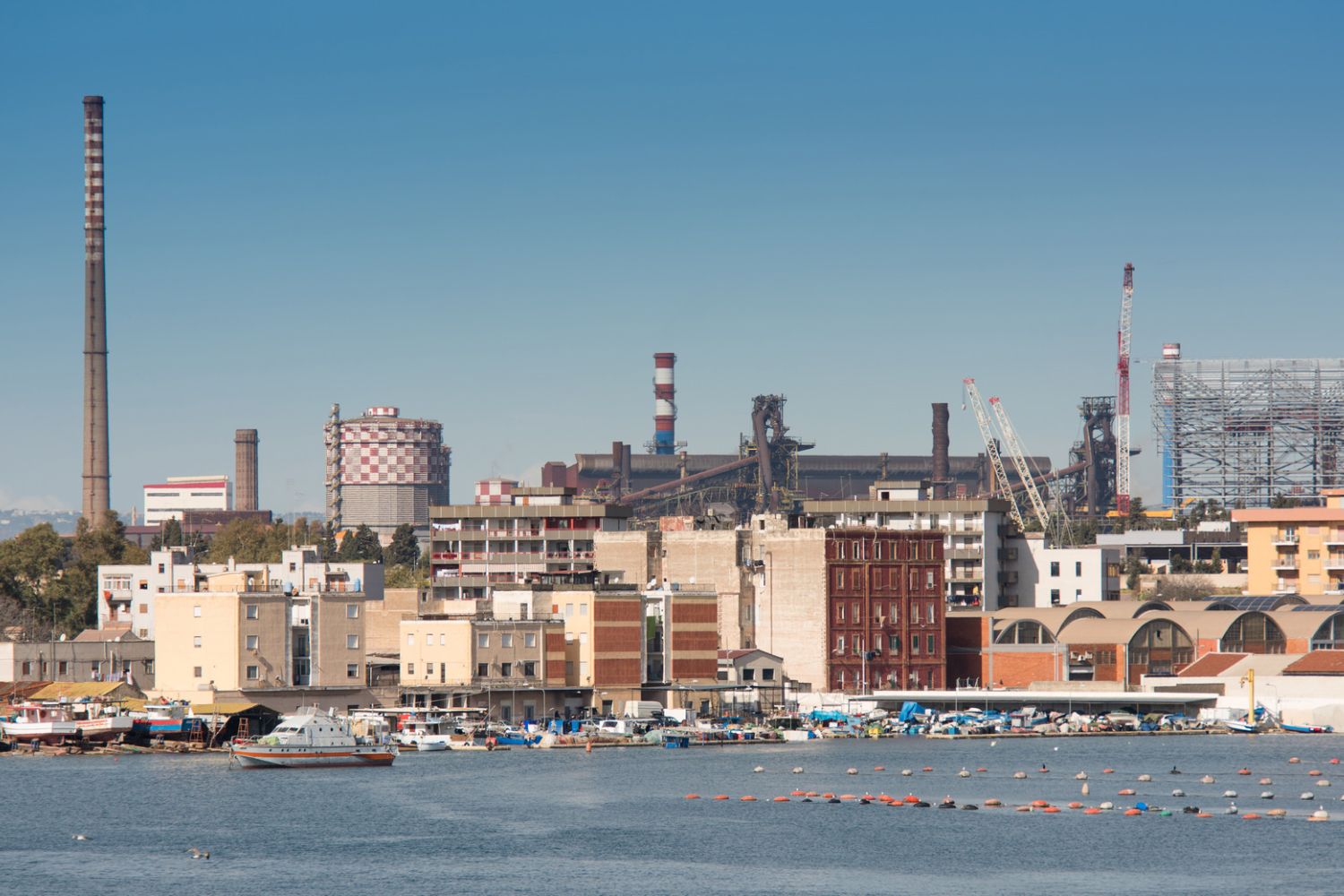
For decades in Taranto the same question has always been asked: does work or health come first? And today, the Court of Cassation puts down on paper a principle that will mark a turning point in the very long affair of the former Ilva: the right to work cannot be separated from the right to live in a healthy and safe environment.
The United Civil Sections of the Supreme Court thus rejected the appeal presented by Ilva and Acciaierie d’Italia, both in extraordinary administration, against the provision ordering the suspension of production activity in the hot area of the Taranto steel plant.
The decree of the Milan Court of Appeal of 27 July, which had granted 90 days to stop the plants, therefore remains valid. A decision motivated by the risks linked to the presence of asbestos and fine dust emissions, based on the elements examined by the judges.
The Court of Cassation deemed the assessment of serious and relevant dangers adequately justified, judging the measure to be consistent with the precautionary principle.
Because the Supreme Court confirmed the stop of the former Ilva
The ruling comes after a long legal battle started by some citizens of Taranto, who had asked for action on the health risks associated with the plant’s activity.
The provision of the Milanese judges imposes the suspension of production activity in the hot area until the implementation of the measures necessary to eliminate the identified risks, in particular those linked to the asbestos present in the plants and dust emissions.
The companies had contested the decision, also recalling the Health Impact Assessment (VIS) study, the opinion of the Istituto Superiore di Sanità and the Integrated Environmental Authorization (AIA) of 2025. But for the Cassation, the Court of Appeal’s reasons relating to asbestos and fine dust are autonomous: each was considered sufficient to support the decision to suspend production.
Health and work must not come into conflict
This is probably the most significant point of the ruling, because it concerns not only Taranto, but the relationship between industrial activity, environmental protection and fundamental rights.
Rosy Battaglia, investigative journalist and documentary maker, author of “Taranto calls”, an exceptional docu-investigation, and creator of Reactive Citizens, a project by civic journalism on health, environment and legality.
We talked about it here: #TarantoChiama: the documentary investigation that pierces the veil on one of the most polluted areas on Earth
Battaglia shares a passage that he defines as significant for everyone.
And it recalls articles 9, 32 and 41 of the Constitution, reiterating how the protection of life, health and the environment places precise limits on the freedom of economic initiative. But above all it clarifies that the right to work cannot be used to justify dangerous conditions for those who work and for those who live in the territories concerned.
In fact, the Supreme Court states that the work protected by the Constitution must be healthy and safe, and that it is up to the State to guarantee its conditions also through adequate economic and social policies.
It is a fundamental distinction for a city that, for too long, has experienced the protection of health and the defense of jobs as two irreconcilable needs.
The European precedents
Already on 25 June 2024, the Court of Justice of the European Union, intervening in the case of the former Ilva, had clarified that the activity of an industrial plant must be suspended when it presents serious and relevant dangers for the environment and human health. That ruling represented a decisive step in the legal case that led to the suspension of the hot area.
Among the elements referred to by the Court of Cassation is also the European Directive 2024/2881 on air quality, which introduces more stringent limits for PM10 and PM2.5 particulate concentrations to be respected by 2030.
It is an important reference because it confirms the evolution of European standards towards greater health protection from air pollution.
Is the former Ilva really shut down? What happens now
The ruling confirms the obligation to stop the hot area, but does not mean that all the systems have already been definitively shut down. In recent weeks they had been kept in pre-heating conditions, without production, thanks to a government provision which allowed the commissioners to keep them in this situation while awaiting the decision of the Supreme Court and in any case no later than December 15th.
However, with the rejection of the appeals, the suspension order remains fully effective. The technical modalities of the stop and the next decisions of the competent authorities remain to be clarified.
Then there is the employment issue: the plant directly employs around 8 thousand people, while the procedure for selling the plants is still open, with the deadline for binding offers extended to 9 November (and not only that: in addition to the Taranto plant, Acciaierie d’Italia owns those in Cornigliano, Novi Ligure and Racconigi, and all depend on Apulian production. The ruling could therefore also trigger a crisis for the other plants of the group, which overall has almost 10 thousand employees).
In any case, a very delicate phase begins for Taranto, in which the protection of workers will have to proceed together with the safety of the plants and environmental restoration.
Meanwhile, the story of the former Ilva has been telling for years a contradiction that should never have become normal: an entire community forced to question itself about the environmental and health consequences of an industrial activity on which thousands of families depend.
The Court of Cassation clarifies that the economic and employment importance of the plant does not cancel the obligations to protect health and the environment, but a sentence – alone – cannot resolve the industrial crisis of Taranto. We need reclamation, safety, investments and, above all, credible economic alternatives for a territory that has already paid a very high price.
