
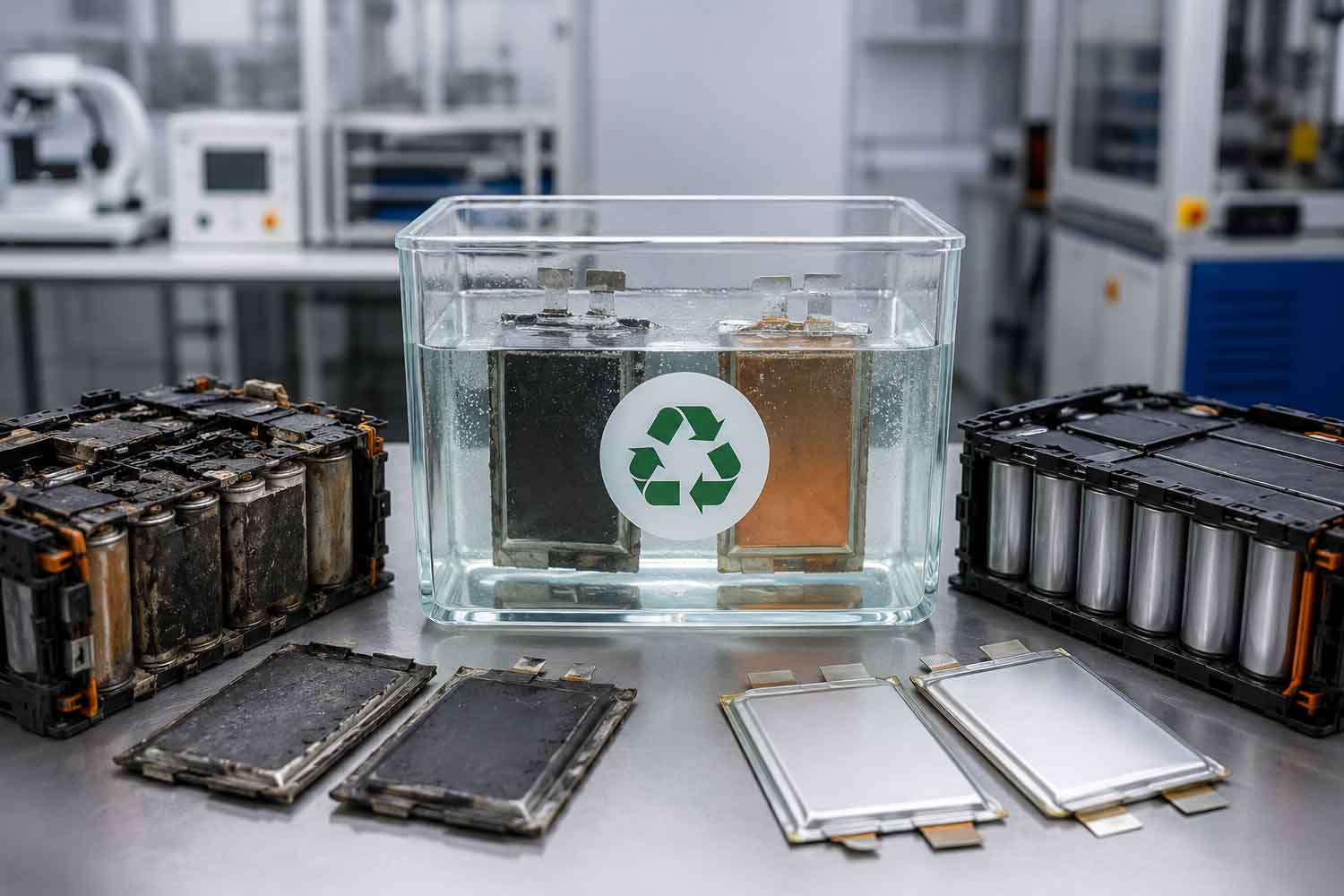
A flat battery, in the usual narrative, almost seems like an object that has reached the end of its life. It is dismantled, shattered, reduced to material to be recovered with heat, acids, heavy industrial steps. Inside, however, an important part of his previous work still remains: worn electrodes, yes, yet still recognisable, still structured, still whole enough to deserve a second chance. The new lithium battery recycling method starts right there, from a less brutal idea: treating the electrodes as components to be repaired, rather than as dust to be rebuilt from scratch.
The technique is called DEER, an acronym for direct electrode-to-electrode regeneration, and works on lithium ion batteries that have reached the end of their life. The electrodes are removed while still intact and immersed in a separate cell with an electrochemical solution based on 1,3-dimethyl-2-imidazolidinone. Laboratory name, very concrete effect: the solvent dissolves the insulating layer that progressively forms between the anode and cathode during the charge and discharge cycles, one of the reasons why the battery loses capacity over time. The study published on Energy & Environmental Science indicates recovery of up to 95% of capacity and greater stability in subsequent cycles.
The problem is in the layer
In lithium-ion batteries, aging resembles a patina that builds up where the chemistry works hardest. This layer, called the electrode-electrolyte interphase, grows with use and ends up hindering the passage of ions. The battery charges worse, performs less, loses autonomy. The DEER method tries to intervene precisely on that barrier, dissolving the inactive components without destroying the architecture of the electrodes.
The difference with traditional recycling lies here. Today many batteries are melted at high temperatures with pyrometallurgical processes, or shredded to obtain the so-called black mass, a dark mass rich in critical materials which then must be treated with chemical processes, often acidic, to recover metals such as nickel, cobalt, lithium and copper. They are useful, mature techniques, already within the industry. However, they have an energetic, environmental and economic price. After recovery, the materials must be refined, resynthesized, transformed back into cell components. The road gets quite long.
With direct recycling, however, the cycle is shortened. The electrodes are cleaned and regenerated into their original shape, then they can be reinserted into a new cell. The study reports a 56% reduction in production costs of recycled cells compared to pyro- and hydrometallurgy-based routes, along with a decline in energy use and greenhouse gas emissions. These are important numbers, especially in a sector where every industrial step weighs on margins and the real sustainability of the supply chain.
Less dust, more recovery
The topic of lithium battery recycling is becoming less and less technical and more and more political. Electric cars, domestic storage, renewable energy systems, portable electronics: the demand for batteries is growing and with it the pressure on lithium, nickel, cobalt, graphite. They are materials extracted in complex supply chains, often concentrated in a few countries, with environmental and geopolitical costs that are difficult to ignore. Each better recovered battery means less raw material to chase elsewhere and less waste that is difficult to manage.
The European Union is already moving in this direction with stricter rules. For lithium batteries, the recycling efficiency targets reach 65% by the end of 2025 and will rise to 70% by 2030. For the recovery of materials, the targets include 90% for cobalt, copper, lead and nickel and 50% for lithium by 2027; by 2031 it will rise to 95% for cobalt, copper, lead and nickel and 80% for lithium. In practice, the used battery is increasingly treated as a secondary mine, with precise obligations and numbers.
Within this framework, a method capable of regenerating the electrodes without immediately destroying the component would have enormous value. The key word, however, remains “would”. The next step will be to demonstrate operation on industrial batteries and on cells with more complex forms of degradation. Those tested so far were around 70-80% healthy, a typical condition for many electric vehicle batteries considered at end-of-life for automotive use, but still far from the worst cases.
The second life is really necessary
The DEER method, for now, does not eliminate the problems of battery recycling. What remains is collection, safe disassembly, variety of chemistries, package standardization, fire risk management, large-scale convenience. A smartphone battery, a scooter battery, an electric car battery and a stationary storage battery belong to the same family, but inside they can have very different geometries, materials and levels of degradation. Bringing a technique from the laboratory to the plants means dirtying it with this reality: volumes, times, costs, safety, logistics.
The direction, however, is interesting because it changes the industrial gesture. Instead of assuming that a used battery needs to be discarded, try saving the part that is still useful. It is a change of look that is only small in appearance. In a supply chain that for years has reasoned in a linear way, extract, produce, consume, discard, the direct recovery of the electrodes makes circularity less decorative and more concrete.
Lithium batteries will continue to age, lose capacity, and reach end-of-life in ever-larger quantities. The difference will be made by how they are treated when they stop running a car, a storage unit or a device. Destroying them immediately will be increasingly difficult to justify, if there is even the possibility of repairing what is still standing inside.
You might also be interested in:
