
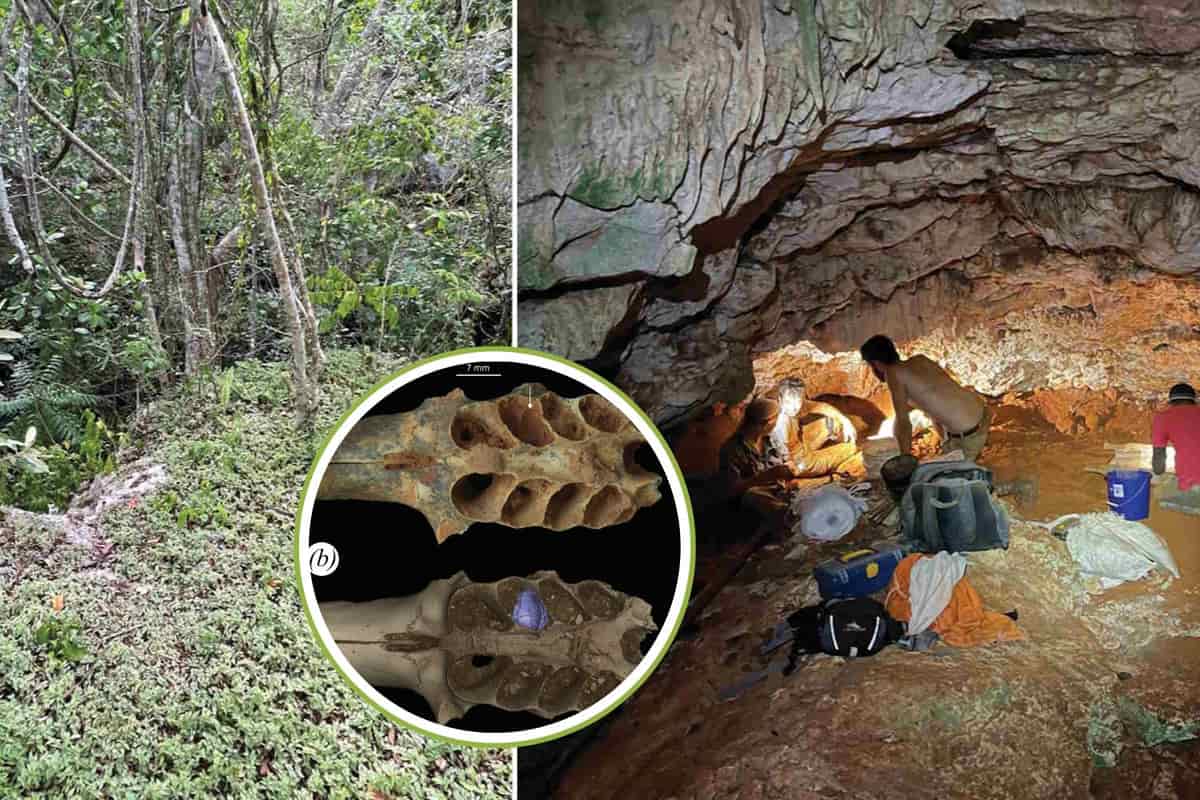
At first glance it seems like one of those places that make you uncomfortable. The floor of the Cueva de Monoa cave in the Dominican Republic, is covered in bones, teeth and skulls. For centuries, perhaps for millennia, it was the result of the activity of a family of now extinct large owls, the Tyto ostologist. They hunted in the tropical forest, returned to the cave and regurgitated what they couldn’t digest. A habit that, over time, has transformed the cavity into a true natural cemetery.
Yet, right in there, among the remains of animals that have disappeared for thousands of years, someone has found an opportunity. Not large mammals, not birds, but bees.
Not social bees, with tidy hives and a queen in the center, but solitary bees. Those that dig small burrows in the ground to lay their eggs and then leave. A fundamental detail, because soft soil is scarce on the island of Hispaniola. Here limestone, caves and rocks dominate. Digging is not easy, and for those who have to reproduce every useful space counts.
This is how, according to a study published in Royal Society Open Science, ancient bees transformed the bones and skulls of extinct mammals into real nurseries.
A cemetery of bones born from extinct birds of prey
©Lazaro Viñola López
The discovery happened almost by chance. Juan Almonte Milan, curator of paleobiology at the National Museum of Natural History of the Dominican Republic, identified the cave during a series of explorations. Going deeper, between tunnels and narrow passages, layer upon layer of fossils emerged: rodents similar to guinea pigs, sloths, birds, reptiles. Over fifty different species, all brought there by owls.
Among those bones, however, some details did not add up. Cavities filled with sediment, smooth, regular, slightly concave. They didn’t seem like the result of chance. Lazaro Viñola López, researcher at the Field Museum in Chicago and lead author of the study, says he had a familiar sensation: those structures recalled the wasp and bee nests observed years earlier at the university.
From there a detailed analysis began. The bees were not preserved, as soft-bodied insects often are. No body, no wings. Only the traces of their work. Yet it was enough to look closely. The cells were small, ellipsoidal, about six millimeters long, with extremely smooth internal walls. Too well-kept to be wasp nests, too “clean” to belong to leaf-cutting bees, which use petals and plant fragments.
The biological signature hidden among the bones
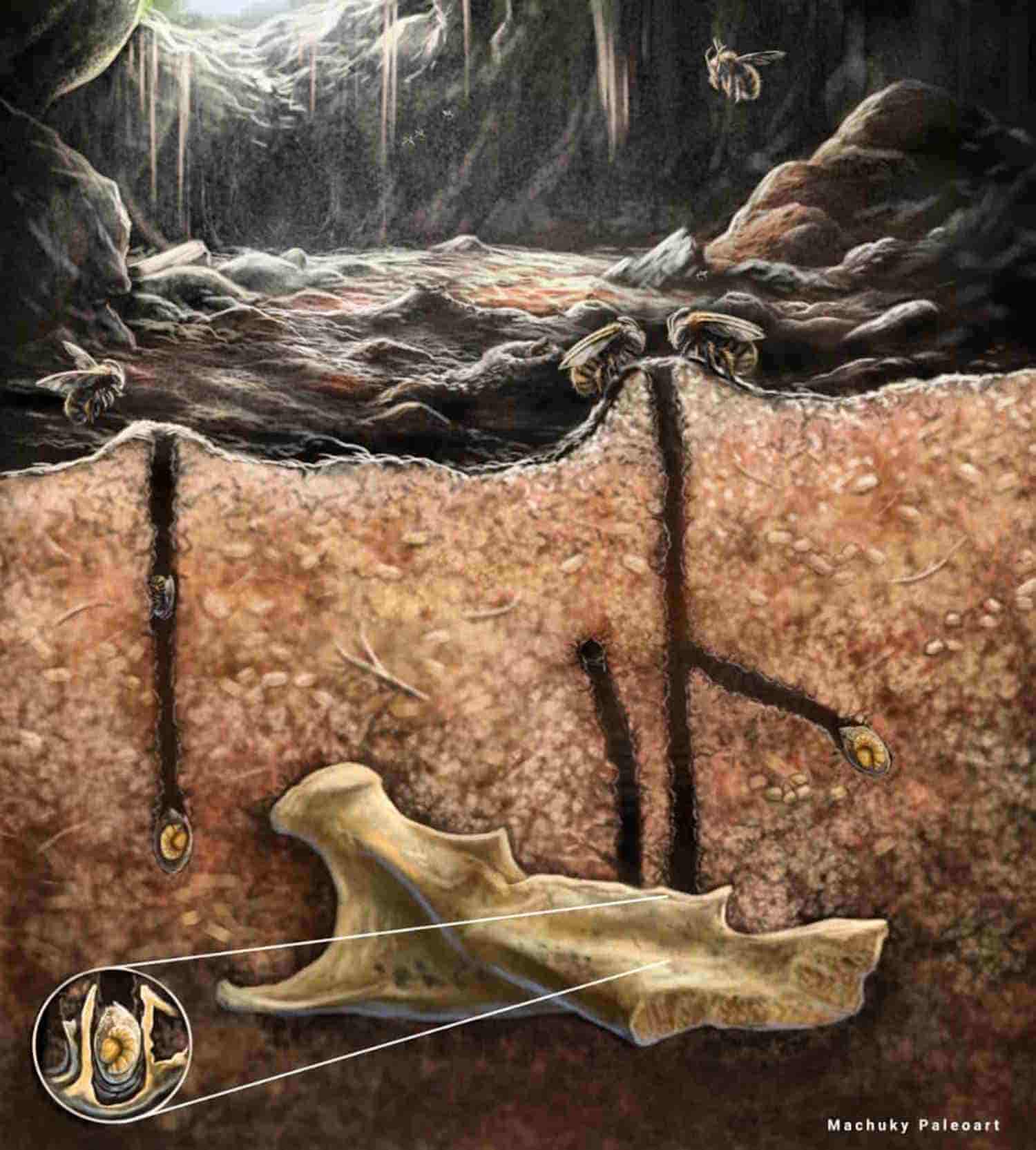
All clues pointed to the family of Halictidaethe so-called sweat bees. Solitary bees, yes, but with a tendency to live close together, in dense groups, making the most of the available space. And that’s exactly what was found in the Cueva de Mono: bones filled with cells next to each other, like little apartments carved into skulls and jaws.
To better understand what happened in there, the researchers analyzed the cell walls with electron microscopy. What emerged tells a lot about the cave environment. Traces of organic substances, fossilized microorganisms, fungi growing on decomposing matter. A humid context, rich in organic residues, perfect for nesting.
There is another detail that struck scholars: almost no trace of pollen. This might seem strange, because bees hoard it as food for the larvae. That’s actually great news. It means those larvae have grown, fed and left the nest. Those bones weren’t failed attempts, but nurseries that really workedprobably for several generations.
We don’t know if the bees responsible for these nests still exist today. Many animal species present in the cave are extinct, but the biodiversity of Caribbean bees is still little known. It’s possible that they too have disappeared, or that they still live on the island, without us realizing it.
This discovery tells a simple and powerful story. In a difficult environment, poor in apparently useful resources, life has found an unexpected solution. Where there were only bones, the bees saw shelter. Where there was a cemetery, they built a future.
And it is also a reminder for those who study the past: there are not only large, spectacular fossils. Sometimes it is the tiny signs, left by almost invisible insects, that best tell how the ecosystems of the past worked.
