
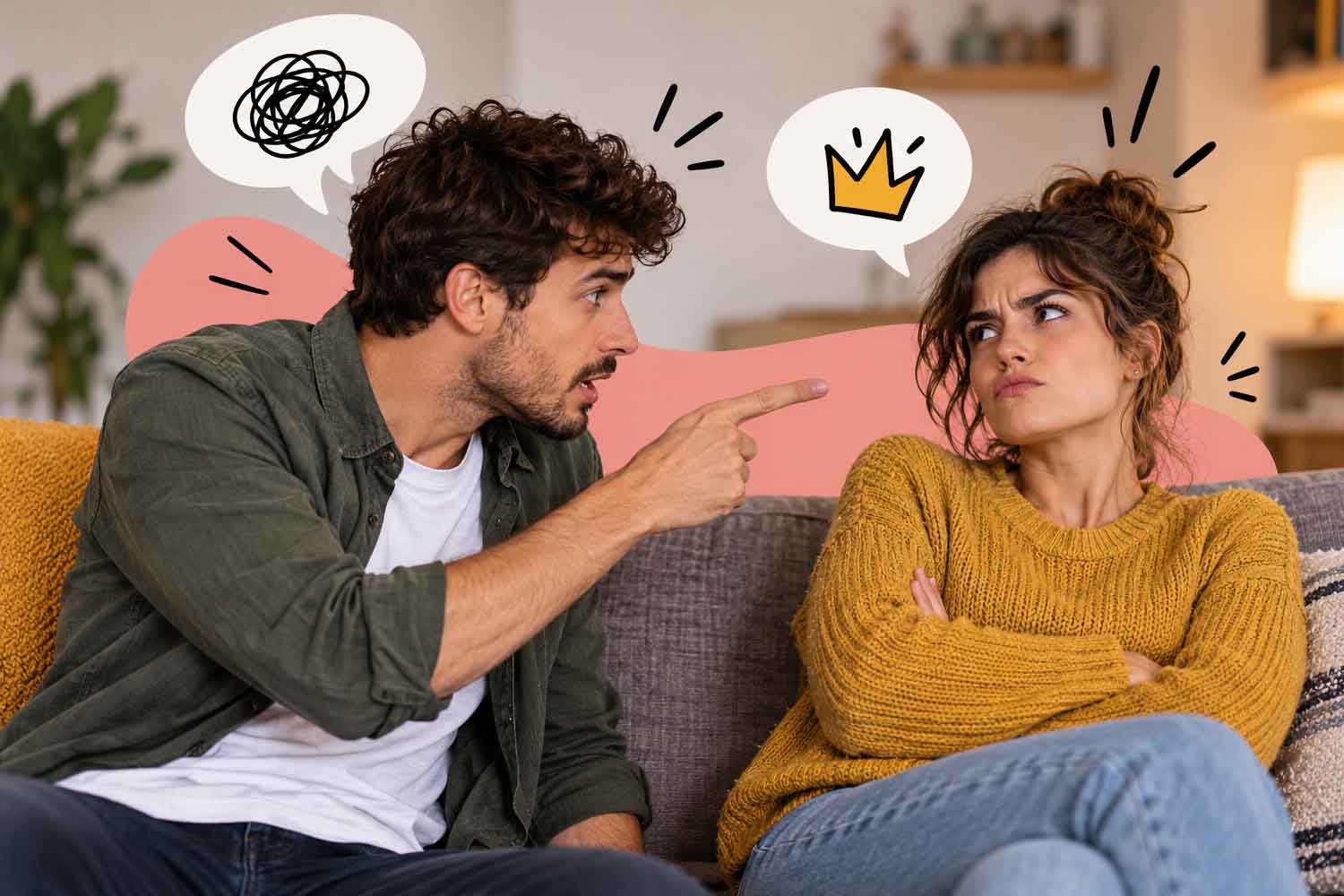
Someone who always wants to have the last word in an argument can be as satisfied with their relationship as someone looking for a compromise. This was stated by some participants in a study conducted in Türkiye on 978 adults. Good news for lovers of the last word, although it would be better not to take advantage of it: research does not show that imposing yourself is good for the couple.
The study published on Collaborate: Psychology by Seçil Keskin and Fatma Can, researchers from Bolu Abant İzzet Baysal University, identified five profiles associated with different ways of dealing with conflicts. And the differences also concern trust, jealousy and sentimental satisfaction.
After all, it doesn’t take much to argue. A forgotten bill, a visit to relatives, the dishwasher loaded the “wrong” way.
“I told you.”
“And I answered you.”
“You didn’t listen to me.”
“Why didn’t you agree with me?”
Four jokes and the dirty dishes have already become a matter of principle. There are those who try to resolve it, those who want to be right and those who give in to recover domestic peace. The researchers tried to understand what these tendencies have in common, cross-referencing the responses to questionnaires on emotional attachment, fear of losing a partner and conflict management. Five individual profiles emerged. The following dialogues are imaginary examples to understand them, because the study did not directly observe the arguments.
Safe-Harmonious: those looking for a compromise
The largest group, 50.2% of the sample (491 people), was defined as “safe-harmonious”. It includes people who experience the relationship with relative tranquility, have little fear of abandonment and, when a problem arises, tend to seek an agreement.
“I always do the cleaning.”
“You’re right, I’ll take care of it this week.”
Such a response would well represent the willingness to compromise. The problem is recognized, a solution is sought and no one necessarily wins. This group reported high levels of trust, commitment and romantic satisfaction. So far, everything is quite predictable.
Safe-dominant: those who always want to be right
Then come the “secure-dominant”, 18% of those interviewed (176 people). They too show good emotional security and a fair willingness to compromise, but during discussions they definitely tend to want to prevail.
“Okay, let’s do as you say.”
“Perfect.”
“But admit that my idea was better.”
The agreement is reached. The discussion, obviously, can continue. Yet, in the questionnaires, these participants declared a sentimental satisfaction practically identical to that of the first group: 7.90 points versus 7.84, on a scale of 1 to 9. The difference is not statistically significant. Trust and commitment are also similar.
Be careful, however: wanting to prevail does not necessarily equate to behaving in an aggressive or domineering manner. The research measures a declared tendency to want to win, without establishing how this manifests itself concretely. A person can therefore feel secure in their relationship and continue to experience discussions as small competitions. Romantic security, it seems, does not automatically guarantee a career in diplomacy.
Fearful-avoidant: someone who fears being left, but struggles to get closer
20% of those interviewed (196 people) belong to the “fearful-avoidant” profile. Here the fear of losing the partner’s affection and a certain difficulty in managing emotional closeness coexist.
“I see you distant, is something wrong?”
“Nothing.”
“Then why don’t you talk to me?”
“Because I don’t want to talk about it right now.”
It is a possible example of a situation in which the need for reassurance clashes with the difficulty in opening up. The person wants to feel loved, but emotional closeness can become difficult to manage. In the sample, this group showed lower willingness to compromise, greater reactivity during conflicts, and lower levels of trust and satisfaction compared to the two confident profiles.
Anxious-unstable: someone who wants to dominate the discussion but gives in to the other’s requests
Then there are the “anxious-unstable”, 7.5% of the sample (73 people). Here the anxiety of losing the partner reaches the highest levels, together with the emotional reactivity during arguments. The peculiarity is that these people show two apparently opposite tendencies: wanting to dominate the discussion and giving in to the other’s requests. An unanswered message, for example, could fuel an argument.
“I wrote to you two hours ago.”
“I was at work.”
“But you were online.”
“I couldn’t answer.”
“Okay, sorry, let’s forget about it.”
In this brief imaginary exchange, insistence and renunciation coexist. The study detected both trends in the profile, although it does not allow us to know whether they actually alternate in the same person. According to researchers, a strong fear of rejection can lead to perceiving even a disagreement as a threat to the relationship.
This group also has the highest levels of jealousy related to suspicion and controlling behaviors. Yet, participants claimed to have invested a lot in their relationship. You can be deeply attached to someone and still experience that relationship with a lot of anxiety. The amount of energy invested, evidently, does not guarantee that it is spent well.
Detached-avoidant: when detachment takes the place of confrontation
The smallest group, the “detached-avoidant” one, includes 42 people, 4.3% of the sample. Here a strong emotional distance prevails, accompanied by a particularly low willingness to compromise.
“Can we talk about it?”
“Do as you wish.”
Three words that, depending on the situation, can mean many things. A momentary renunciation, the desire to interrupt the discussion or a substantial disinterest. Alone, of course, they are not enough to identify this profile. In fact, the researchers found low scores in several conflict management strategies, including the avoidance of arguments. They therefore hypothesize a more general form of disengagement, without being able to describe how it manifests itself in daily life.
It is also the group that reported the lowest levels of trust, commitment, investment in the relationship and sexual satisfaction. Taking a break during an argument, perhaps to avoid saying words you regret, can be reasonable. Systematically ignoring problems is another matter. And the questionnaires do not allow us to establish what behavior these people actually adopt.
Jealousy is not all the same
There is another curious result. Participants in the two most secure profiles reported relatively high levels of emotional jealousy, despite declaring greater trust in their partner.
The explanation comes from the questions used.
The researchers distinguished three forms of jealousy: the emotional one, linked to the reactions to a possible threat to the relationship; the cognitive one, made up of doubts and suspicions; and the behavioral one, which can translate into controls.
“I saw you flirting with that person.”
“We were just talking.”
“It didn’t seem like it to me.”
Feeling annoyed by a situation like this is different from constantly suspecting a betrayal.
“Who were you with?”
“With colleagues.”
“And why didn’t you send me a photo?”
Here also appears the attempt to verify what the other is doing. The questionnaires included situations related to flirting, suspicions and questions about the partner’s movements.
An intense emotional reaction can therefore coexist with good trust in the relationship. In the anxious-unstable profile, however, the highest mean scores concerned suspicion and controlling behaviors, although not all differences between groups were statistically significant for the latter.
And then there’s the sex. Among the 671 sexually active participants, the two secure profiles generally showed greater satisfaction than the fearful-avoidant and detached-avoidant groups. The anxious-unstable group, however, reported relatively high sexual satisfaction, similar to that of the secure profiles for some measures. You can therefore have a satisfying sex life and still manage anxiety and jealousy quite poorly. The different components of a relationship do not necessarily all proceed in the same direction.
Before assigning a label to your partner
Before recognizing your sweetheart in one of the five profiles, you need to consider some details. The 978 participants lived in Türkiye and had an average age of approximately 25 years. The recruitment started from some university classrooms, and then continued through personal referrals. The sample included primarily young adults with a relatively high level of education. Furthermore, 63% were dating someone they didn’t live with, while around a fifth were married. The researchers also found similar configurations when comparing married and unmarried people, but the percentages identified do not represent all couples.
Above all, the study collected individual responses, without directly observing the arguments or systematically comparing the two partners’ versions. Someone, therefore, could describe themselves as a patient, reasonable and always willing to compromise person. Your significant other may have a lot to add to the description.
The five profiles are statistical classifications, not psychological diagnoses. The research photographs only one moment of love life and cannot establish whether a certain way of arguing makes you happier or how it changes over time. An interesting finding remains: People who are equally confident in their relationships can approach conflict in very different ways. And those who invest a lot in a relationship can still experience it with anxiety and suspicion.
To better understand these dynamics, research will be needed that observes the discussions and involves both partners. For now we have five profiles built on what people say about themselves. The version of those who were on the other side of the discussion is still missing. And, since it’s a couple’s argument, he might have some objections.
