

These systems allow you to exploit the heat present in the external air to heat the rooms and produce domestic hot water, using electricity. Furthermore, many models can also be used to cool the home during the hot season: a versatility that makes them a solution to be used at different times of the year, with a single system capable of meeting comfort needs in both winter and summer.
But how to choose the most suitable heat pump?
There is no ideal model for all homes: you need to consider the size of the house, the level of thermal insulation, the climate of the area where you live and the characteristics of the heating system already present. Even the possibility of integrating the heat pump with a photovoltaic system, the ease of installation, the silence and the intelligent management of consumption can make the difference.
A fundamental aspect then concerns energy efficiency. Heat pumps transfer thermal energy rather than producing it solely through combustion or electrical resistance, and can therefore provide more heat than the electricity they consume. Actual performance, however, depends on operating conditions and building characteristics. For this reason it is best to rely on a professional who evaluates the heating needs of the home and correctly dimensions the system, avoiding both insufficient power and an oversized system.
The refrigerant used is also a feature to know. Among those used in new generation heat pumps we find propane (R290), a natural refrigerant with a very low global warming potential (GWP), equal to 0.02, and R32, used in other models.
It is also important to evaluate the delivery temperature, i.e. that of the water sent to the heating system, because it affects compatibility with the terminals present in the house.
The best heat pumps on the market
We have selected three solutions that respond to different needs: a connected heat pump, designed to manage energy together with photovoltaics and storage; an indoor solution, without external unit, suitable for contexts with architectural or space constraints; and an outdoor monobloc, available in eight sizes from 4 to 14 kW to adapt to different heating needs.
Viessmann Vitocal 200-A intelligent energy
With the new Vitocal 200-A intelligent energy (ie), Viessmann is focusing on an air-water heat pump that combines energy efficiency, versatility and intelligent system management. Designed for both new buildings and energy requalification interventions, this solution is designed to adapt to different types of homes and to accompany the evolution of domestic needs over time.
One of its strong points is the ability to reach a delivery temperature of up to 75 °C. This feature expands the possibilities of using the heat pump even in existing buildings equipped with traditional radiators, allowing the existing terminals to be maintained without the need to intervene on the system. The range includes powers from 6 to 12 kW, so as to allow a choice commensurate with the heating needs of the house.
Vitocal 200-A ie is a monobloc heat pump: the hydraulic circuit is integrated into the outdoor unit, together with the circulation pump and the electric resistance. The project aims to reduce overall dimensions and simplify handling and installation operations. Added to this are pre-configured and modular internal units, designed to make the design and maintenance of the system easier.
The machine uses the natural refrigerant R290, characterized by a declared global warming potential of 0.02, and reaches the A+++ energy efficiency class in the conditions foreseen by the labelling. The reversible operation also allows you to manage heating in winter and cooling in summer, as well as the production of domestic hot water.
The focus is not limited to performance. The compact structure and the front grille with an essential design were awarded the iF Design Award 2026. The fan, optimized from an acoustic point of view thanks to the Advanced Acoustic Design technology, helps to make the Vitocal 200-A ie particularly silent during operation, an aspect to consider especially when the outdoor unit is installed near other homes.
However, the feature that most distinguishes this solution is the possibility of inserting it into a connected energy system. Through Viessmann One Base Intelligence and the universal Controller, the heat pump can communicate with other components, such as photovoltaic systems and storage systems, contributing to the coordinated management of energy flows. Control via the ViCare app allows you to manage operation more easily, while the software updates and open architecture are designed to facilitate the integration of compatible devices in the future.
Vitocal 200-A ie is therefore aimed at those looking for a home air conditioning system that can become the center of a larger energy system, with the possibility of gradually integrating new technologies and functions.
Midea H-Pack: the heat pump without an external unit
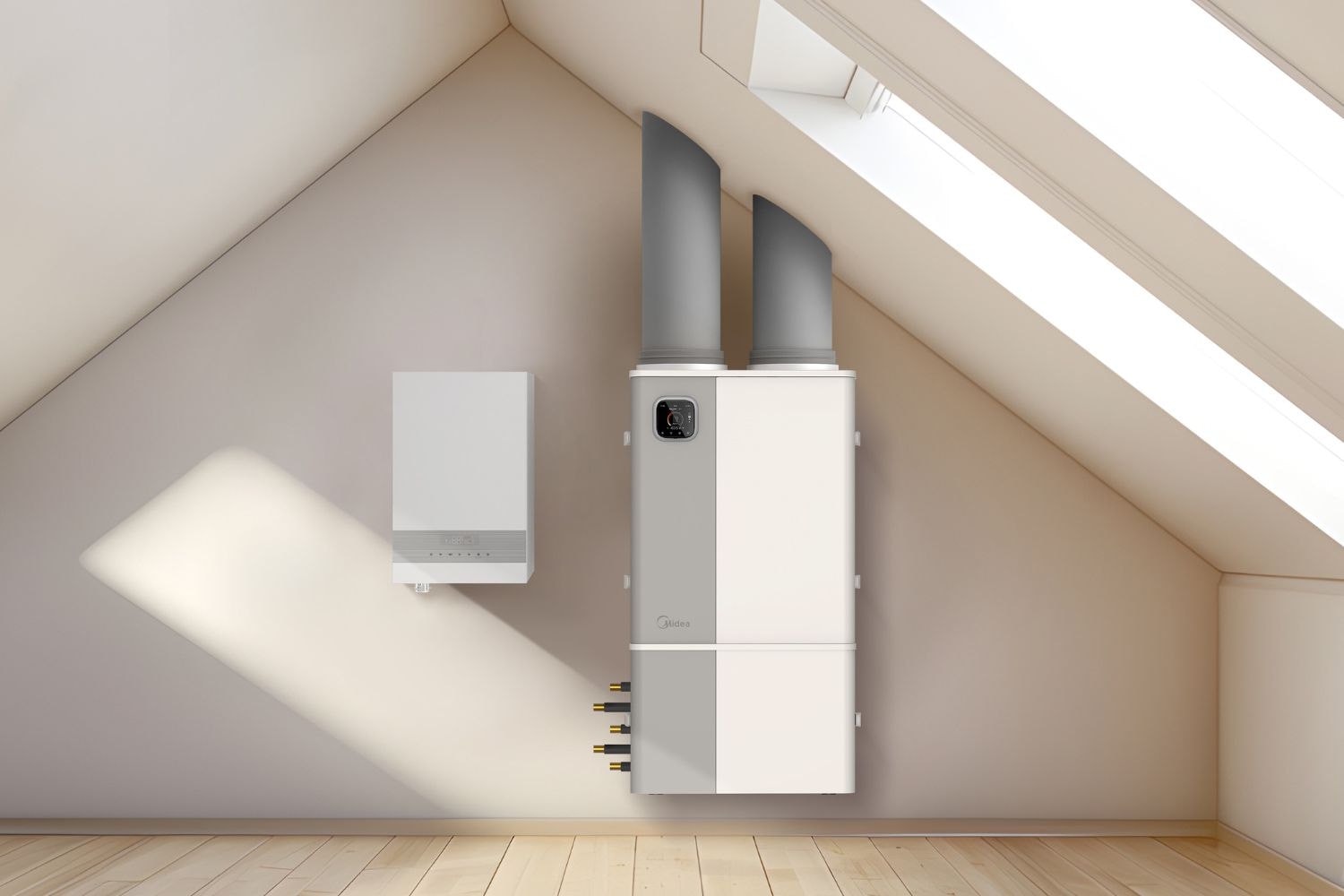
When considering the installation of a heat pump, one of the obstacles can be the location of the outdoor unit. In some condominiums, historic buildings or homes with limited space, finding a suitable location is not easy and there may be architectural constraints to respect. It is precisely this need that Midea HPack responds to, an air-water heat pump designed to be installed entirely inside the building, without the traditional external unit.
The solution is designed both for new homes and for the energy requalification of existing buildings. Its indoor configuration allows the system to be placed in a technical room or in a suitable service compartment, using special ducts to suck in external air and expel the outgoing air. It therefore does not mean that connections with the outside are not necessary: it changes the way in which the passage of air is managed, without requiring a machine installed on the facade or balcony.
HPack focuses on flexibility even when working on an existing system. It can be integrated into a hybrid configuration with a boiler or used in a fully electric solution, depending on the chosen configuration and the characteristics of the building.
The possibility of reaching delivery temperatures of up to 75 °C in operation with the heat pump alone and up to 90 °C in a hybrid configuration allows it to be evaluated even in the presence of traditional radiators. In the latter case, reaching the highest temperature requires the contribution of the boiler. However, the technician will verify the conditions necessary to obtain adequate performance.
From an energy point of view, Midea H-Pack reaches an efficiency class of up to A+++ and uses the natural refrigerant R290, characterized by a low global warming potential. The declared thermal capacity Pdesignh is 5kW. For the fully electric configuration, an optional hydrobox with 3 kW auxiliary electric resistance is also available, which can contribute to heating in moments of greatest demand.
Daily management has also been designed to make use easier. The system offers control and management functions via app, allowing you to monitor and regulate its operation even remotely. The structure is also designed to facilitate access to the main components and make installation and maintenance operations easier.
The most obvious advantage of HPack is therefore the possibility of evaluating a heat pump even when the installation of a traditional external unit presents difficulties. Before choosing this solution it is however necessary to check the availability of adequate internal space, the feasibility of the ducts for air exchange and the compatibility with the existing system.
Riello NXHP 004-014
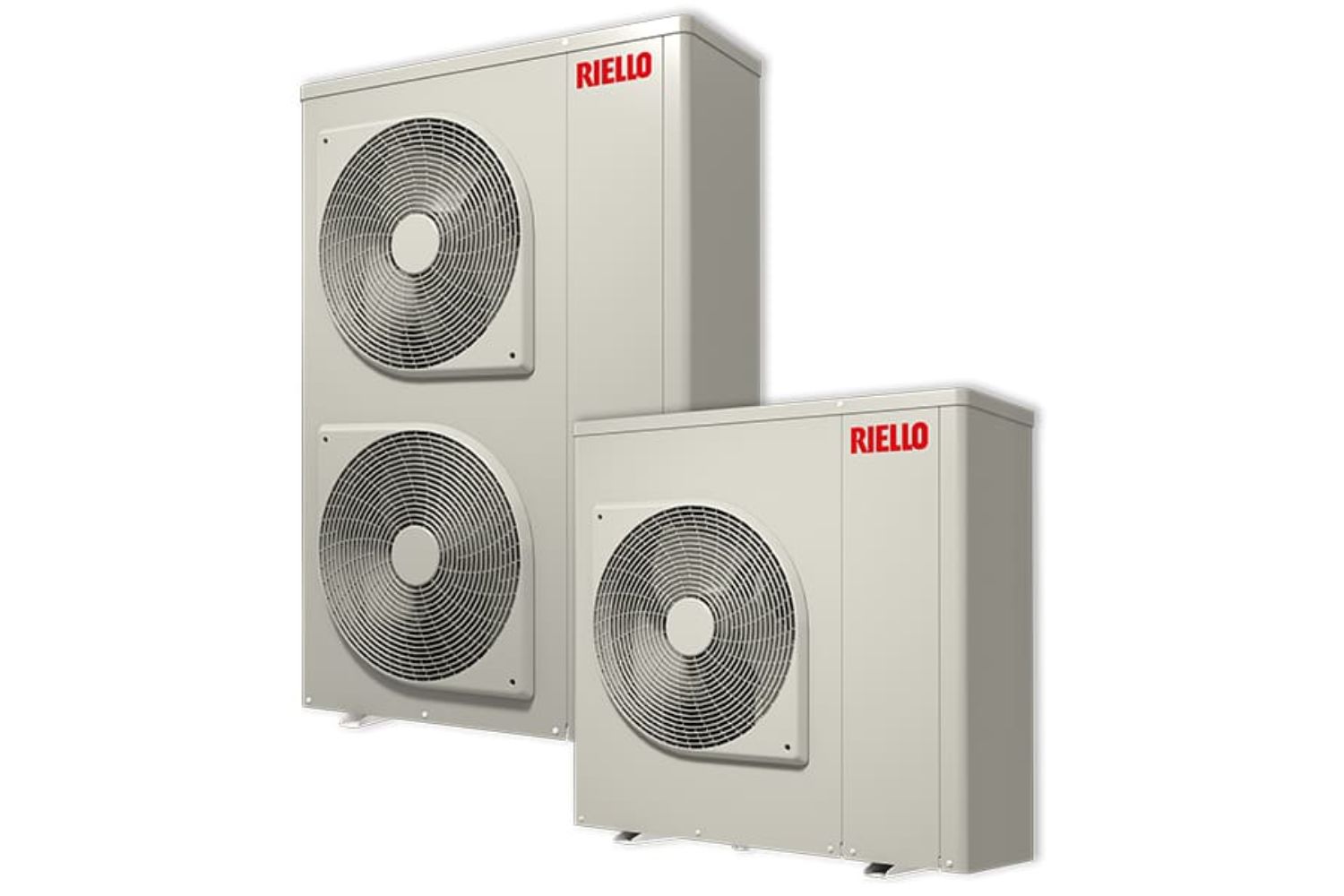
Riello also offers heat pump systems designed to manage multiple home needs through a single system. Among these is the NXHP 004-014, a monobloc air-water heat pump, designed for the heating and cooling of rooms and, depending on the configuration of the system, also for the production of domestic hot water.
The range includes eight models, with heating powers from 4 to 14 kW, to adapt to different living needs. It uses the natural refrigerant R290, with a global warming potential (GWP100) of 0.02, and reaches the A+++ energy class with water at 35°C and A++ at 55°C in heating.
The delivery temperature can reach up to 75 °C, a feature that allows it to also be combined with systems with radiators, as well as underfloor radiant systems and fan coils, depending on the characteristics of the system.
The compressor with DC inverter technology modulates the power according to the actual heating needs, while the compact dimensions and low weight facilitate installation even in small spaces.
The machine is equipped as standard with the WUI control, which allows you to manage heating, cooling and domestic hot water; the same command can control up to four units connected in cascade.
How to choose the most suitable heat pump for your home
The solutions we have seen show how today there are heat pumps designed to meet different housing needs: from models that allow energy to be intelligently managed and integrated with photovoltaic and storage systems, to indoor solutions, useful when it is not possible to install a traditional external unit, up to monobloc systems available in different powers.
But how to orient yourself in the choice? It is not enough to look at the energy class or the performances indicated in the technical data sheet. It is also important to evaluate the characteristics of your home, the level of insulation, the type of heating system already present and the space available for installation. The costs must also be considered as a whole: in addition to the price of the machine, installation, any adjustments to the electrical or hydraulic system and maintenance must be taken into account.
The most suitable heat pump is not necessarily the most powerful or with the greatest number of functions, but the one chosen and sized based on the real needs of the home. This is why it is important to rely on a qualified installer, who can evaluate the building’s heating needs and identify the most suitable solution. A correctly designed system is in fact the first step towards achieving good home comfort and making the most of the energy consumed.
