
@wikimedia
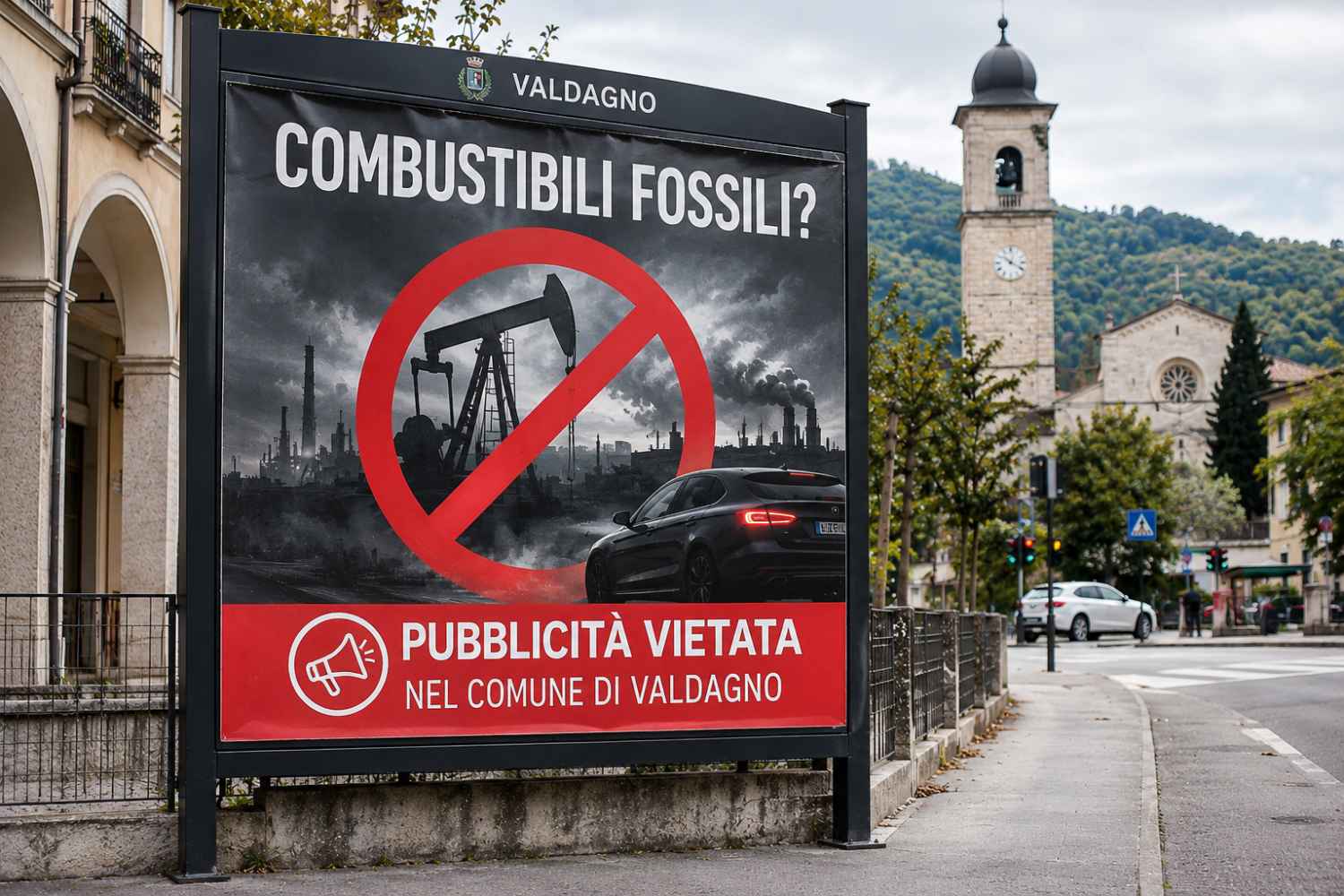
Moving from good intentions to concrete actions is always the most difficult part. In Valdagno, in the province of Vicenza, they succeeded: it is the first Italian municipality to implement the ban on fossil fuel advertising. The City Council approved the update of the Plan for advertising and public billboards, which prohibits the installation, display and dissemination of advertising messages in favor of fossil fuels or products fueled exclusively by them.
The ban applies within 150 meters of what the regulation defines as sensitive places: hospitals, squares, schools, parks, retirement homes and public transport areas. A band that, in fact, covers a very large portion of the municipal territory. The distinguishing factor is the power of the advertised product: an advert for a car that runs exclusively on diesel falls within the ban, that of a hybrid does not.
The novelty lies entirely in the transition from the political direction to the norm. Florence, Genoa, Monza and, more recently, Rivoli had already approved motions committing their respective administrations to introduce restrictions on the advertising of fossil fuels and activities with high CO₂ emissions. However, these are declarations of intent, which in order to become effective require a subsequent act, Valdagno accomplished this act.
The idea was brought to Veneto by the Padua Climate Action Week, the event promoted by Aequilibria which in April ended with an appeal to Italian municipalities to move in this direction.
We became aware of this initiative at a European level thanks to the Padova Climate Action Week, which is trying to promote it at an Italian level,
says mayor Maurizio Zordan. For the mayor, the choice is consistent with the history of the area: the Agno Valley first invested in hydroelectric power, then joined the PAESC and recently supported a biomass district heating project for a large part of public buildings.
From a strategic point of view, guidance, including direction, is needed to be given to citizens, so that we can all work together on the energy transition, he adds.
For Daniele Pernigotti, CEO of Aequilibria and creator of Padova Week, Valdagno took a step further than what was asked:
He took up that call by moving from political commitment to a concrete and applicable tool.
And he underlined how the Vicenza Municipality is not an isolated case. In the Netherlands there are already 18 administrations that have introduced or started restrictions on fossil advertising, and in the world there are more than 60 cities and territories that have adopted measures of this type. In 2024, the UN Secretary General António Guterres also asked governments to ban advertising by companies in the sector.
And in Europe?
Looking at Europe, the tools chosen are different: ranging from municipal regulations to policies on advertising spaces managed by administrations. The scope also changes, as bans can cover only fossil fuels or extend to carbon-intensive goods and services, such as flights, cruises and combustion cars. The Hague, for example, has been applying a ban included in municipal legislation since 2025 and also confirmed in court. Amsterdam has introduced restrictions in 2026 that affect fossil fuels, flights, cruises, fossil energy contracts and combustion vehicles. In the United Kingdom, Edinburgh has excluded various categories linked to fossil fuels and high-emission products from advertising spaces controlled by the Municipality, and similar measures have also been introduced or started by other British and Swedish administrations.
Behind these measures there is also a cultural issue.
Advertising contributes to forming our imagination and therefore to establishing what acquires a positive or negative value,
observes Pernigotti.
Banning the advertising of fossil fuels is a first step towards building a collective thought that accompanies the transition away from fossil fuels, a scenario recognized internationally as fundamental for tackling the climate crisis.
For other municipalities to follow Valdagno’s example, however, a bit of technical clarity is also needed. Aequilibria is working with CEN, the European Committee for Standardization, on a common framework that establishes with scientifically based criteria which goods and services can be considered high carbon intensity in advertising and commercial communications.
We must make solid and shared criteria available to the administrations – concludes Pernigotti – which allow the activities involved to be clearly identified and the political directions to be transformed into concretely applicable measures.
