
Italy recycles more than the European average, but continues to depend heavily on energy imports; electric cars are increasing, but there are still few; cities invest in climate adaptation, while greenhouse gas emissions start to grow again. And, despite increasingly frequent droughts, we continue to waste over 40% of the water released into water networks.
It is a photograph made of contradictions and delays that emerges from the Report on the State of the Green Economy 2026, presented at the opening of the XV edition of the General States of the Green Economy, organized by the Foundation for sustainable development as part of Ecomondo, in Rimini.
A budget that immediately highlights an issue: Italy is proceeding too slowly with respect to the environmental objectives that it has committed to achieving by 2030 and this while the climate crisis is hitting our country with increasing intensity.
In Italy we are experiencing an overall critical situation in the transition to the Green Economy, with some limited positive signs, declared Edo Ronchi, president of the Foundation for Sustainable Development, underlining however how an Ipsos survey reveals a growing push towards sustainability on the part of citizens and businesses.
Italy still far from its objectives
The climate
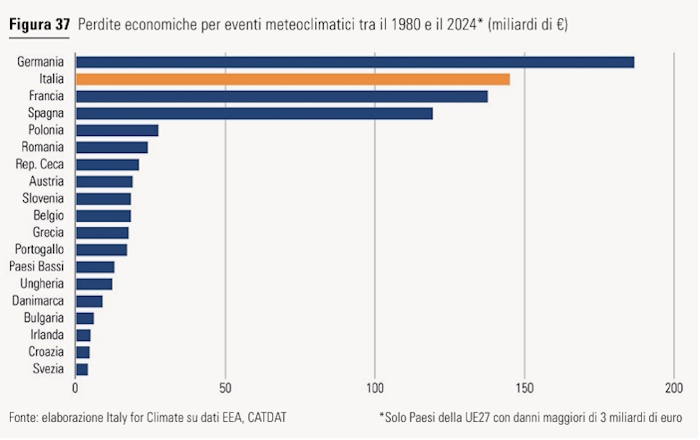
The first data concerns the climate. Italy is located in the Mediterranean, one of the planet’s climate hotspots, where temperatures are rising faster than the global average. Over the last 50 years, the national average temperature has increased by more than 2°C and, according to the Report, more than 2,300 extreme climate events were recorded in 2025 alone. Summer 2026 also saw a particularly prolonged and simultaneous extension of extreme heat warnings in numerous Italian cities.
Also worrying is the trend in greenhouse gas emissions, which will increase again in 2025 after years of reduction.
Between 2015 and 2024, Italy cut an average of 7 million tonnes of greenhouse gases per year. To meet the objectives of the Integrated National Energy and Climate Plan (PNIEC), from 2026 it should reach 14 million tonnes of annual reductions, double the pace maintained in recent years. An acceleration that, at the moment, cannot be seen.
Late renewables
In 2024, renewable sources represented just 19.6% of overall Italian energy consumption, compared to a European average of 25.2%. The national target set for 2030 is 39.4%. As regards electricity production, in 2025 the contribution of renewables was 47%, still far from the 70% expected by the end of the decade.
And new installations are not growing fast enough: in 2025, Italy added 7.2 GW of renewable capacity, compared to 23.3 GW in Germany and 10.8 GW in Spain. To achieve the national objectives it would be necessary to reach a rate of around 10 GW per year.
Added to this is a structural problem: Italian energy dependence on foreign countries stands at around 74%, compared to a European average of 57%. A vulnerability that also exposes the country to price fluctuations and international geopolitical tensions.
Circular economy
If the shadows prevail over climate and energy, the circular economy represents one of Italy’s main strengths. In 2024 the circular use rate of materials, i.e. the share of secondary raw materials reintroduced into the economy, reached 21.6%, against a European average of 12.2%.
The productivity of resources is also higher than that of the main European partners: in 2025, Italy generated 4.6 euros of GDP for each kilogram of materials used, compared to the 3 euros of the EU average. Furthermore, in 2025, 77.3% of packaging waste was recycled.
However, an important limit remains: 47.1% of the materials used by our country depend on imports, a percentage more than double the European average of 22.1%.
We are therefore capable of recovering and using resources efficiently, but we continue to depend heavily on foreign supplies.
Waterfall
Italy is the European country that consumes the most water for civil and industrial uses and occupies second place, after Spain, for withdrawals intended for agriculture. Yet, water availability per inhabitant is less than half the European average, with around 2,260 cubic meters per year.
According to ISPRA data referred to in the Report, climate change has already contributed to reducing water availability by 20% compared to the beginning of the twentieth century. The paradox is that over 40% of the water introduced into Italian water networks is wasted.
Even the reuse of purified water remains marginal: according to ENEA estimates, just 4% is recovered, compared to a national potential that could reach 23%.
@States General
Mobility
Some positive signs are coming from the automotive market. In the first half of 2026, the share of battery electric car sales rose from 5.2% to 8.4%, while plug-in hybrids went from 5.3% to 9%. In the same period, the market shares of petrol and diesel cars decreased, falling to 19.7% and 6.8% respectively.
But while the automotive market changes, local public transport continues to struggle with insufficient resources.
Between 2015 and 2025 the National Fund for public transport grew nominally by 6%, but, considering inflation, it lost 13.5% of its real value, equivalent to approximately 660 million euros. A figure that highlights how the mobility transition cannot be limited to the replacement of private cars.
Organic farming in decline after ten years of growth
There is no good news even from organic farming. After a decade of expansion, in 2025 certified and in-conversion surfaces decreased by 5.4% compared to the previous year.
A significant setback, considering that between 2015 and 2024 the surface area dedicated to organic crops increased by 59.3%. Sicily and Puglia remain the regions with the greatest presence of organic agriculture, while the value of PDO and PGI production continues to grow, reaching 20.7 billion euros.
Meanwhile, the effects of the climate crisis are weighing more and more on agricultural production: according to data from the European Environment Agency reported in the Report, drought is responsible for 54% of agricultural losses linked to climate events, while intense rainfall accounts for 21%.
Cities are trying to change
Finally, among the most encouraging elements of the Report, the role of Italian cities emerges, where initiatives to address the effects of climate change are multiplying. Thanks also to the interventions financed by the PNRR, several administrations have launched adaptation measures, from the creation of climate refuges to the reduction of heat islands.
Projects for so-called sponge cities are also spreading, which include permeable surfaces, green areas and rainwater collection and management systems to reduce the risk of flooding and conserve water resources for use in periods of drought.
They are interventions that show how the ecological transition can translate into concrete changes in the daily lives of citizens, even if structural delays and investment gaps remain to be overcome.
@States General
The photograph of the States General of the Green Economy 2026 therefore shows a country at two speeds: if on the one hand there are good performances in the circular economy, the growth of electric mobility and city initiatives, on the other we have to deal with emissions that are not decreasing enough, renewable sources that are still insufficient, water waste and inadequate investments in public transport.
Meanwhile, 2030 is approaching and, at the current pace, climate and energy objectives risk remaining only on paper.
HERE you can find the complete report.
