
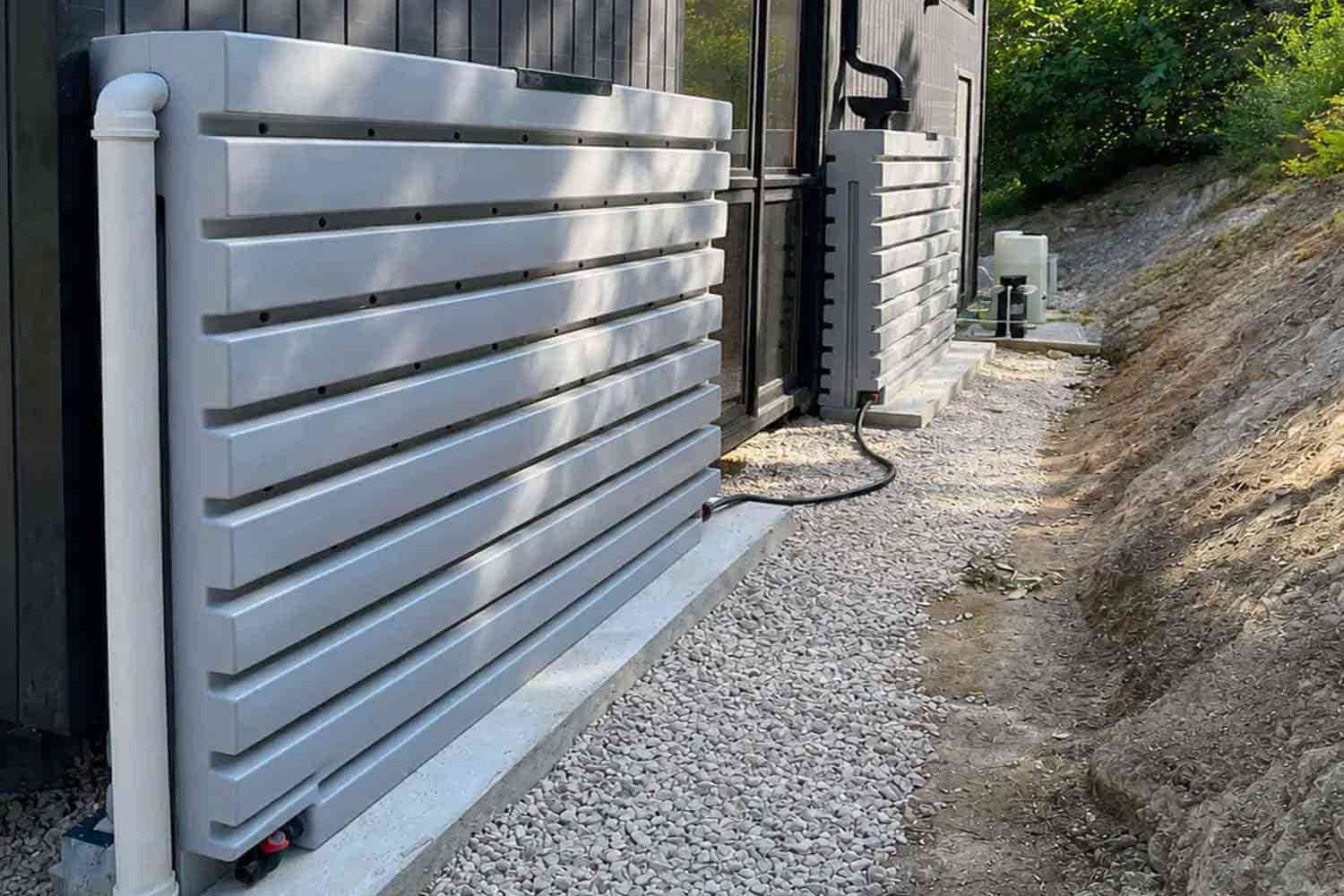
A tank capable of collecting 1,000 liters of rainwater, just 30 centimeters thick and discreet enough to look like a normal fence. This is the idea developed by Harves Technology, a Turkish company that has transformed the traditional garden cistern into a modular wall, designed especially for those who have little space and would like to avoid taking up a large part of the land with a bulky plastic container.
It is called Harves Rainwater Wall and has rather particular dimensions: 225 centimeters wide, 175 centimeters high and only 30 centimeters deep. In this structure there is room for approximately one thousand liters of water, equivalent to one hundred ten-litre watering cans. A reserve that can be useful during the drier periods, especially for those who have a vegetable garden, flowerbeds or a garden that needs to be watered regularly.
How the wall that collects rainwater works
The operation exploits a principle already known by those who use traditional rainwater recovery systems. Rain falling on the roof is channeled through the gutters and directed towards the tank.
Before entering the structure, the water passes through a filter that traps leaves, sand and other debris. Once accumulated, it can be withdrawn through a tap or used with a pump to power an irrigation system. The peculiarity lies in the shape. According to specifications published by Harves Technology, the tank is made of linear low-density polyethylene (LLDPE), a resistant plastic material, with walls approximately 6-7 millimeters thick.
The manufacturer proposes it as an alternative to the large cylindrical or cubic containers that are usually placed next to homes. The panel can be installed along a facade, near a fence or used as an independent divider between two areas of the garden. Three shades of gray are also available, from anthracite to concrete, to match the look of the building.
From 1,000 to 5,000 litres, without taking up the whole garden
The structure is modular: the panels can be connected to each other to increase the quantity of stored water. With two elements you get to 2,000 litres, with three to 3,000 and with five to 5,000 litres. An interesting solution especially when you have a sufficiently long wall, but little free surface.
However, there is a detail to consider before thinking about placing the tank next to the first available fence: a thousand liters of water weigh about a ton. The panel, once full, therefore exerts a considerable load on the ground and on the support systems. You need a stable and adequate base, correctly sized fixings and, in the case of an independent structure, suitable supports.
The presence of a wall does not automatically mean that it is suitable for supporting the system. It is also necessary to prepare connections with the gutter and an overflow drain, which is essential when the tank reaches its maximum capacity. Filling also depends on local conditions. A 100 square meter roof, during a 10 millimeter rainfall, theoretically receives 1,000 liters of water. The amount actually recoverable will be lower due to the losses and efficiency of the system.
How much does the Harves Rainwater Wall system cost?
Saving space comes at a price. On the European commercial site of Harves, the 1,000 liter module is offered at a recommended price of 1,099 euros, including VAT at 21%. The 2,000 liter configuration costs 2,149 euros, while the 5,000 liter configuration reaches 5,195 euros.
The figure includes the panel, the filter and standard supports for fixing. However, the fittings, any pump, transport and installation remain to be considered. As for economic convenience, a traditional tank of the same capacity can cost significantly less.
Even assuming a saving of 4 euros for each cubic meter of tap water replaced, approximately 275 full uses of the tank’s capacity would be needed just to recover the initial price of 1,099 euros. A purely indicative calculation, which excludes installation, maintenance and differences between water tariffs. The main advantage therefore remains the possibility of conserving a good quantity of water using a space that could otherwise remain unused.
Can the recovered water also be used for other jobs?
The accumulated rainwater can be used to irrigate plants, vegetable gardens and lawns, but also to clean garden tools and furniture. Being generally low in limestone, it can also be useful for some outdoor cleaning jobs. However, the tank filter does not make the water drinkable.
For any domestic uses, such as supplying the toilet flush, dedicated systems are needed, separated from the water network intended for human consumption and compliant with the applicable rules. It must also be remembered that the storage capacity does not guarantee continuous availability during drought. Once the thousand liters are used up, new rainfall will be needed to fill the tank.
Harves Rainwater Wall therefore offers a concrete solution to a very common problem in small gardens: finding space to collect rainwater without sacrificing that intended for plants or people. The classic tank remains cheaper. The tank wall, on the other hand, uses a surface that we often already have available. You just need to check that it is the right one to hold a ton of water.
