
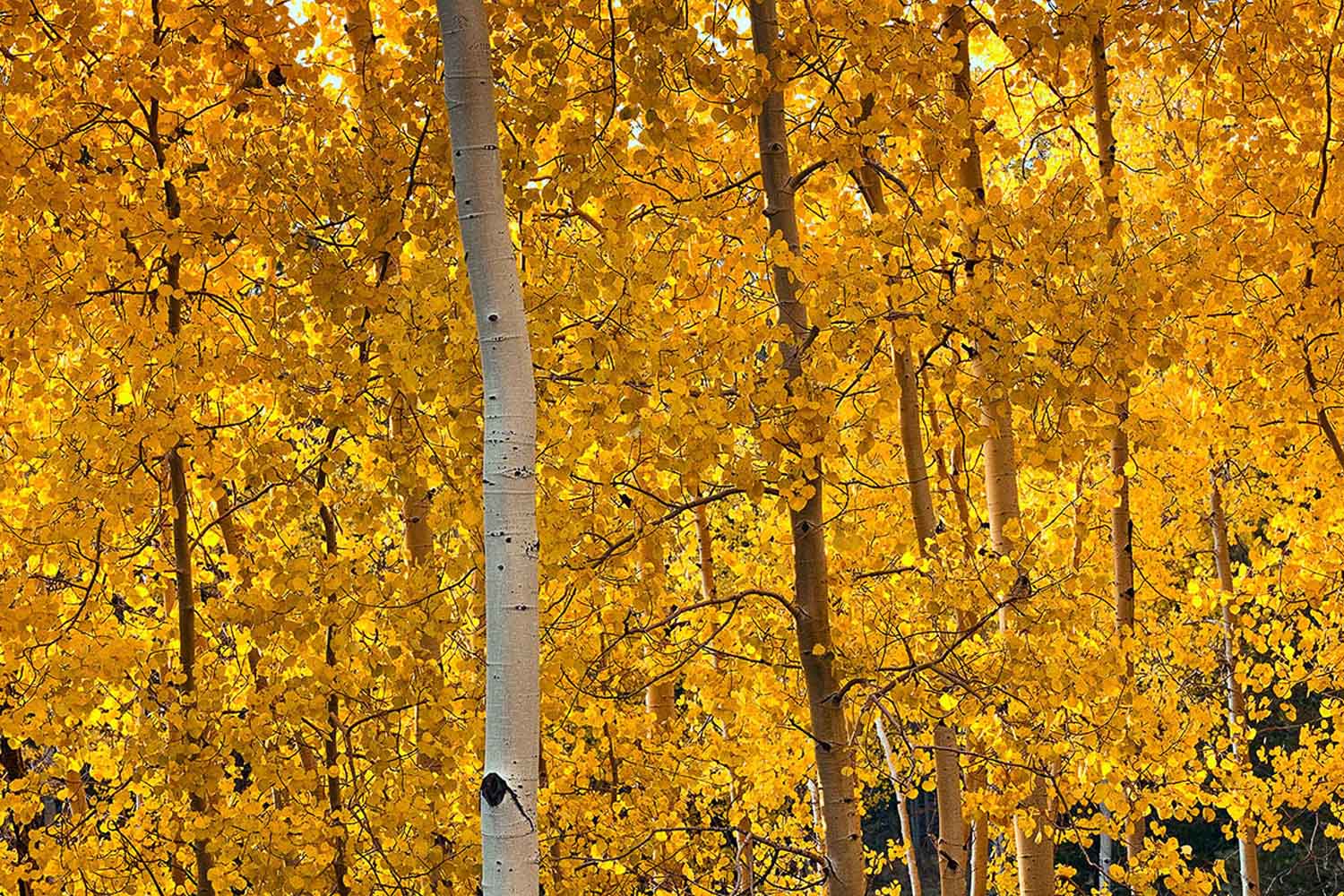
Aspen trees may retain a memory of the drought and use it the following year to produce more insect-deterring chemicals. Even when water becomes available again and the old leaves have fallen, the new ones still carry the consequences of the previous summer. In the experiment, these defensive substances increased by up to 11%.
The discovery comes from a University of Utah study published in aNew Phytologist on September 13, 2026. For three years, the researchers observed how 360 young cottonwood trees (Populus tremuloides) reacted to periods of controlled drought, discovering that some of the tree’s responses continued to manifest themselves even in the following growing season.
A surprising feature, especially for a species that completely loses its leaves every autumn and has to rebuild its foliage every spring.
The new leaves are reminiscent of the previous year’s drought
The protagonists of the study are American aspens, trees recognizable by their light bark and leaves that vibrate at the slightest breath of wind, until they become an intense yellow in autumn. They populate the mountains of North America and can form entire forests through clonal reproduction, with numerous trunks sharing the same genetic heritage.
To study them, the group coordinated by Talia Karasov and William Anderegg, together with researcher Aubrey Hawks, collected plant material from five national forests in Utah and Colorado, subsequently cultivating it in an experimental field at the university. From 2021 to 2023, some groups of trees received regular water, while others received reduced watering, up to a quarter of that reserved for control specimens. In some cases, after a particularly dry summer, irrigation has returned to normal.
And it is by observing the latter that the researchers found the most interesting result. In 2022, poplars that had experienced drought during the previous year had 11% more salicinoid phenolic glycosides than regularly irrigated trees in 2021. In 2023, the same comparison showed an 8% increase.
These are natural substances that make the leaves less attractive to numerous herbivorous insects. Their concentration, however, did not show a significant increase during the first year of drought. In short, the most marked response arrived with a certain delay. As if the trees kept a trace of the conditions they went through and continued to modify their defenses even after the end of the water stress.
A chemical defense that can make the difference
According to Karasov, these compounds can represent up to 20% of the weight of a dried leaf. A considerable amount, especially considering that producing defensive substances requires resources that the plant could use to grow. Yet in the experiment, the researchers found no evidence that increasing these particular defenses resulted in reduced growth.
There is also another interesting fact. Trees with higher concentrations of phenolic glycosides generally had a smaller portion of damaged canopy. For each additional percentage point of these substances in the dry weight of the leaves, the statistical model estimated a decrease of approximately 1.8 percentage points in the damaged canopy.
A relationship that suggests a possible protective benefit, even if the damage observed included different types of alterations to the leaves and the study did not directly measure how many insects ate them.
Furthermore, the response to the drought also involved other chemicals. Condensed tannins, involved in protection against some microorganisms, followed a different trend: in 2023, trees subjected to two or three consecutive years of drought had about a third less than those that had gone through a year of recovery. The tree, therefore, appeared to change the way it distributed its resources among different forms of defense.
The mushrooms on the leaves also change
The research also looked at fungi that live on the surface and inside of leaves. In trees subjected to drought, the researchers found a greater relative presence of fungi belonging to potentially pathogenic groups. On the contrary, where phenolic glycosides increased, their presence tended to decrease.
The differences also affected individual groups of fungi. Those like that Golovinomycesassociated with powdery mildew, were less abundant during drought, while those of the genus increased Ganodermawhich includes species capable of attacking already weakened trees. This means that drought can simultaneously change the chemistry of leaves and the community of organisms that live there. However, some of the fungi identified can live on trees without causing disease: their presence alone does not indicate an infection.
Do trees really have memories?
Scientists talk about “functional memory,” an expression used to describe the persistent effects of an environmental experience on plant physiology.
It remains to be understood what mechanism allows poplars to retain this trace of drought. There may be changes in the regulation of chemical processes or physical consequences of stress, such as damage to the finer roots and tissues that transport water. The two possibilities have not yet been distinguished experimentally.
The significance of this response for tree survival also requires further observation. Prolonged drought is in fact one of the main factors associated with the phenomenon known as Sudden Aspen Declinethe rapid decay of American aspens, which can lead to the death of entire forest stands.
Understanding how these trees cope with water stress could help predict their resilience, especially in a climate characterized by increasingly intense dry spells. As the researchers explain in the presentation of the study published by the University of Utah, further experiments will be needed to establish how long these modifications persist and whether they actually favor the survival of the trees.
Meanwhile, one thing has been observed: a poplar can lose all its leaves in autumn and grow new ones in spring, continuing to carry with it the consequences of a particularly difficult summer. Last year’s leaves have fallen. The drought had evidently left something behind.
