
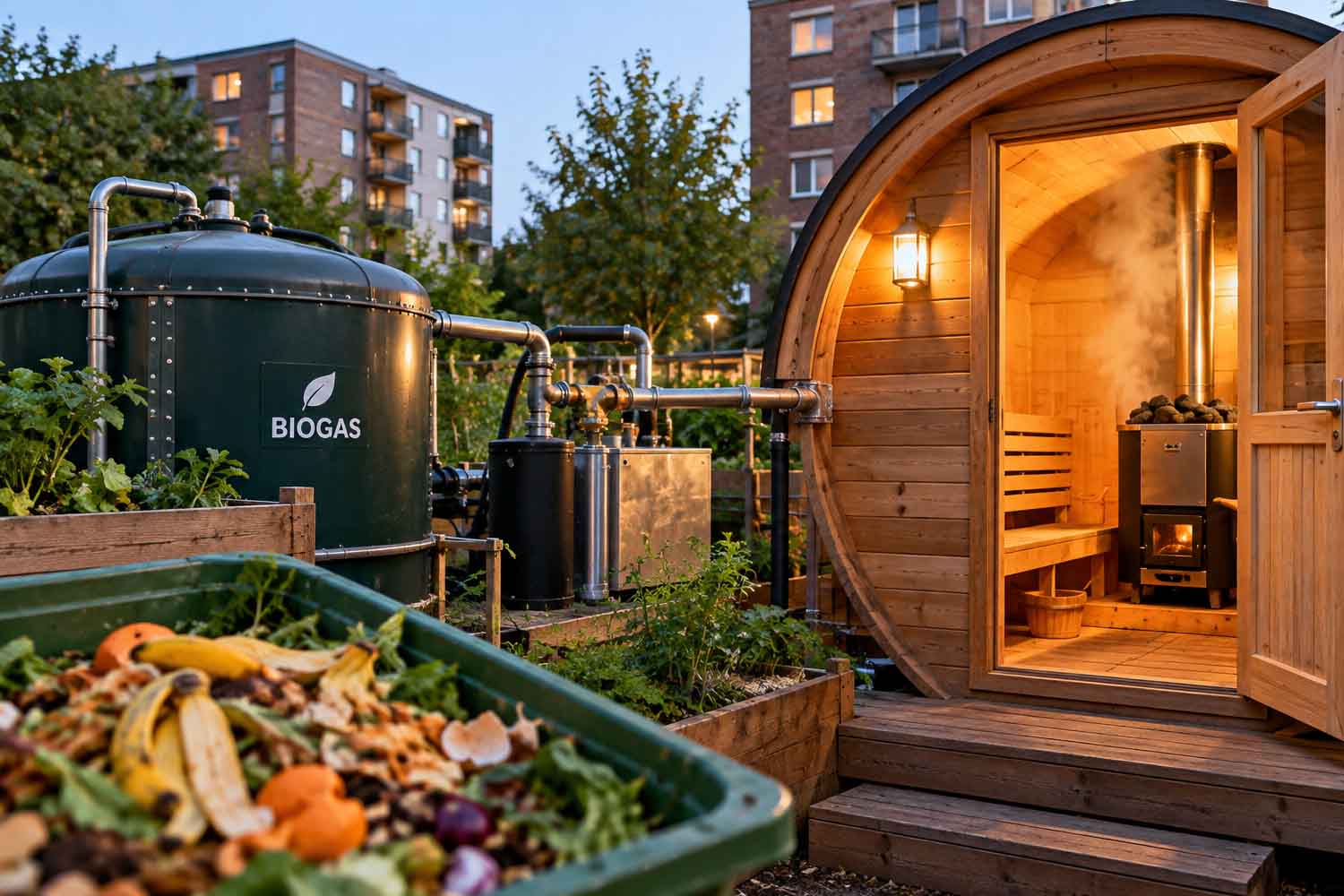
A modified stove, a wooden sauna and kitchen scraps collected from nearby homes. In east London, in the Poplar neighborhood, a group of designers have managed to heat a community sauna using biogas produced from residents’ food waste. The first test worked: the stove reached a temperature sufficient to heat the room and produce the steam typical of saunas.
The result was telling Charlie Duckworthco-founder of Community Sauna Baths, the organization that built the facility. It took about two years of work and some difficulty, including convincing manufacturers to provide a stove designed to run on such an unusual fuel. The project is called R-Urban Poplar and was born in a place that until 2017 was occupied by an unused car park and some garages. Today there are vegetable gardens, laboratories, a collective kitchen, spaces for growing mushrooms and a plant capable of transforming organic waste into energy.
How kitchen leftovers become heat
The operation starts from food waste from homes in the Teviot Estate, a residential complex in Poplar which has 535 homes. The waste is collected, separated from foreign materials and shredded. After a pasteurization treatment, they end up in a biodigester, a closed container in which some microorganisms decompose organic matter in the absence of oxygen.
During this process, called anaerobic digestionbiogas is developed, a mixture containing mainly methane and carbon dioxide. The gas is collected and used as fuel for the sauna stove, where combustion produces the heat needed to warm the room. The biodigester was developed by Mad Leap, an organization specializing in organic waste recovery systems, through the work coordinated by Rokiah Yaman and Guy Blanch.
The treatment also produces a residual material rich in nutrients, called digestate, which can be transformed into fertilizer and used, after appropriate treatments, to grow new plants. Food waste can thus contribute both to the production of energy and to the recovery of substances useful for agriculture. Anaerobic digestion technology has existed for some time and is also used in industrial plants. A smaller application is being tested in Poplar, designed to work within a neighborhood and make the recovered resources available to the inhabitants.
The goal is to recover 900 kilos of waste per week
The project has rather concrete numbers: according to the collection program published by Mad Leap, the new biodigester, together with the composting system already present, should make it possible to treat approximately 900 kilograms of food waste per week. An amount equivalent, in the promoters’ estimates, to around a quarter of the food waste generated by the 535 homes on the Teviot Estate. It is the capacity envisaged by the project, therefore, and not an already documented weekly quantity.
To have a real reference, the Just FACT program report published by the Women’s Environmental Network states that, during the years preceding the installation of the new biodigester, R-Urban had collected over 4,000 kilograms of organic waste thanks to the contribution of twelve families and the waste produced by the community garden. Material recovered through composting, rather than being sent for incineration.
To be able to permanently treat 900 kilos every seven days it will therefore be necessary to involve more inhabitants, organize continuous collection and verify how much material the system will actually be able to transform. After all, collecting food waste in a residential complex is not very simple. We need suitable containers, spaces, available people and a system capable of managing odors, contamination and maintenance.
The sauna could also help finance vegetable gardens
The choice of the sauna has a reason that goes beyond the curiosity of warming up thanks to potato peelings. Producing biogas on a small scale requires facilities, maintenance and a sufficiently regular amount of organic material. To make such a project economically sustainable, we must also find a convenient use for the energy obtained.
A sauna requires a lot of heat and can therefore represent an interesting use for the gas produced. If the facility manages to organize more paid sessions during the day, the proceeds could help keep other community activities running as well. The model is yet to be verified, but the logic is quite simple: residents give away waste, the system recovers energy and fertilizer, the sauna offers a service and any proceeds support the project.
R-Urban Poplar, moreover, was created precisely to experiment with forms of circular economy on a local scale. In the spaces of the former car park, vegetables are grown, workshops are organised, objects are repaired and skills are shared. Part of the activities is also dedicated to the preparation of community meals.
The initiative received support from the Just Food and Climate Transition programme, coordinated by the Women’s Environmental Network, which worked with various local entities to make Tower Hamlets’ food system more sustainable and accessible. A particularly important aspect in a densely populated area of London, where many families live in flats without gardens and collective spaces have a value that goes far beyond their surface area.
The first test was successful, now we need to make the whole system work
The experiment has already shown that an adapted stove can use locally produced biogas to heat a sauna. However, the data necessary to evaluate the continuous operation of the plant is lacking. Complete operating budgets that allow us to establish how much gas is produced regularly, how much energy is needed for each session and what the actual management costs are are not yet available.
Measurements will also be needed on an environmental level. Biogas comes from organic material, but its combustion still produces carbon dioxide. Furthermore, any leakage of methane would have a negative impact on the climate balance. To understand the overall benefit you will need to compare the entire process with available alternatives for waste disposal and heating the facility. Community Sauna Baths aims to make saunas accessible through a non-profit model, with free initiatives and discounts for certain categories of users. In Poplar the goal is to also add local fuel production to this model.
The promoters had indicated autumn 2026 as the period to move from tests to use by residents. At the moment, however, a regular opening of the sauna powered by waste has not been confirmed. The heat produced by the kitchen leftovers reached the stove stones. Now we need to figure out if it can get there every day, with enough gas to accommodate the residents and enough revenue to keep the plant running.
View this post on Instagram
