
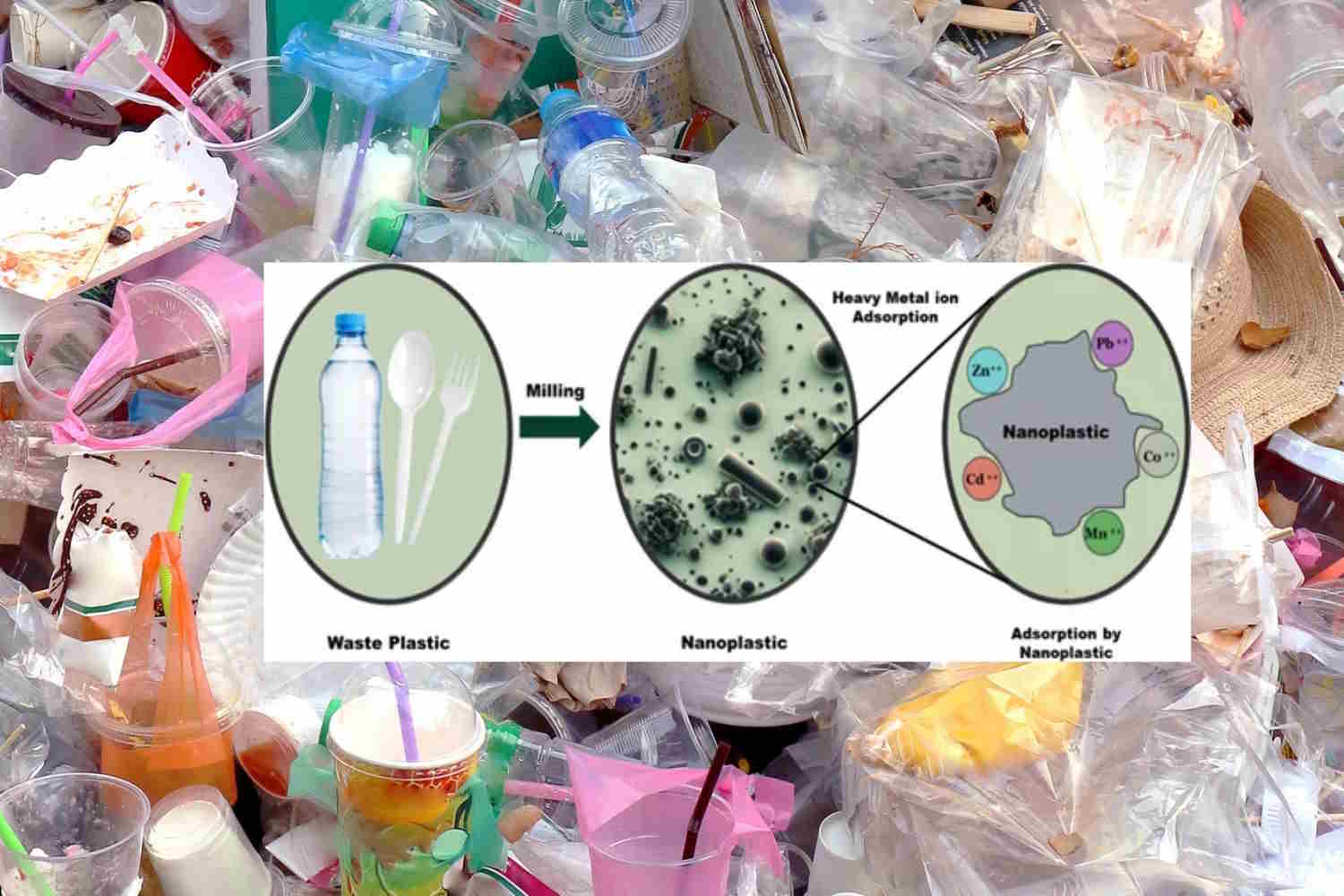
When we think of plastic pollution, we imagine bottles abandoned on the beach, bags entangled in branches or those fragments floating in the ocean like small wounds. What we see, however, is only the surface of a problem that becomes tiny, almost invisible, until it disappears before our eyes. And it is precisely there, in the most microscopic dimension, that plastic becomes truly insidious.
A recent study has highlighted what we can no longer ignore: nanoplastics never arrive in the human body alone. They know how to choose uncomfortable companions, in this case heavy metals. And, as if it were the most natural thing in the world, they carry them with them with surprising speed. So surprising that lead, the most dangerous of all, is captured in a few minutes, like an unwanted guest who doesn’t even have time to knock.
How nanoplastics move
To understand the extent of the problem, just imagine the daily life of our beloved (and hated) plastics. A bottle left in the sun, a container scratched from use, the cap of a drink forgotten in a flowerbed: over time they disintegrate into increasingly smaller fragments, until they become particles invisible to the naked eye. And those particles travel. They enter rivers, land, the sea. They reach the fish that ends up on the plate, the water that flows from the tap, even the air we breathe between one room and another.
To reconstruct what happens in the real world, the researchers crushed very common objects in the laboratory: soft drink bottles, candy boxes, take-away containers. Once they created their “cocktail” of nanoplastics, they exposed it to heavy metals such as lead, cadmium, zinc, manganese and cobalt. The result was almost instantaneous: the particles bonded to the metals as if they were magnets.
And this is where what scientists call the “Trojan Horse effect” comes into play. Nanoplastics, already dangerous enough, become perfect vehicles for heavy metals to enter living organisms. They don’t knock on the door, they don’t ask permission: they infiltrate. And once inside, metals do exactly what we’ve known for years. They disturb the nervous system, alter development in children, interfere with very delicate organs and biological processes.
The most disturbing detail is that these particles do not choose. They enter everywhere. They have been found in the blood, brain, lungs, even the placenta. A subtle confirmation of how the problem is not external, but deeply internal to us.
@ACS ES&T Water
What can we do to reduce exposure
The truth, however inconvenient, is that we live immersed in plastic. We’ve made it part of our normality and getting rid of it will be a long ride. Until we know all the implications of this disturbing combination, the only way forward is prudence.
Reducing the most superfluous contacts with plastic almost becomes a gesture of self-defense: avoid heating food in plastic containers, prefer alternatives such as glass or steel, choose less packaged products, filter domestic water with systems capable of retaining both microplastics and heavy metals. Even the domestic environment can hide dangers, because dust accumulates everything that the outside world disperses. Cleaning with a certain criterion – without becoming obsessive – helps more than it seems.
And then there’s the wardrobe. Synthetic fibers release microfragments that end up in drains and from there everywhere. Choosing natural materials means reducing part of the problem at its root.
The general picture is still full of question marks. We don’t know exactly what happens when these particles, with their metallic hosts, remain in the body for a long time. But this research has given us a very clear message: the problem is not so much what we see, but what is already traveling inside us without showing up.
Our health has never been so linked to the materials we created.
