
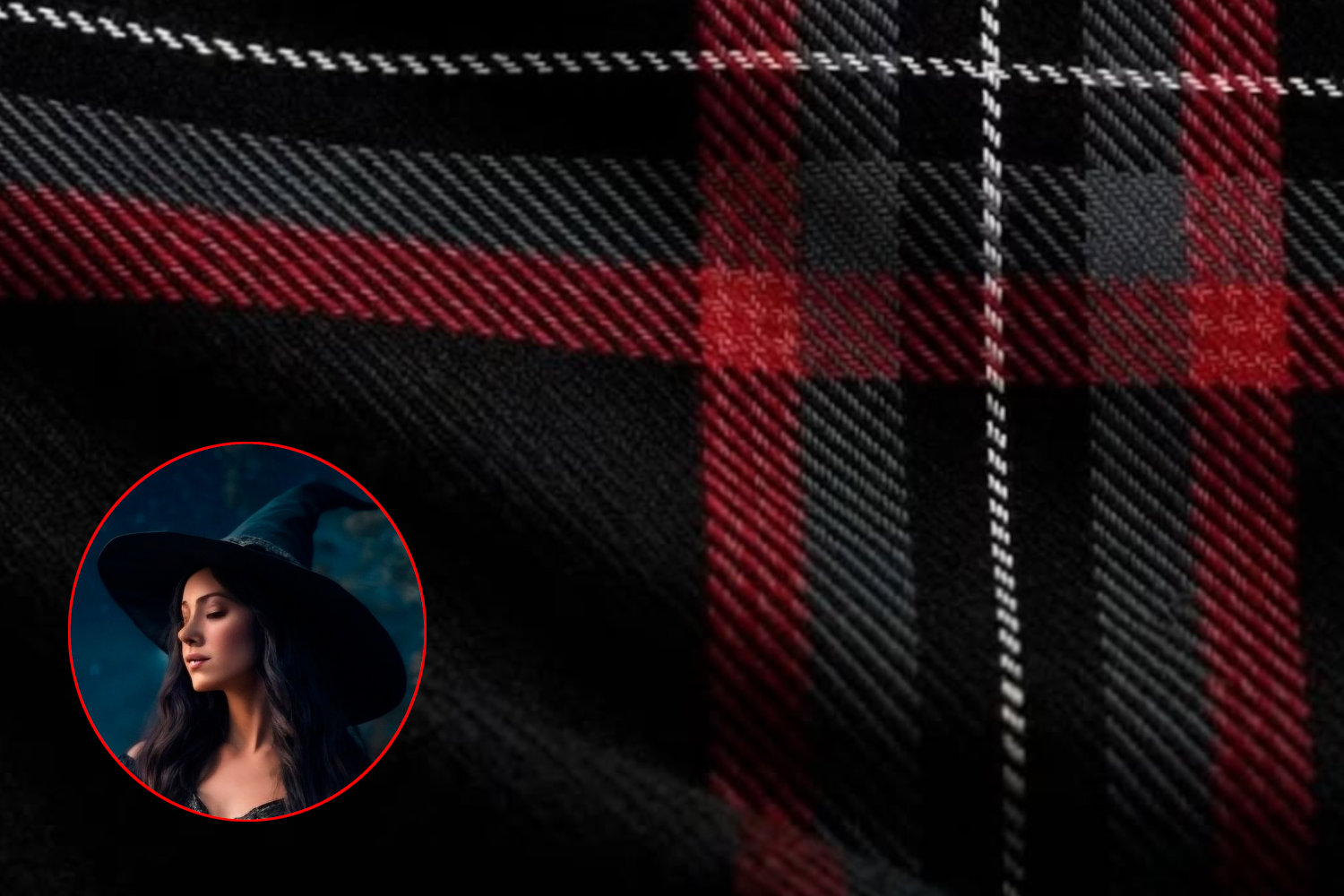
The memory of a dramatic page in Scottish history today finds a tangible form through the creation of a commemorative fabric unique in the world. The project was born from the initiative of Claire Mitchell and Zoe Venditozzi, founders of the Witches of Scotland campaign launched on International Women’s Day 2020, together with designer Clare Campbell.
View this post on Instagram
The origin of the project and the memory of historical persecutions
The primary objective is to remember the approximately 4,000 people, mostly women, wrongly accused of witchcraft in Scotland over the past centuries. The design was officially included in the Scottish Tartans Register with the code 14651, being classified as a fabric of a modern corporate and commemorative nature, distant from the classic logic of family clans.
The historical period examined concerns the 173 years between 1563 and 1736, a period in which the law known as the Witchcraft Act remained in force. Among the approximately 4,000 people persecuted, it is estimated that over 2,500 were executed. The fundamental idea of the creators was to create a real living memorial to wear. Anyone can freely purchase and wear this authorized garment, while the production and weaving of the original weave remain confidential and require authorization from the Witches of Scotland Limited organization to avoid unofficial imitations.
The symbolism of the colors and the meaning of the threads in the weave
Every single element inserted into the weave of the fabric contains a precise numerical and symbolic explanation chosen by the creators. The shades of black and gray were selected to evoke both the darkness of the centuries of persecution and the ashes of the victims executed at the stake. The red and pink accents, which are repeated 3 times within the design, directly recall the legal tapes used historically and still today to bind judicial documents and official accusation files.
The numerical composition of the textile design is particularly complex. A large central section made up of exactly 173 black threads represents the years of validity of the witchcraft law. Furthermore, the numbers of the two extreme years have been translated into algebraic sum in the plot: the year 1563 generates 15 threads, while 1736 produces 17. In the center of this dark block, 3 white threads stand out, inserted to symbolize the three great goals of the campaign: the obtaining of legal pardon for the condemned, the formulation of an official apology by the institutions and the creation of a monumental national memorial. On the institutional front, a first concrete response came in 2022, when the then First Minister Nicola Sturgeon formalized the Scottish Government’s official apology.
