
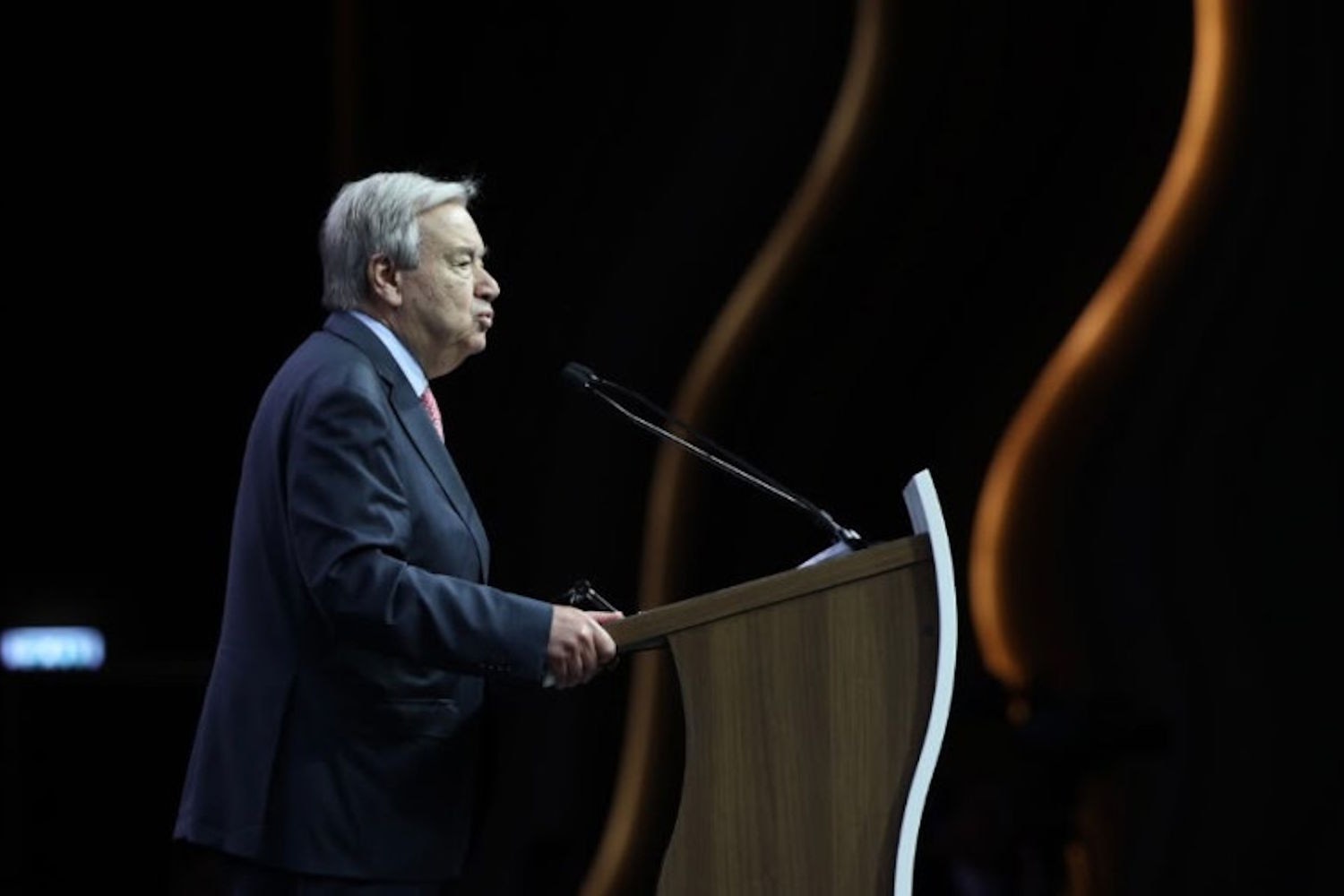
“Fossil fuels must go the way of the dinosauryes”, “fossil fuels must disappear like the dinosaurs“, with his usual incisive language, António Guterres – at his last COP as Secretary General – opened the new day of COP31 yesterday. And his was an immediate complaint:
Climate disasters are affecting lives, livelihoods and economies around the world. This is the path to mutually assured destruction. Eleven years ago, in Paris, the world promised to limit the increase in global temperature to 1.5 degrees. Science tells us that going beyond that level is now inevitable. But science isn’t telling us to give up. He’s telling us to fight harder.
A clear and concrete dig at the most influential leaders who took to the stage yesterday without ever speaking openly about abandoning fossil fuels, except Lula. It is estimated that the Heads of State and Government present in Antalya represent less than a fifth of global emissions.
In fact, the Heads of State or Government of the five major emitters are absent: China, the United States, India, Russia and Japan. Of the top ten emitters, only Iran and Saudi Arabia are present, while – among the large European and G7 economies – France, Germany, Canada, Spain and Italy are also missing.
Yet, according to Guterres, the tools to change course already exist. And some numbers demonstrate how much the energy landscape has changed in the last decade.
Ten years ago, solar energy produced just 1% of the world’s electricity. By 2025, it alone met nearly three-quarters of the increase in global electricity demand. Electric mobility has also made enormous progress: if ten years ago only one car sold in a hundred was electric, in 2026 the share should approach one in three. In short, technologies are advancing. It is the political decisions that are not keeping pace.
To meet climate goals, global emissions would need to fall by around 6% each year. The current national commitments, even considering those subject to certain conditions, would at best guarantee just one third of the necessary reduction. And even if all announced plans were fully implemented, global warming would exceed 2.5°C by the end of the century, risking triggering irreversible changes in climate systems.
Then there is another contradiction highlighted by the Secretary General: three-quarters of humanity live in countries that import fossil fuels, exposed to fluctuations in oil, gas and coal prices and to the economic consequences of international crises.
“Dinosaurs didn’t have a lobby”
But dinosaurs didn’t have a lobbyobserved Guterres, recalling that the fossil industry can instead count on enormous economic interests and a notable capacity for influence.
According to the Secretary General, the strategy of those who want to slow down the transition is always the same: question scientific evidence, delay climate policies, postpone interventions and shirk their responsibilities.
For this reason he asked governments to adopt credible national paths to gradually abandon fossil fuels, protecting workers and the communities involved.
The directions are precise:
According to the objectives recalled by Guterres, by 2035 the global capacity of renewables will have to at least triple compared to 2025 levels, while electricity production from coal without emissions abatement systems will have to decrease by at least 75%.
But it is on money that Guterres’ speech highlighted one of the most evident disparities of the climate crisis:
In the last quarter alone, the nine largest oil companies pocketed $95 billion in profits. Meanwhile, the Loss and Damage Fund received approximately $600 million. That’s what these companies produced in about 14 hours.
A figure equivalent, that is, to what those same oil companies earn in less than a day.
A comparison that highlights the imbalance between the resources accumulated by the fossil industry and those actually available to the populations suffering the most serious effects of the climate crisis.
Hence the Secretary General’s request to governments: tax the extra profits of fossil fuel companies and use the revenues to support the countries most exposed to climate disasters.
Those who pollute must pay, Guterres reiterated.
Guterres’ four demands
Guterres has proposed a new Climate Justice Pact based on four priorities:
The central issue remains that of inequalities: emerging and developing economies, excluding China, are home to almost two-thirds of humanity, but receive less than a fifth of global investments in clean energy. Hence the request to developed countries to guarantee at least 300 billion dollars a year by 2035 and triple financing for climate adaptation.
In closing, the Secretary General thanked young people, scientists, indigenous peoples and civil society, calling them “the awareness of this battle” against the climate crisis.
Then, recalling that from next year he will no longer be at the helm of the United Nations, he promised:
I won’t stop telling the truth. And I won’t stop fighting for it.
A final message that brings the discussion back to the essential point: the energy transition can no longer be just a promise. We need certain times, resources and concrete responsibilities.
