
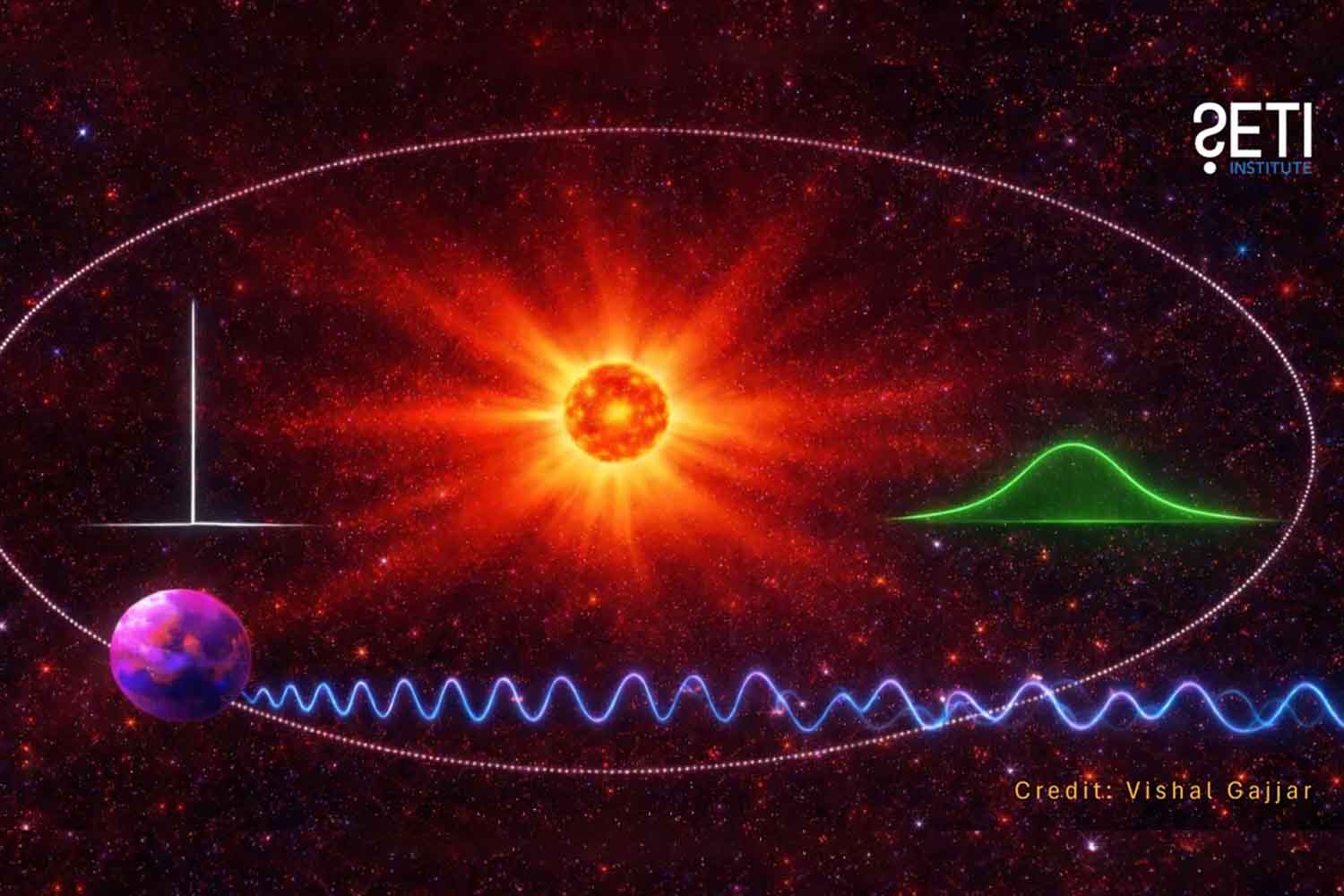
A radio signal can emanate from a distant planet in a very orderly way: a precise, narrow frequency, easy to distinguish from background noise. Then it must pass close to its star. And that’s where the problems begin. Around a star there is stellar wind, that is, a continuous flow of charged particles. There is plasma, a kind of electrically active gas. There are magnetic storms, flares, sudden explosions. All this can “dirty” the signal before it even leaves its star system.
This is the hypothesis at the center of a new study published in The Astrophysical Journaldedicated to the research of alien signals and technosignatures, i.e. possible technological traces produced by extraterrestrial civilizations. The research remains cautious: it speaks of a limit in listening methods, not evidence of intelligent life outside Earth. The point, however, is concrete. For decades, many SETI programs have primarily searched for very narrow radio signals, because it is difficult to produce such precise emissions in nature. If a distant civilization transmitted a kind of very clean “radio note”, that note could reach us already enlarged and weakened.
The signal widens
To understand the mechanism, just imagine a thin line drawn on a sheet of paper. At the beginning it is clear. Then someone passes over it with a dirty finger: the line remains, but it becomes wider, less legible, less easy to separate from the rest. Something similar could happen with radio signals, only on a cosmic scale.
When a radio wave passes through areas filled with charged particles, its shape can change. The energy that was previously concentrated in a very precise frequency is distributed over a wider range. For radio telescopes this makes a big difference. A narrow peak stands out in the data. A wider and weaker signal risks being confused with the background noise.
So far, much research has favored precisely those very thin peaks, because they seem to be the most interesting candidates. The new analysis suggests broadening our gaze: a possible extraterrestrial message could arrive less elegant, less “clean”, more difficult to recognize. The question changes shape. It’s not enough to wonder if someone is broadcasting. We need to understand in what state that signal would be able to reach us.
The role of the stars
The most delicate part happens near the star from which the signal originates. Each star has its own activity. The Sun, for example, emits solar wind and can produce flares or coronal mass ejections, large amounts of plasma launched into space. Around other stars these phenomena can be even more intense.
To measure the effect, the researchers used a nearby reference: radio transmissions from space probes in our solar system. Those communications are known, controllable, observed as they pass through environments influenced by the Sun. Starting from data like this, the team built a model to estimate how wide a narrow signal can spread in different star systems.
This is where the M-type red dwarfs. They are stars smaller and colder than the Sun, very common in the Milky Way: they represent about three out of four stars in our galaxy. Precisely because of this abundance they are often at the center of research on extrasolar planets. Many rocky worlds orbit such stars. The problem is that several red dwarfs can have very lively magnetic activity, with eruptions and harsher space weather.
In such a rough environment, a very narrow radio signal could come out already transformed. Not canceled, at least according to the model. Transformed. Wider, weaker, less easy to locate with instruments programmed to look for almost perfect signals.
A less rigid search
The practical consequence concerns the way in which SETI searches are carried out. If alien signals are only searched for as very thin lines, some candidates may be left out of the filters. We therefore need research capable of considering slightly broader signals, especially when the hypothetical planet orbits around a very active star.
This means choosing better objectives, evaluating the behavior of the star, observing at more suitable frequencies and designing less rigid algorithms. In some cases, observing at higher radio frequencies could help, because the broadening of the signal tends to weigh less. They are technical details, sure, but they have a very concrete effect: they decide what is considered interesting and what is rejected as noise.
The search for intelligent life outside Earth also thrives on this. Not just large antennas pointing towards the sky and waiting for a sensational signal. Much more often it is work on data, on filters, on margins of error, on incorrect hypotheses that bring with them tools built with great intelligence and some inevitable human prejudice.
The most useful part of the study lies right here: it reminds us that the space crossed by a signal is not an empty corridor. It is a physical, unstable environment, full of particles and magnetic fields. A distant civilization may be transmitting an orderly signal, but its star may deliver it to us in a very different form.
So far, no one has found an extraterrestrial message hidden in the data. But the research on alien signals he may have to learn to look even at what appears less clean, less narrow, less easy to pigeonhole. Sometimes the problem isn’t silence. It is the filter with which we listen.
