
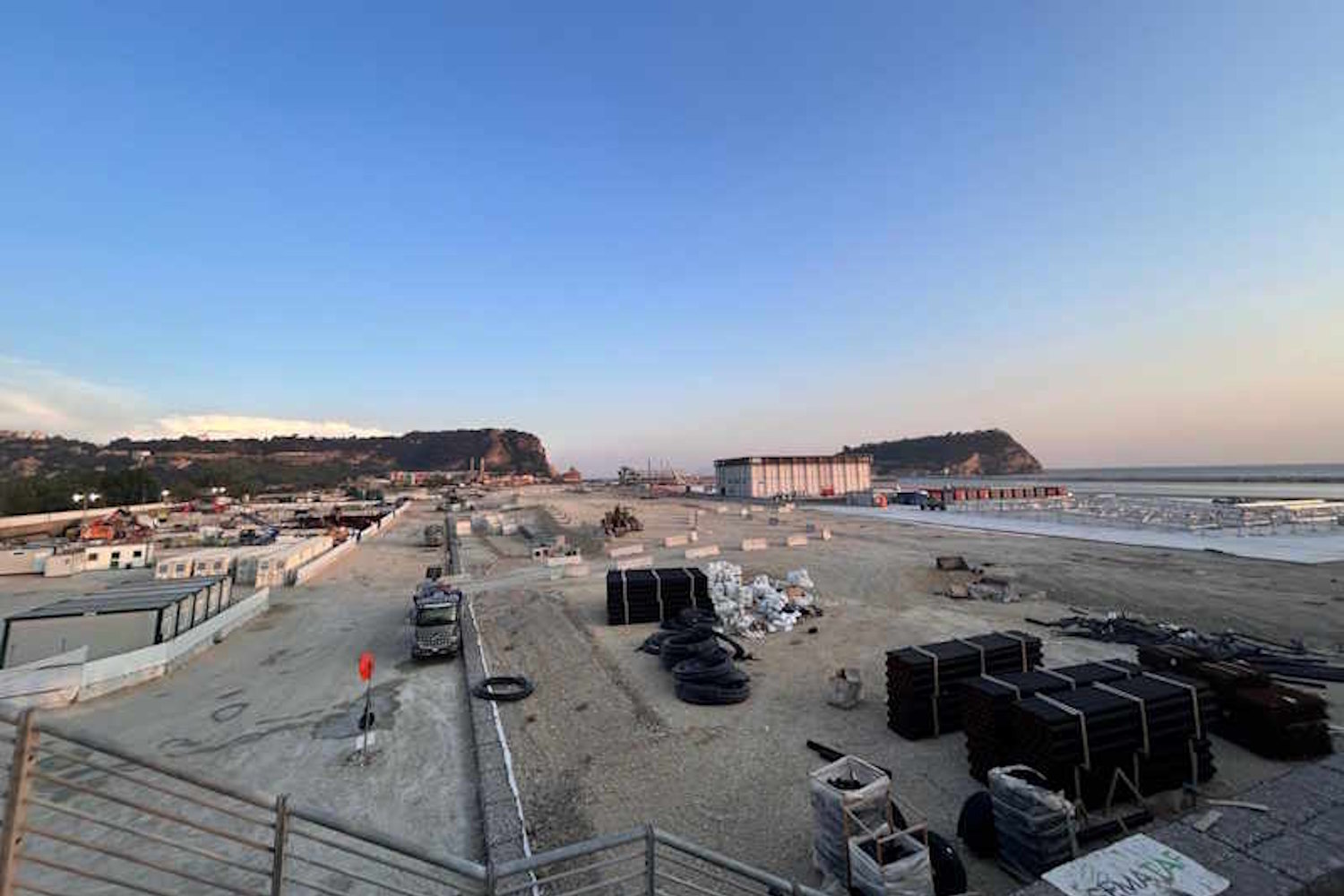
A bay that Naples has been waiting to have back for over thirty years, almost 200 thousand square meters of industrial landfill and an international sailing competition that should represent the opportunity for redemption. But is Bagnoli really being reclaimed or is the ground mainly being prepared for the 2027 America’s Cup?
This is the question at the center of the investigation “Smooth sailing!” of Report, written by Luca Chianca with Alessia Marzi and broadcast on Sunday 15 November on Rai 3. A report that raises questions about the management of construction sites, the environmental safety of dredging and the fate of the former Italsider-Cementir industrial area.
We talked about it here: Are they really reclaiming Bagnoli or building a port? Report sheds light on the America’s Cup construction sites
While the institutions talk about accelerating the redevelopment, some documents examined by the program show that an important part of the definitive interventions still remains to be carried out.
The fill that is not removed
For decades, the Bagnoli recovery project has involved the removal of the fill, that enormous artificial platform made with waste materials from old industrial activities, to give the city back a public beach and a reclaimed coastline. With the arrival of the America’s Cup, however, the program has changed: the bases of the sailing teams will be built in that same area, while the landfill will be covered and made safe.
According to documents shown by Report, approximately 104 thousand square meters will be insulated through a capping(environmental safety technique which consists in covering contaminated soil with one or more protective layers, in order to isolate pollutants and limit their dispersion into the environment. In practice, instead of digging and removing the polluted material, it is left in place and sealed). Basically, a waterproof cover intended to prevent contact with contaminated materials. A solution designed for a temporary duration of 18 months, which – obviously – only raises questions about the management of the area after the competition.
The Higher Institute of Health, in an opinion dated November 2025, underlined that partial and temporary interventions cannot be considered equivalent to the overall remediation of the site. The mayor of Naples and extraordinary commissioner for Bagnoli, Gaetano Manfredifor its part defends the choice not to completely remove the fill.
The environmental impact analysis showed that it is safer, from an environmental point of view, to leave it in place and bury it rather than remove it, he declared in January, explaining that the removal of the materials would have entailed a significant impact linked to transport and disposal.
A position that does not erase the central question: when will the definitive safety measures be completed and what will actually remain accessible to citizens?
Dredging and the risk of dispersion of contaminated materials
The investigation then focuses on the dredging operations necessary to lower the seabed to allow access for boats. According to Report, some works were carried out with equipment different from that indicated in the executive project, directly moving marine sediments and raising doubts about the possible dispersion of polluting substances.
When questioned by Luca Chianca, Manfredi rejected the objections:
Let’s say that the work being done is perfectly controlled and everything is going very well.
And, when asked about the methods used on construction sites, he added:
This is not the case, the dredging is done as planned.
The Mayor then explained that the recovered material would be transferred to tanks to then be dried, analyzed and subsequently destined for disposal based on its characteristics. But the very presence of uncovered tanks is one of the aspects contested in the investigation, due to the risk that dust and volatile substances could disperse into the environment.
ARPAC confirmed that it had reported critical issues in the use of dredging equipment, specifying however that the checks on the water did not reveal significant increases in the pollutants monitored.
Therefore it is not possible to say that widespread contamination of the sea caused by the works has been confirmed. However, questions remain about the completeness of the controls and the methods of managing the sediments.
Fine dust
Air quality has also come under scrutiny. During 2026, ARPAC control units near construction sites recorded episodes of exceeding the daily reference threshold of 50 micrograms per cubic meter for PM10.
On some days, however, the transport of Saharan dust also contributed to the high values, while the monitoring carried out from 3 to 9 November did not detect new exceedances. The data therefore does not allow us to automatically attribute all pollution episodes to construction sites, nor does a single exceedance necessarily equate to a violation of the annual legal limit. But, in any case, it would be useful and fundamental to verify that the handling of contaminated soil occurs with adequate dust containment measures and constant controls.
Who really pays to clean up Bagnoli?
Another issue raised by Report directly concerns the use of public resources. In 2024, Invitalia reached a settlement agreement with Basi 15, owner of the former Cementir area, which provided for the free transfer of the properties and the assumption of the reclamation operations by the public entity.
The agreement made it possible to close previous disputes and acquire the availability of the area, but it also reopened the debate on the European “polluter pays” principle.
According to the critical issues highlighted by the investigation, the risk is that the costs of clean-up, instead of falling on those responsible for the pollution, end up burdening the community.
Invitalia claims, on the contrary, that the transaction made it possible to acquire the land without paying compensation and to overcome disputes that would have further slowed down the redevelopment.
It remains to be understood what the overall cost of the cleanup will be and what resources will be needed to complete it.
Meanwhile, the inhabitants of here ask for only one thing: to have Bagnoli back. Getting back the sea, the beach, that piece of the city removed from everyday life. And, above all, knowing that under their feet, and in the waters in front of their homes, there are no longer any poisons left by decades of industry. The America’s Cup can be a great occasion, of course, but it cannot become yet another promise of rebirth destined to remain half-finished.
