
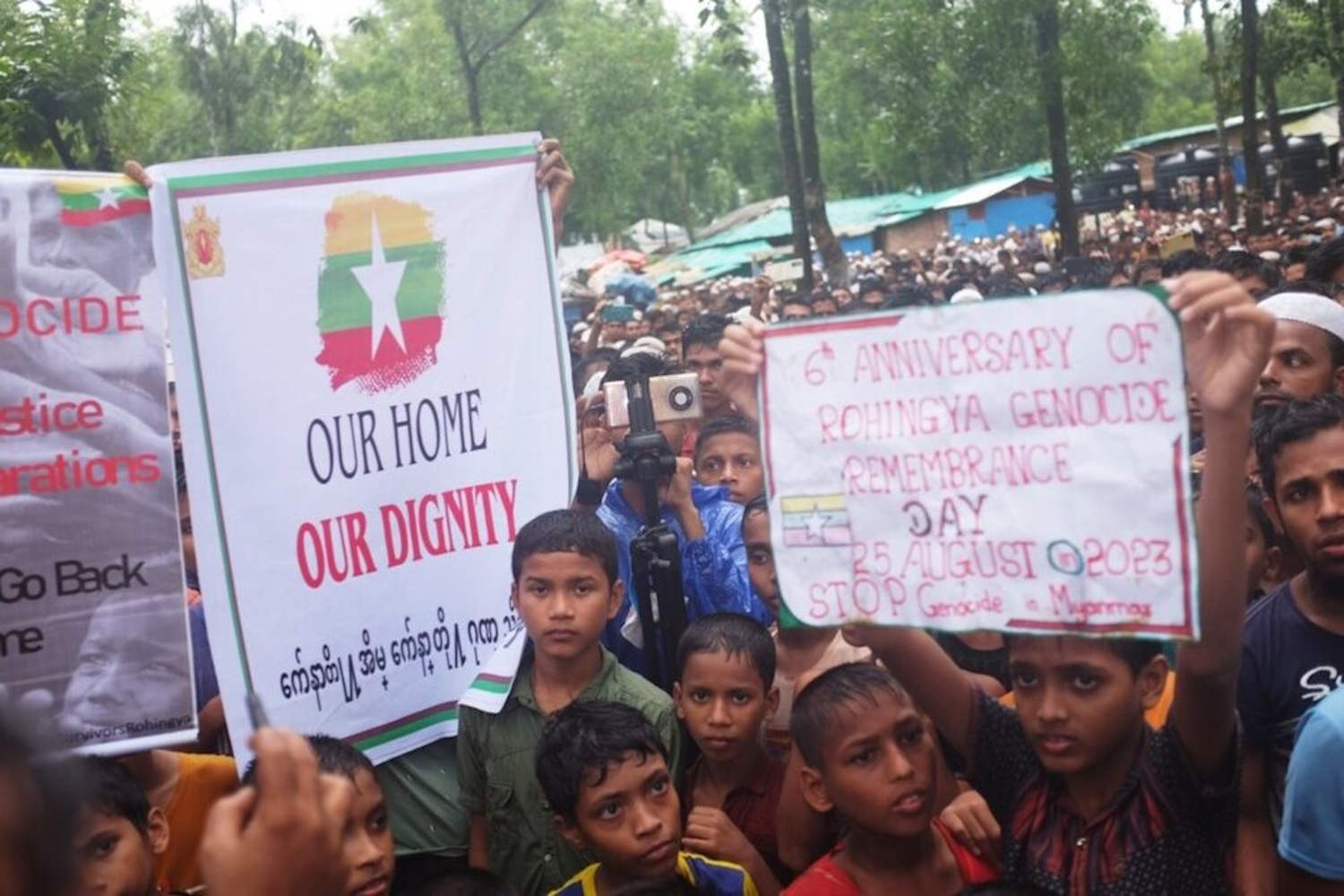
A genocide against the Rohingya minority during the brutal military campaign of 2017. This was established by the International Court of Justice in The Hague, the highest judicial body of the United Nations, with a historic ruling that could become a fundamental precedent for other international proceedings, starting with that concerning Israel and the war in Gaza.
For the first time in its history, in fact, the Court recognized a State directly responsible for genocide. A decision arrived with nine votes in favor and six against, at the end of a legal battle that began seven years ago.
According to the judges, Myanmar acted with the intention of destroying a substantial part of the Rohingya population, a predominantly Muslim ethnic minority, which has been discriminated against for decades in the Buddhist-majority country. It was not, therefore, just a case of particularly violent military operations or a campaign of forced expulsion, as claimed by the Myanmar authorities, but of acts carried out with a specific genocidal intent.
Specifically, the ruling concerns operations conducted by the Myanmar army in 2017 in Rakhine State, on the border with Bangladesh. In just a few months, over 700,000 Rohingya were forced to abandon their homes, fleeing a military campaign marked by mass killings, burning villages, sexual violence and attacks against civilians, including women and children.
According to reconstructions recalled by the United Nations, more than 10 thousand people were killed. And not only that: terrible acts of violence and rape against women have also emerged, perpetrated for years above all to compromise the ability and possibility of the Rohingya community to have children.
The 1948 UN Convention, in fact, considers genocide not only the killing of members of a national, ethnic, racial or religious group, but also acts committed with the intention of preventing their births. The Court also examined restrictions imposed on Rohingya families, including limits on the number of children. A decisive element to establish that the atrocities were not just the result of military repression, but were part of a policy aimed at the destruction, at least partial, of an entire human group.
The legal battle started by Gambia
It was Gambia, a small West African country with a Muslim majority, that brought Myanmar to the International Court of Justice, which in November 2019 presented an appeal for violation of the Genocide Convention. Myanmar has always rejected the accusations, claiming that the military operations were a response to attacks by armed Rohingya groups. A justification that did not convince the majority of judges.
The testimonies of the survivors and the evidence collected by the United Nations investigators were decisive, including the reconstructions of the attacks on the villages and the systematic violence against the civilian population. For thousands of Rohingya forced to live in refugee camps in Bangladesh for years, the decision represents the first, important recognition of their history.
The Court ruled that Myanmar must take concrete measures to remedy the violations committed. These include the prosecution of those responsible, the restitution of stolen assets, compensation for damages and above all the possibility for refugees to return to their homes in safe conditions, voluntarily and with dignity.
Myanmar will also have to submit a report on the measures taken and compensation within two years.
The ruling is final and binding, but the International Court of Justice has no independent tools to enforce its execution. The question therefore remains open of how to concretely guarantee justice and protection to a population who, almost ten years after the violence, continues to live far from their homeland.
Meanwhile, the reach of the decision could go well beyond the borders of Myanmar. The ruling could also take on particular importance for the proceedings initiated by South Africa against Israel, accused of violating the Convention on Genocide in the Gaza Strip.
The legal issue is above all one: how to demonstrate the intention to destroy, totally or partially, a group protected by the Convention.
In the case of Myanmar, the judges found that the combination of violence, persecution and measures against the Rohingya population demonstrates this intention, rejecting the argument that the operations were mainly motivated by the fight against armed groups.
This does not mean that the ruling anticipates the outcome of the Gaza case, which involves different facts and evidence. But the Court’s reasoning could represent an important reference for evaluating other alleged genocides.
Sources: The International Court of Justice / Amnesty International
